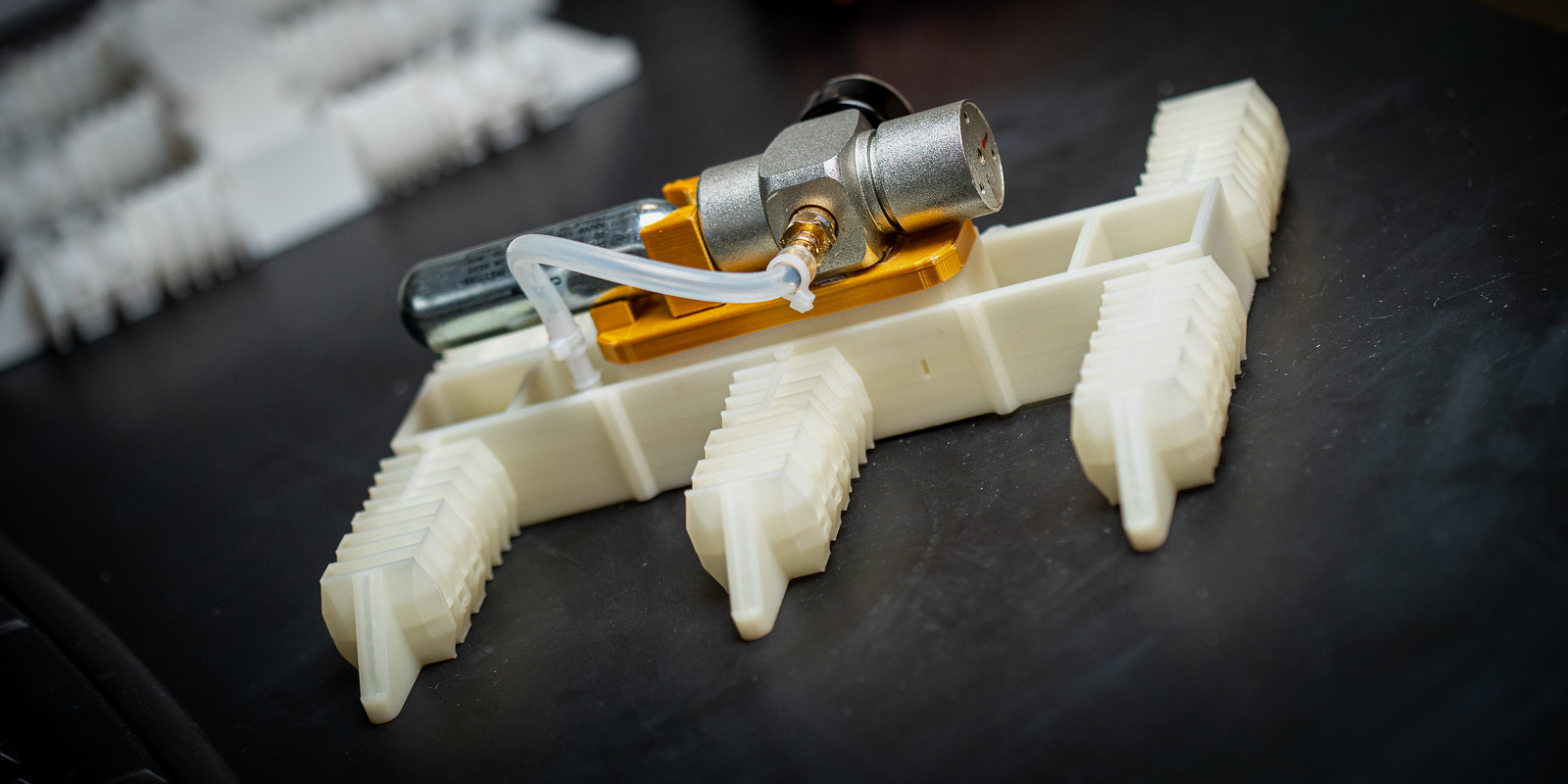
Researchers have developed a 3D printed soft robot that uses pneumatic actuation to achieve biomimetic locomotion, marking a significant advance in compliant mechanism engineering. The robot combines flexible materials with precise pneumatic control systems to enable smooth, adaptive movement patterns inspired by marine organisms.
Bio-Inspired Design Enables Flexible Movement
The robot features a 3D printed flexible body structure that works with its environment rather than against it. Unlike rigid robotic frameworks, the pneumatic actuation system allows the robot to compress, expand, and undulate in fluid motions similar to cephalopods and other soft-bodied marine life.
The hybrid design integrates soft materials with precision pneumatic components, creating a compliant mechanism that can adapt to various surfaces and obstacles. This approach eliminates the mechanical stress points common in traditional rigid robots while maintaining controlled movement precision.
Applications Span Medical and Industrial Sectors
Soft robotics technology addresses critical needs in medical devices that must safely interact with human tissue, where rigid components could cause damage. The flexible design also enables deployment in confined spaces for exploration and inspection tasks impossible for conventional robots.
Manufacturing applications include handling delicate objects that would be damaged by rigid grippers. The integration of additive manufacturing techniques makes soft robotics development more accessible to research institutions and companies developing specialized robotic solutions.