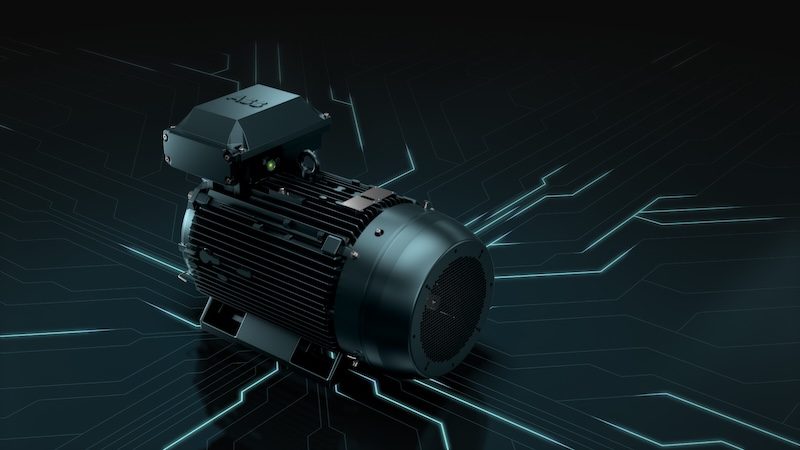
ABB launched Intelleqt, which it calls the world's first low-voltage industrial motor with AI and sensing built in during manufacturing, at the SPS trade fair in Nuremberg on November 24. The motor ships with embedded sensors, edge computing and connectivity that generate real-time operational data from its first rotation, rather than requiring plant operators to bolt on separate monitoring hardware.
ABB is targeting the global market for IEC and NEMA low-voltage motors, worth about $18 billion, where more than 300 million motor-driven systems already account for roughly 60% of industrial electricity consumption worldwide. Stefan Flöck, president of ABB's IEC Low Voltage Motors division, said most of those motors currently generate no data at all even as manufacturers push toward AI-driven operations.
The Numbers Behind the Pitch
ABB says Intelleqt can flag energy-saving opportunities worth 30% or more and cut unplanned downtime by up to half through earlier fault detection, the kind of failure the company says can cost up to $1.5 million per incident in sectors like data centers, water infrastructure and food production. The motor's open architecture is designed to plug into whatever digital platform a customer already runs, rather than locking buyers into ABB's own software stack.
Those figures matter because ABB's own research points to a gap between ambition and execution on the factory floor: the company cites data showing 84% of manufacturers report some benefit from AI projects, but only 20% have managed to scale those projects beyond a pilot. Intelleqt is ABB's bet that the bottleneck sits lower in the stack than most AI tools target, not in the software layer, but in basic industrial hardware that was never built to report on its own condition.
Low-voltage motors are also the component inside countless robot arms, automated guided vehicles and conveyor systems, where unplanned failures ripple through entire production lines. By building AI and connectivity into the motor itself, ABB is extending the predictive-maintenance pitch that robot makers like Fanuc and Yaskawa already sell through their own controllers down into a part that today typically ships as a passive, uninstrumented commodity.
Timing, and a Robotics Business in Flux
The launch lands at an awkward moment for ABB's robotics ambitions elsewhere. Chinese regulators have blocked the company's planned $5.4 billion sale of its robotics unit to SoftBank over concerns about data transfers, and ABB has said it may pursue a public listing of that unit instead if the deal cannot be salvaged. Intelleqt sits in a different division, low-voltage motors rather than robotics, but it reinforces the same strategic direction: selling intelligence embedded in industrial hardware rather than treating AI as a bolt-on service.
ABB is starting with a co-creation phase alongside OEMs and end users before a broader rollout planned for 2027, beginning in Europe, Japan, China and India. ABB's bet is that building the intelligence into the motor at the factory, rather than retrofitting it in the field after the fact, will prove cheaper and more reliable at scale. Whether customers pay a premium for that distinction will become clearer once the 2027 rollout reaches named buyers.