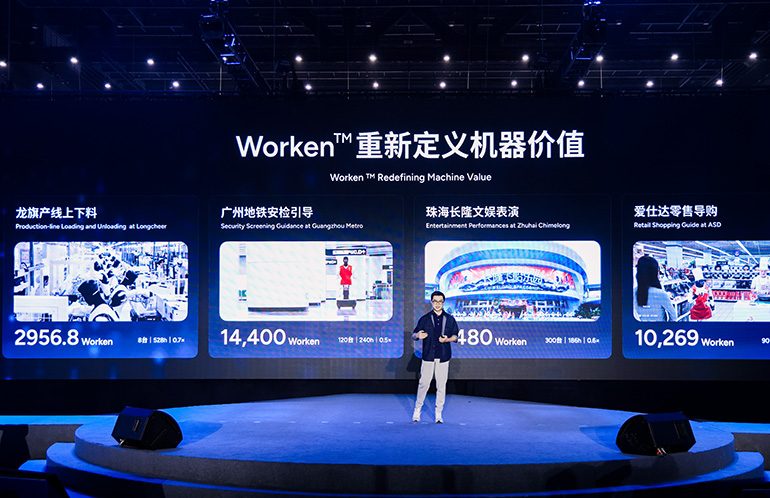
AgiBot shipped its 20,000th humanoid robot off the production line in September, and on October 29 the Shanghai-based company used its Innovation Day event to argue that unit counts are the wrong way to measure the industry's progress.
The company, which led global humanoid robot shipments in the first half of 2026 according to IDC, introduced a new metric called Worken: Active Robots multiplied by Autonomous Working Hours multiplied by an Output Efficiency Ratio benchmarked against human task performance. The pitch, delivered by founder Peng Zhihui, was blunt: "How much productive work are they actually delivering?"
Alongside the metric, AgiBot debuted AHA3, its third-generation hardware architecture and first commercial platform combining locomotion, interaction and manipulation intelligence in one design. The robot runs on liquid cooling for sustained operation, carries IP67-rated joints for dust and water resistance, and connects over Wi-Fi 6 and 5G. AgiBot also released GO-3 Preview, an embodied foundation model built on what it calls a World Reasoning Action Model, and WITA-Omni 1.0, an interaction model that fuses vision, speech and facial expression into a single on-device system.
Why shipment counts are losing credibility
Humanoid makers have spent 2026 racing to announce production milestones, from pilot lines to five-figure unit totals. Investors and customers have started asking the harder question: how many of those robots are actually working, and for how long, rather than sitting on a factory floor as a demo unit.
AgiBot's Worken framework is a direct response to that skepticism. By multiplying active deployment against autonomous hours and real output, the company is effectively proposing an industry-wide KPI that could make it easier to compare rival humanoid fleets — assuming competitors adopt a similar yardstick, which is far from guaranteed.
Where AgiBot sits in the race
AgiBot has built a large ecosystem around its hardware, claiming partnerships with 255 universities and 511 enterprises and a developer base above 80,000. That scale puts it in direct competition with Chinese rivals like UBTech and Unitree, as well as US players such as Figure AI and Tesla, all of which are chasing commercial humanoid contracts in logistics, manufacturing and retail.
The GO-3 Preview model's benchmark claims — first place on RoboDojo and RoboColiseum, and the top score on RoboTwin — are self-reported and have not yet been independently verified. AgiBot says GO-3 and WITA-Omni will roll out to developer partners in the coming months, and the real test will be whether Worken scores, once published, show meaningful autonomous output rather than marketing-friendly round numbers.