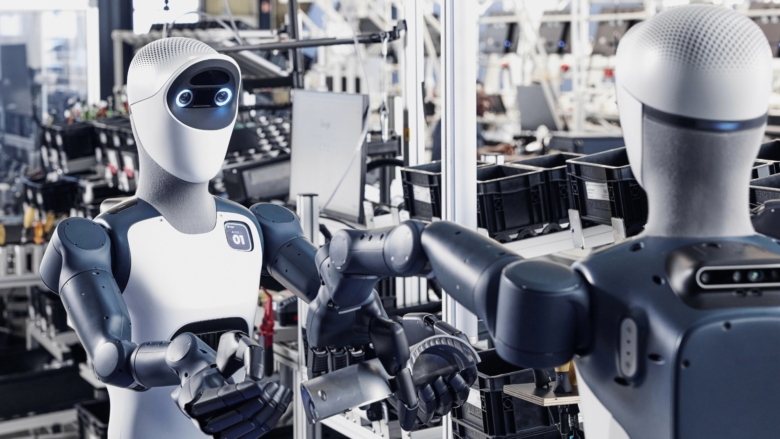
Agile Robots SE has closed a $500 million growth round led by SoftBank Group, with Nvidia, Hitachi and T.Capital also writing checks, the Munich-based robotics maker confirmed on November 12, 2026. The raise values the eight-year-old company at $8.5 billion and brings its total funding since 2018 to roughly $2 billion, according to Trending Topics. Founder and chief executive Zhaopeng Chen said the money will fund a US push, expand manufacturing in Bavaria, and lay the groundwork for a potential public listing.
What does Agile Robots actually build?
Agile Robots makes the hardware and control software behind factory automation: robot arms, robotic hands, grippers, driverless transport systems — essentially self-navigating forklifts and carts that move parts around a plant without rails or human drivers — and fully assembled production cells that bundle several of those pieces into one station a factory can bolt onto an existing line. It also builds Agile ONE, a humanoid robot aimed at repetitive industrial tasks rather than warehouse demos or consumer novelty.
The company's pitch, in Chen's words, is that it takes technology "straight from the lab into industrial series production," skipping the long detour many robotics startups take between a working prototype and a machine a factory will actually buy in volume. That emphasis on shippable hardware rather than research demos is part of why SoftBank and Nvidia are circling: both have spent 2026 assembling positions across the robotics stack — chips, actuators, full humanoids — on the bet that physical AI, meaning software that controls machines acting in the real world rather than just generating text or images, is the next major compute market.
Where is the $500 million actually going?
Chen named three priorities: opening a US beachhead to chase manufacturing customers closer to American factories, scaling production capacity in Bavaria, and preparing the financial and governance infrastructure a public listing requires. None of those come cheap. Standing up a US sales, service and applications-engineering organization typically costs a scaleup tens of millions of dollars a year before it generates meaningful revenue, and a company on an IPO track needs audited multi-year financials and investor-relations staff well before it ever files a prospectus.
Who's backing the round, and how does it compare with rivals?
SoftBank's lead role extends a pattern: the Japanese conglomerate has poured billions into robotics and AI infrastructure this year as part of chief executive Masayoshi Son's broader bet on advanced AI. Nvidia's participation is smaller in dollar terms but strategically loaded — the chipmaker has increasingly invested directly in robotics firms that build on its Jetson and Isaac platforms, a move that effectively subsidizes demand for its own hardware and software stack.
Agile Robots now competes in a crowded field of well-funded industrial-automation and humanoid players, including fellow German startups Neura Robotics and RobCo, alongside Apptronik, Figure, 1X, Tesla's Optimus program and China's Unitree. At $8.5 billion, Agile Robots' valuation trails the multibillion-dollar marks reported for Figure and Apptronik, but it is unusually large for a company whose revenue still leans heavily on conventional robot arms and production cells rather than humanoids alone — a sign investors are pricing in both an established industrial business and future humanoid upside.
What happens next?
Chen has framed the raise partly in geopolitical terms, arguing that physical AI is one way for Europe to avoid falling further behind the US and China in the broader AI race. Watch for Agile Robots to announce US facility sites or customer pilots in the coming months, along with any signals on IPO timing — a listing would make it one of the first pure-play European robotics companies to go public since the current humanoid funding wave took off.