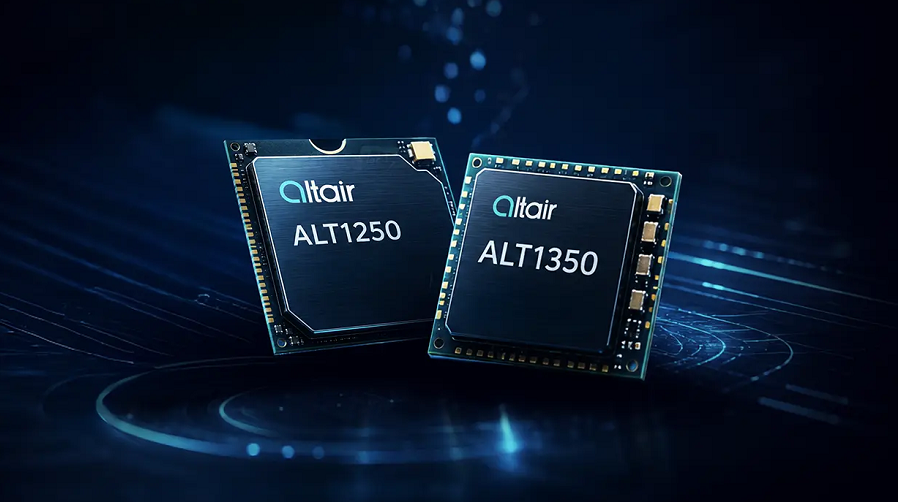
Altair Semiconductor, a wireless networking chipmaker that spun out of Sony earlier this year, raised $100 million in a Series A round led by Maverick Silicon, the company said November 26. Pitango, which backed Altair's spinout from Sony with $50 million earlier in 2026, also returned as an investor, while Sony retained a stake in the company, according to SiliconANGLE. No valuation was disclosed.
The round brings Altair's disclosed funding since its Sony separation to at least $150 million, and the company says the new capital will fund mass production of its flagship chip, new product development and international expansion.
What does Altair Semiconductor actually make?
Altair designs wireless networking chips that let battery-powered sensors and connected devices talk to cellular networks. Its flagship chip, the ALT1550, supports multiple protocols on a single piece of silicon: 5G NR eRedCap at up to 233 Mbps, LTE-M at up to 1 Mbps, and Cat 1bis at up to 10 Mbps, alongside a transceiver, baseband processor, onboard memory, power management and a satellite connectivity module.
An earlier module, the ALT1255, targets ultra-low-power NB-IoT use cases for devices that transmit data only occasionally, using selective deactivation to stretch battery life. The company says its chips already run inside millions of deployed devices, including smart utility meters, delivery-truck trackers, medical devices and street lighting systems.
Why does a chip for smart meters matter to physical-AI and robotics buyers?
Autonomous systems and industrial robots increasingly depend on dense networks of low-power sensors to report location, condition and status data back to a central system, whether that's a fleet of delivery trucks, a warehouse robot swarm or grid infrastructure monitoring equipment. Chips like the ALT1550 that combine multiple cellular protocols on one die reduce the cost and power budget of adding that connectivity to a sensor or robot, which is part of why industrial and medical device makers have already adopted Altair's earlier silicon at volume.
The addition of a satellite connectivity module on the ALT1550 also signals a push toward connecting remote or off-grid sensors and equipment, a capability relevant to agriculture, mining and infrastructure-monitoring robotics that operate outside cellular coverage.
How does Altair stack up against other IoT chipmakers?
Altair competes in a crowded cellular IoT chip market against players like Qualcomm, Sequans Communications and Nordic Semiconductor, all of which offer LTE-M, NB-IoT or RedCap silicon for similar sensor and tracking applications. Altair's pitch is combining several cellular standards plus satellite connectivity on one chip, reducing the number of parts a device maker needs to stock and qualify.
The $100 million Series A is a large round for this segment, suggesting investors see IoT connectivity chips as under-supplied relative to demand from device makers racing to add cellular and satellite links to sensors, trackers and industrial equipment.
What comes next for Altair?
The company's near-term priority is ramping mass production of the ALT1550 and expanding beyond its current customer base in utilities, logistics, medical devices and lighting. Watch for disclosed customer names, a valuation figure, and whether Altair pursues further rounds as it scales manufacturing, since the SiliconANGLE report did not name a CEO or include executive commentary on specific production targets or timelines.