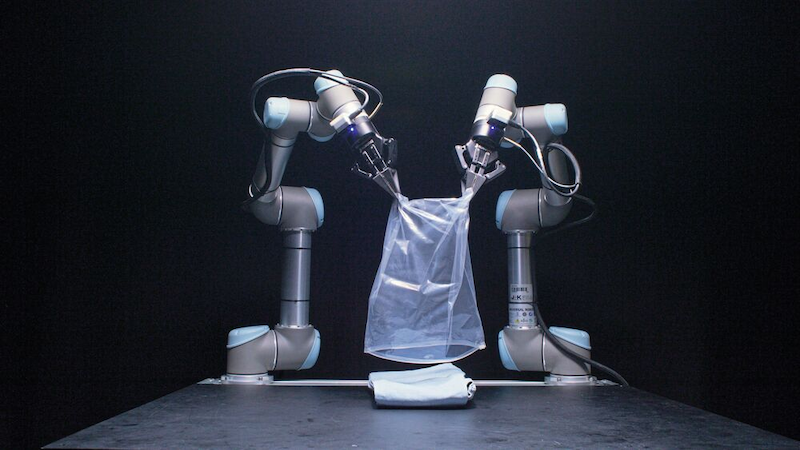
A robot arm hovers over a pile of wrinkled laundry, no two pieces folded the same way, no two pieces in the same place twice. For decades, that kind of unstructured, deformable material defeated factory automation built for rigid, predictable parts. Munich-based Bentic says its robots are now doing that work at nearly 100 customer sites, and the company plans to ship its first systems to the United States before the end of 2026, according to Robotics and Automation News.
Bentic, which rebranded from Sewts, builds a platform called Jupiter that pairs a foundational model predicting how deformable materials will behave with an action model that translates those predictions into robot movements. The approach targets textiles, e-commerce returns, automotive cable harnesses, technical textiles, carbon fiber components and food processing — categories where material shape changes unpredictably as a robot handles it.
Why deformable materials have resisted automation
Industrial robotics has automated rigid, repeatable tasks for decades: welding car bodies, placing identical electronic components, palletizing uniform boxes. Soft, floppy or irregular materials broke that model, because a robot trained to grip one crumpled shirt sees a different shape the next time it reaches for a seemingly identical shirt.
Bentic's pitch is that Jupiter learns continuously from the operational experience of its entire installed fleet, improving its material-behavior predictions across customers rather than retraining from scratch at each site. That fleet-learning model is similar in spirit to how autonomous vehicle companies pool driving data, applied instead to factory floor tasks nobody had cracked at scale: folding laundry, sorting returned clothing, routing cables through car harnesses.
Mehran Zaker of Emerald Technology Ventures, which led Bentic's €7 million Series A in August 2023, framed the shift bluntly: "Physical AI is changing that equation. Bentic is showing that robots can learn to work with the complexity of the real world."
The road to the US and the competition waiting there
Approaching 100 installed systems puts Bentic well ahead of most dexterity-focused robotics startups still in pilot stages, though still far behind established industrial automation vendors with installed bases in the tens of thousands. The company's planned US entry by year-end puts it in a market already crowded with warehouse automation players chasing similar deformable-handling problems, including companies working on e-commerce returns sorting and textile processing for logistics operators.
Bentic's bet is that its multi-year head start handling textiles specifically, built up through European automotive and e-commerce deployments, gives it an edge in material-behavior prediction that newer entrants would need years to replicate. Whether that data advantage holds once larger, better-funded robotics companies turn their attention to soft materials will likely determine how much of the US market Bentic can claim before competitors catch up.