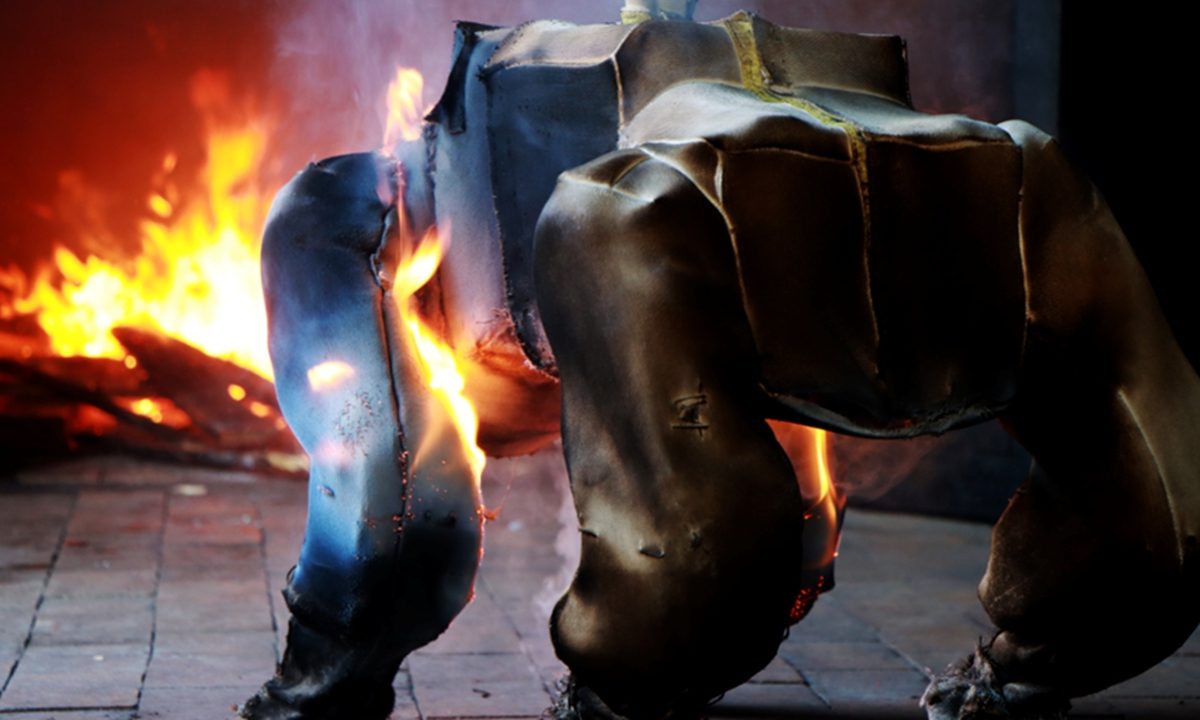
A four-legged robot walked out of a 1,000°C fire after 10 straight minutes inside the flames, in a test conducted at a fire station in Suzhou, Jiangsu province, on November 25, 2026. The robot was developed by the Harbin Institute of Technology's Suzhou Research Institute, working with Sichuan Longjia Aerospace Materials Technology and the Jiangsu Provincial Intelligent Robotics Technology Innovation Center, according to Global Times.
What let the robot survive is a composite suit five to six millimeters thick, adapted from the thermal-shielding material used on China's Long March 5 launch vehicle. The outer layer resists flame directly, while inner layers insulate, absorb, and reflect heat away from the robot's joints and electronics. Even the feet got special treatment: a reformulated rubber compound designed to stay flame-retardant and heat-resistant under the robot's own weight while walking on burning ground. "We take thermal protection technology originally developed for rockets and adapt it for a robot dog," said lead developer Guo Shuai.
Built to See Through Smoke, Not Just Survive It
Surviving heat is only half the job. The robot carries laser-gated imaging that can see through dense smoke, along with a 5G link for real-time video transmission back to human commanders. Researchers say the combination lets the robot identify fire sources and locate trapped people even when visibility for a human firefighter would be close to zero. During the Suzhou test, the robot climbed stairs, turned corners, and paused on command, all while maintaining stable control and high-definition video feedback. The team says the design covers roughly 95% of real-world fire scenarios and is rated for use inside buildings over 30 stories tall, where stairwells fill with heat and smoke long before flames reach every floor.
Where This Fits in the Robot-Firefighter Race
China has been pushing quadruped robots into hazardous jobs faster than most other markets, with companies like Unitree and Deep Robotics already selling robot dogs for inspection and patrol work. Firefighting is a tougher proposition because it demands both mechanical survival at extreme temperatures and reliable autonomy in zero-visibility conditions, a combination few commercial platforms have tackled head-on. Most fire-service robots on the market today are either tracked vehicles too bulky for tight stairwells or drones that can't operate inside a burning structure at all.
The Suzhou team has not disclosed a timeline for commercial deployment or pricing, and the November 25 test appears to be a proof-of-concept rather than a field-ready product. The next step will likely be live trials with an actual fire brigade, where the robot would need to prove it can operate alongside human crews rather than just survive a controlled burn.