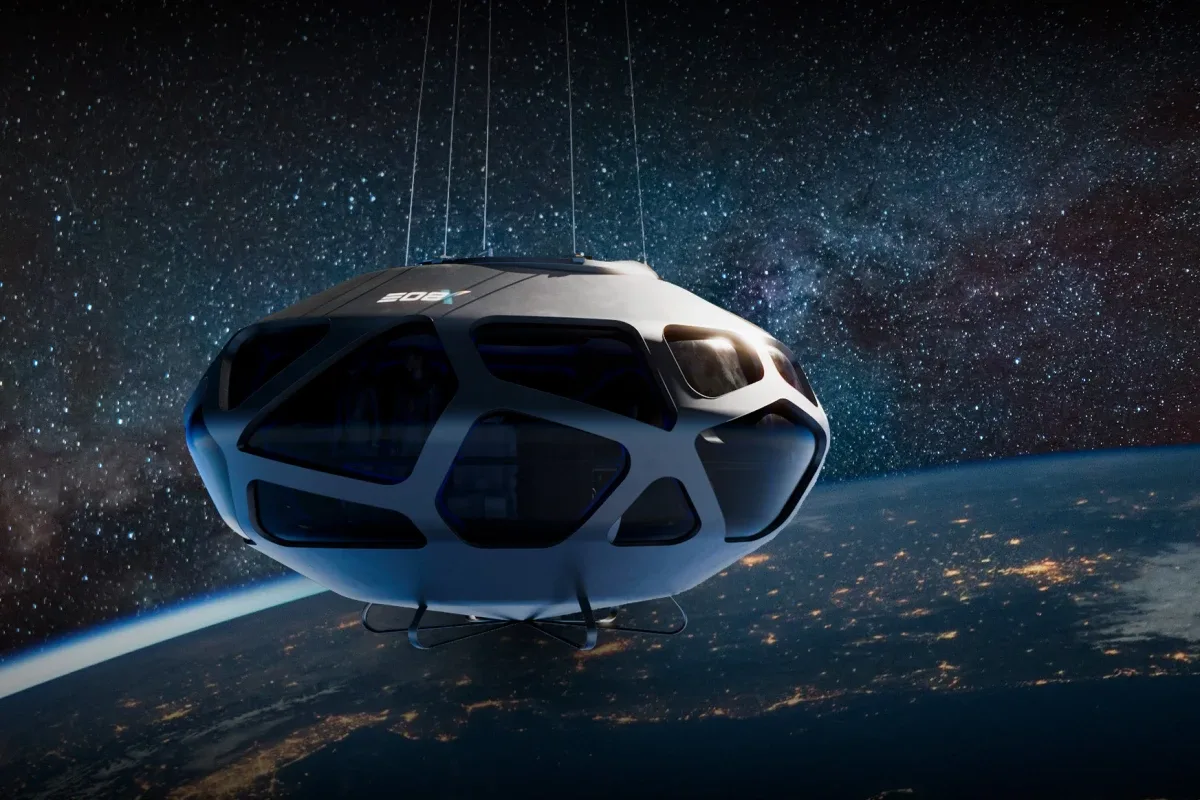
EOS-X Space, a Spanish company building pressurized balloon capsules that carry passengers to the edge of the stratosphere, has raised €110 million ($120 million) at a $1.2 billion valuation. Global Emerging Markets led the round, announced November 6, 2026, bringing EOS-X Space's total funding this year to $260 million. The company plans to use the money to expand into the United States, scale industrial capacity, and develop civil and military applications of its balloon technology, according to TechFundingNews.
What does EOS-X Space actually fly?
EOS-X Space's product is a pressurized, carbon-fiber capsule lifted by a helium-filled stratospheric balloon rather than a rocket. The capsule carries seven passengers plus a pilot to roughly 40 kilometers (131,000 feet) above the Earth, high enough to see the curvature of the planet and the black of space, though not high enough to experience weightlessness or cross the internationally recognized boundary of space at 100 kilometers.
A flight takes about five hours total: two hours of ascent, two hours cruising at altitude, and one hour of descent and landing. Tickets cost between €150,000 and €200,000 (roughly $160,000 to $214,000). The capsule includes panoramic windows, ergonomic seating, a bar and a lavatory, closer to a private jet cabin than a spacecraft.
Founder Kemel Kharbachi, a Spanish entrepreneur with a background in tourism, built the company around the idea that balloon flight is mechanically simpler and cheaper to operate than rocket-based tourism. EOS-X Space acquired U.S. rival Space Perspective in 2025, consolidating two companies pursuing the same balloon-capsule approach after Space Perspective struggled to reach commercial flight on its own.
How will EOS-X Space use the new funding?
The company says the capital will fund a push into the U.S. market, where it plans to launch flights alongside its existing base in Seville, Spain, with European commercial flights following in 2027. Money will also go toward scaling production capacity for its capsules and balloons, and into developing civil and military versions of the technology, a category that could include high-altitude surveillance or communications platforms built on the same balloon hardware.
EOS-X Space says it expects its first commercial flight by the end of 2026 and projects roughly $675 million in annual revenue once operations ramp up, a figure based on selling out flights at current ticket prices.
Investors and the road to this round
Global Emerging Markets led the latest round. It follows a $140 million Series D in May 2026 and comes after EOS-X Space's valuation climbed from roughly $230 million in mid-2025, shortly after the Space Perspective acquisition, to $1.2 billion now. The company has said it is targeting a dual listing on the NYSE and London Stock Exchange at a future valuation around $4.5 billion.
Who else is chasing stratospheric tourism?
EOS-X Space's absorption of Space Perspective leaves it with less direct balloon-tourism competition than it had a year ago, though World View Enterprises in the U.S. has pursued a similar high-altitude balloon concept for years without reaching commercial flight. The bigger competitive set is rocket-based space tourism from Virgin Galactic and Blue Origin, which fly faster, higher and briefly weightless trips at broadly comparable or higher price points. EOS-X Space's pitch is that balloon flight is lower-risk and cheaper to scale into a repeatable business than rocket launches.
What to watch next
The test for EOS-X Space is whether it actually flies paying passengers before the end of 2026, as promised, after Space Perspective spent years missing its own commercial timelines before being acquired. A successful first flight would be the strongest signal yet that balloon tourism, not just rocket tourism, can become a repeatable business, and would set up the company's planned push toward a multibillion-dollar public listing.