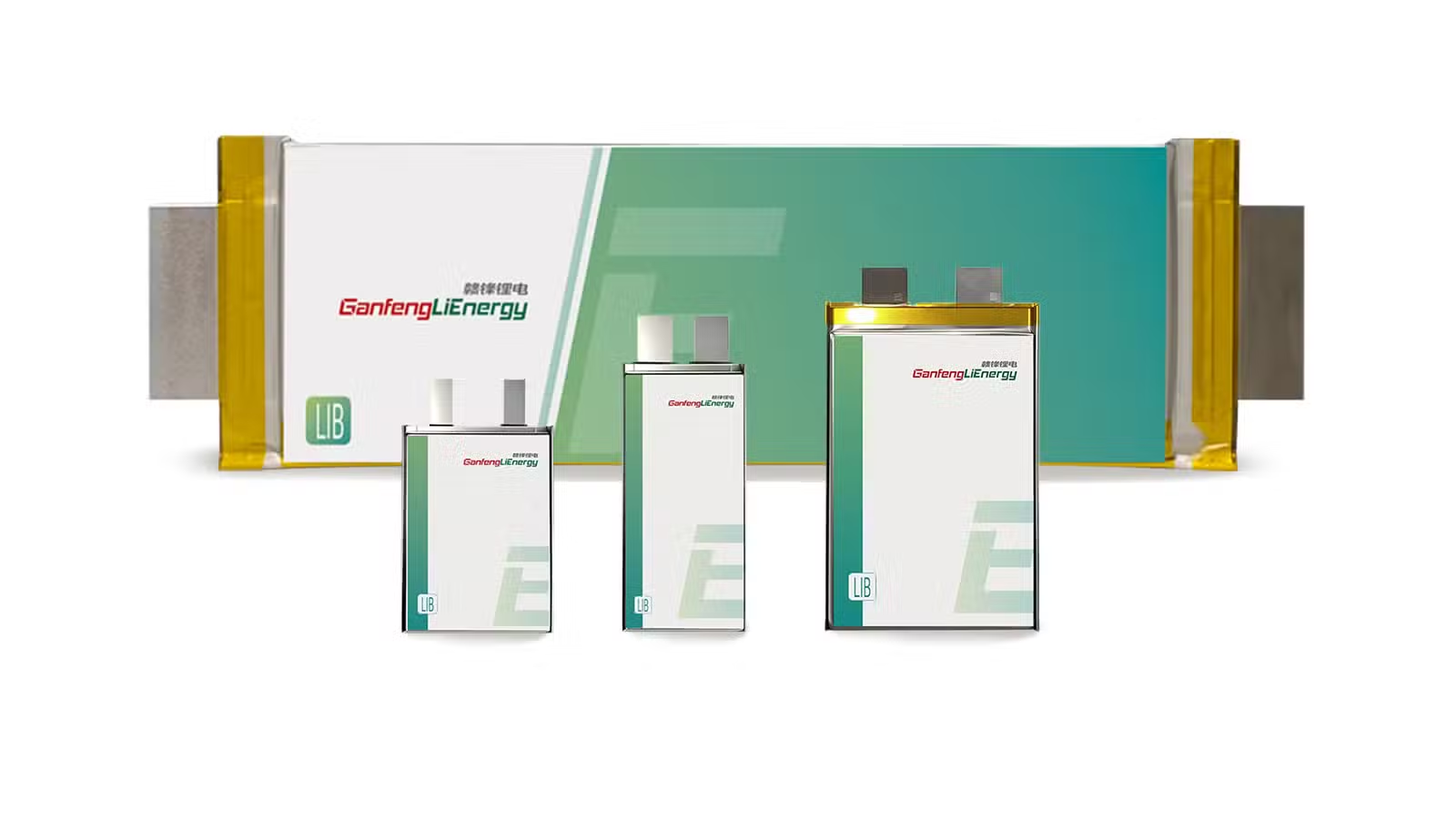
Ganfeng Lithium, one of China's largest lithium producers, has begun small-scale production of a solid-state battery cell rated at 500 watt-hours per kilogram (Wh/kg), according to investor-relations minutes the company released on May 21, 2026. Ganfeng said the 10 ampere-hour cell is the world's first solid-state product at that combination of capacity and energy density, setting a new benchmark for the future commercialization of lithium-metal batteries.
Why 500 Wh/kg matters
500 Wh/kg roughly doubles the gravimetric energy density of today's best mass-produced lithium-ion EV cells, which sit in the 250–300 Wh/kg range. At 10 Ah, the new cell is also large enough to be relevant for vehicle and aerospace use rather than a lab curiosity. Higher gravimetric density unlocks lighter battery packs, longer EV range and more workable payloads for electric vertical takeoff and landing (eVTOL) aircraft and humanoid robots, where every kilogram of battery directly trades against passenger weight, sensors or operating time.
A second cell crosses 1,100 cycles
Ganfeng also reported that its earlier 400 Wh/kg solid-state cell has now surpassed 1,100 charge cycles and completed engineering validation. Cycle life has been one of the most persistent obstacles to commercial solid-state deployment, with many prior demonstrations losing capacity quickly under realistic use. Engineering validation is a step further than a laboratory result and signals the cells are ready for pilot integration with real vehicle and battery management systems.
The company said it is pursuing two parallel solid-state routes built around silicon-carbon and lithium-metal anodes, with lithium-metal at the core of its push toward higher specific energy. Ganfeng's R&D spend rose to 4.51% of operating revenue in 2025, supporting the dual track. The new cells are aimed primarily at premium EVs, the so-called low-altitude economy of small aircraft and drones, robotics and consumer electronics.
From investor disclosure to real-world platforms
The most concrete near-term application is in low-altitude aviation. Ganfeng said its high-density cells are already powering the AE200-100 eVTOL developed by Geely-owned Aerofugia Technology — one of the first acknowledged tie-ups between a major Chinese lithium maker and a commercial eVTOL program. With eVTOL demonstrators accelerating worldwide, including efforts like BluJ Aerospace's Gen #2 prototype on the VANTIS platform and Archer Midnight's move into the UAE's restricted-type-certificate program, energy density is becoming a critical differentiator.
How it fits the broader solid-state race
Ganfeng's announcement extends a striking few weeks for the solid-state sector. Earlier this week we covered ProLogium's $3.8B SPAC deal to list on Nasdaq, and last week's research showed a magnesium-tin alloy boosting solid-state battery life by 400-fold. Together with Ganfeng's pilot, the news points to a transition from breakthrough claims to engineering validation, scaled supply chains and platform integration. The next milestones to watch will be Ganfeng's expansion from small-batch to GWh-class manufacturing and the first non-eVTOL platforms running on its 500 Wh/kg cells.
Reporting based on coverage from CnEVPost, electrive and Ganfeng investor disclosures.