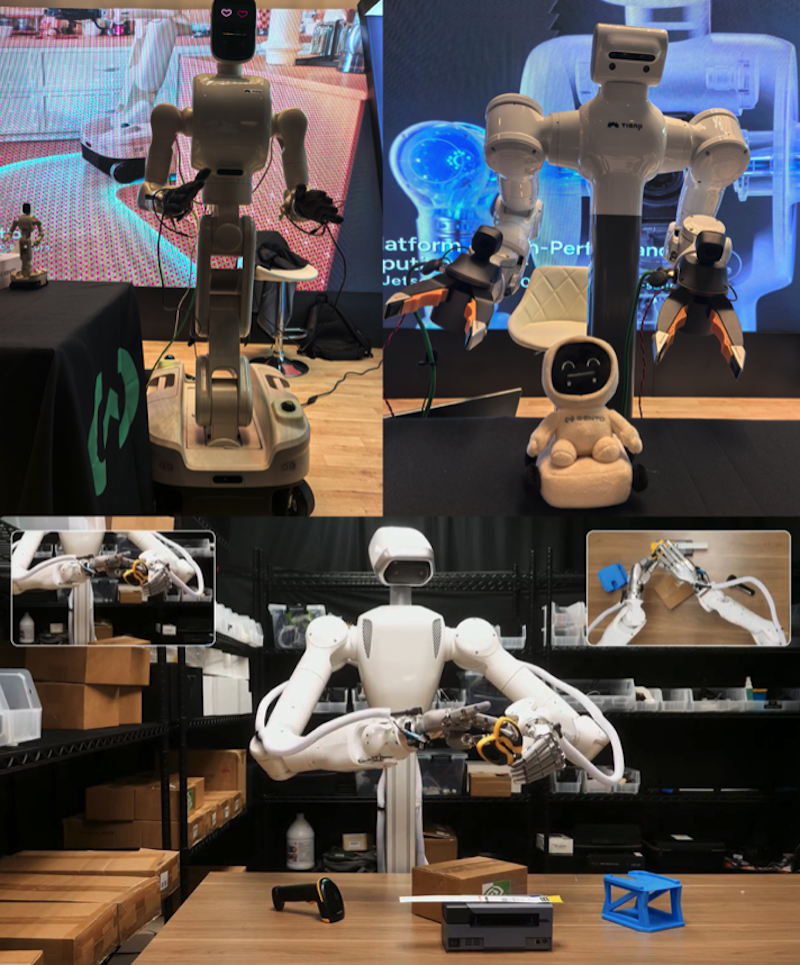
GENTO, the robotics brand of Chinese manufacturer Tianji Intelligence, showed off its first in-house dexterous hand at the Conference on Robot Learning in Austin, Texas, running November 9 to 12, 2026. The hand carries 21 degrees of freedom — five joints in the thumb and four in each of the other four fingers — packed into a unit that weighs 750 grams and measures 200 by 96 by 45 millimeters, according to PR Newswire.
Nvidia used the hand to show off its new GR00T 2 foundation model, mounting two of them on a custom humanoid platform called Marvin Pro and having it prepare banana yogurt with both hands at once.
What does "degrees of freedom" actually buy you?
A degree of freedom is one independent way a joint can move. Human hands have roughly 27, which is why they can do everything from threading a needle to palming a basketball. Most industrial robot grippers get by with one or two — open, close, maybe rotate — because factory tasks are usually scripted and repetitive. Twenty-one degrees of freedom puts GENTO's hand much closer to human dexterity, letting each finger curl, spread and rotate somewhat independently rather than moving as a single rigid claw.
The harder engineering problem isn't adding joints, it's making them feel things. GENTO says its hand detects torque as small as 0.02 newton-meters at each joint — roughly the twisting force of gently turning a doorknob — through sensors built into the mechanism. That torque feedback runs through a control loop at 160 hertz, meaning the hand recalculates its grip force 160 times per second. In practice, that's what lets a robot hand close around an egg without crushing it or a paper cup without crumpling it, because the hand can feel resistance building and back off before damage happens.
Why does this matter beyond one trade show demo?
Dexterous hands have become the bottleneck in humanoid robotics. Legs that walk and arms that reach are largely solved problems; hands that can pick up an unfamiliar object, feel how hard they're gripping it, and adjust in real time are not. Nvidia, Tesla, Figure and a wave of Chinese manufacturers have all poured money into hand development over the past two years because a robot that can walk into a kitchen but can't pick up a glass isn't commercially useful.
Tianji Intelligence isn't a startup chasing its first customer. The company, backed by industrial robot maker Yaskawa Electric and precision manufacturer Everwin Precision, says it has already shipped more than 30,000 industrial robots and, in 2025 alone, delivered over 2,000 force-controlled robotic arms to customers. It raised roughly 1 billion yuan (about $140 million) in a Series B and B+ round led by Hillhouse Venture Capital and Meituan, followed by a strategic Series B++ round backed by Ant Group and Sofina. That capital base lets GENTO sell components — hands, arms, sensors — to more than 45 robotics and embodied-AI companies rather than betting everything on building its own branded humanoid.
How does it compare to rivals?
GENTO's hand sits in a crowded field that includes Nvidia's own reference hand designs and hands from Chinese rivals. What sets GENTO apart, according to its own pitch, is a "sensor-up" design philosophy: rather than bolting tactile sensors onto an existing mechanical hand, the company builds the transmission and sensing layer first and designs everything else — rated fingertip force, grasp diameter, cycle life — around keeping that sensing accurate as the hand wears down. The company says the hand is rated for one million grasp cycles before performance degrades, a durability figure aimed squarely at manufacturers who need robots on a shift schedule, not a lab bench.
Whether 21 degrees of freedom and millisecond-level torque sensing translate into robots that reliably sort warehouse parcels or assemble electronics is still an open question. But the fact that Nvidia chose GENTO's hand to demo GR00T 2's bimanual skills, rather than building its own, suggests the hardware is further along than most of its component-maker competitors.