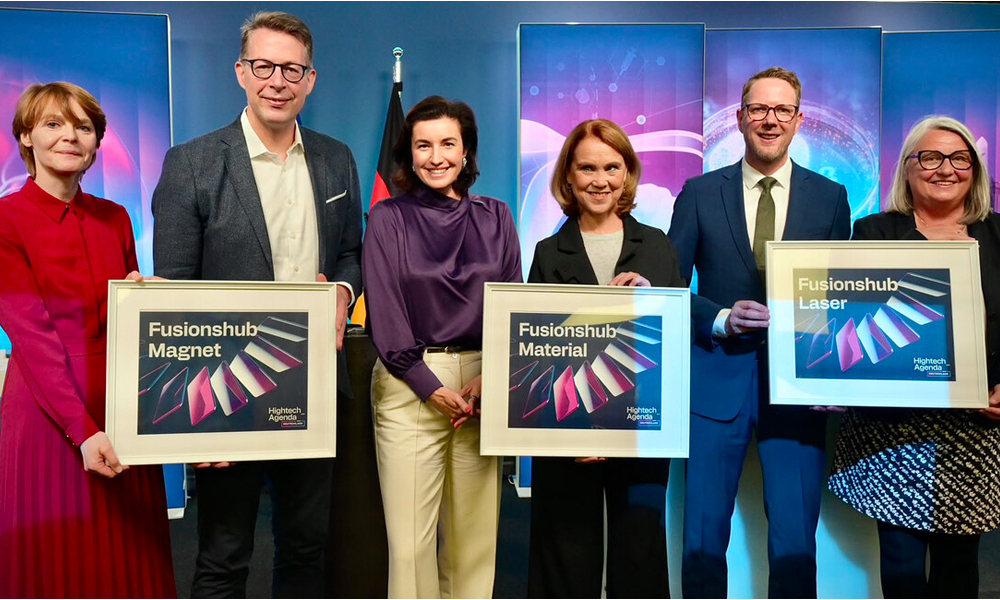
Germany's Federal Ministry for Research, Technology and Space (BMFTR) has formally launched three national fusion hubs — VEGA for laser fusion, STRIDE for magnetic fusion, and MAT-TRIX for fuel cycles and materials — backed by an initial €125 million (US$144 million) as part of Berlin's "Germany on the way to a fusion power plant" action plan.
Three hubs, one power-plant goal
Announced on July 29 and detailed further in the week ending August 15, the hubs are designed as central locations where companies, research institutions and industry work side by side — on-site and virtually — on the specific engineering choices that separate a physics experiment from a working power plant. VEGA is coordinated by Marvel Fusion and Focused Energy, based around RWE's former Biblis nuclear power plant, and will consolidate Germany's expertise in photonics, high-power lasers and target manufacturing. STRIDE is coordinated by Proxima Fusion, Gauss Fusion and the Max Planck Institute for Plasma Physics, and focuses on stellarator technology — a field in which Germany already holds an internationally leading research position. MAT-TRIX, led by the Karlsruhe Institute of Technology, tackles the cross-cutting problems of tritium production, breeding blankets and materials able to survive a fusion reactor's neutron flux over decades.
Structuring, not just funding
The €125 million is deliberately framed as a coordination layer rather than a mega-grant. Federal support is expected to be topped up by state funding, private-sector investment and international collaborations. Six successive expansion phases run from August 2026 through December 2029, starting with the establishment of joint legal and administrative structures, formal alignment between 34 initial academic and industrial partners, and the launch of frameworks for STRIDE, VEGA and MAT-TRIX. BMFTR has also signaled that its next tranche of support will move to "milestone-based financing" for merged companies, in the model already used to accelerate commercial stellarator and inertial-confinement work in the United States.
A €400 million laser fusion bet takes shape
The launch lands weeks after Marvel Fusion, the state of Colorado and Siemens Energy signed a letter of intent to advance laser-driven fusion energy, and shortly before Focused Energy closed a $240 million Series A — the largest in the global fusion industry to date, targeting a first grid megawatt-hour by 2037. On the magnetic side, Proxima Fusion's quasi-isodynamic Stellaris design and Gauss Fusion's GIGA power plant concept give STRIDE two concrete industrial anchors. The hubs, in effect, formalize a Berlin-backed European fusion cluster that competes head-to-head with the US private-sector push — one now with public money and industrial process behind it.
Reporting based on coverage from optics.org, World Nuclear News and BMFTR.