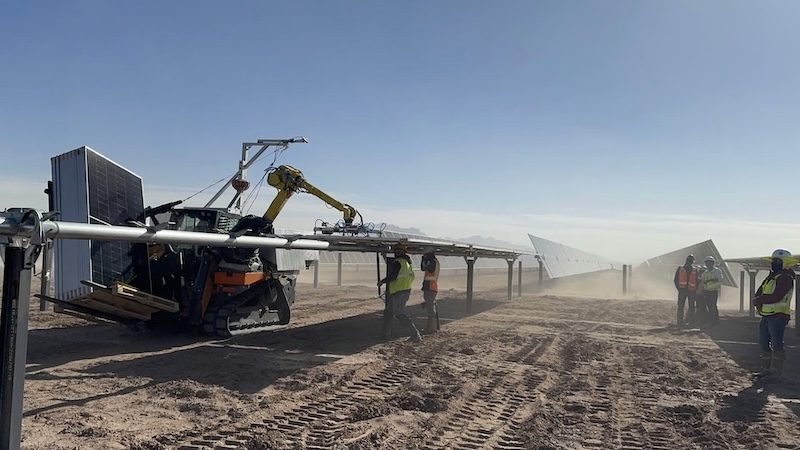
Construction robotics startup Gritt has partnered with MasTec, one of North America's largest infrastructure builders, to deploy its AI-powered systems across MasTec Renewables' utility-scale solar projects. The companies announced the deal on November 10, 2026, following what they describe as successful field deployments and evaluation on active job sites, according to Robotics & Automation News.
Gritt builds robotic attachments for standard construction equipment, aimed at tasks like picking and placing components, assembly, and material transport on solar sites. Rather than deploying fully autonomous machines, the system uses craft employees already on site to guide and validate the robot's work, with the company framing this as a way to speed up adoption without replacing existing crews.
What exactly will Gritt's robots do on MasTec's solar sites?
The initial scope covers utility-scale solar installations across MasTec Renewables' project portfolio, which spans multiple states. Gritt's pitch is general-purpose construction intelligence: the same underlying AI system can be reconfigured for different tasks and different equipment setups rather than being built for a single fixed job, which matters on solar farms where repetitive panel and racking assembly dominates labor hours.
Gritt says its systems have already operated in a range of weather conditions, including rain, desert heat, and snow, during the evaluation phase that preceded this agreement. That matters for solar construction specifically, since utility-scale projects are often sited in remote, exposed locations where weather variability is the norm rather than the exception.
Why is this deal significant for construction robotics?
Construction has lagged manufacturing and warehousing in robot adoption because job sites are unstructured, outdoors, and change daily. A partnership with a company the size of MasTec gives Gritt a route to scale across many sites and multiple states rather than a single pilot location, and gives it recurring exposure to the kind of repetitive assembly work that robotics companies typically target first.
MasTec Renewables VP of Construction Rob Turner said the company sees "an opportunity to pair our teams' expertise with technology that supports them," while Gritt CEO Puneet Puri framed the deal around iterative improvement, saying "every deployment is an opportunity to make our systems more capable." Both framings point to a human-in-the-loop model rather than a push toward full automation on day one.
What comes next for the partnership?
The companies say they plan to expand beyond solar into additional infrastructure sectors within MasTec's broader business, which spans telecommunications, pipeline, and power-grid construction alongside renewables. Neither company has disclosed contract value, unit counts, or a timeline for expansion beyond the initial solar rollout, and the partnership's success will likely be judged on whether Gritt's attachments can keep pace with MasTec's existing crews on throughput, not just technical demonstrations.