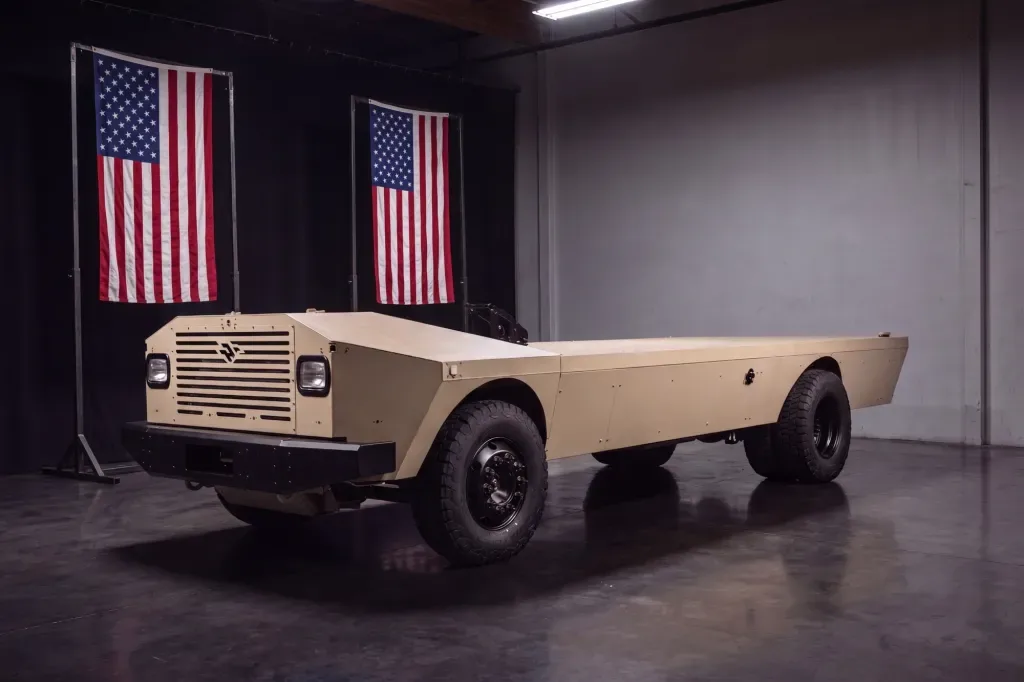
Harbinger, the Garden Grove, California-based maker of electric medium-duty truck chassis, raised $240 million in Series D funding announced November 5, 2026. Tiger Global, Capricorn's Technology Impact Fund and Ridgeline co-led the round, which also drew in FedEx, Maniv, Greycroft, Volkswagen-backed Leitmotif and Fidelity Management, according to TechCrunch.
Why is a truck company raising money for defense and power?
Harbinger built its business on an electric chassis platform that already underpins delivery vans, work trucks, RVs and ambulances. The new money extends that same vertically integrated electrification stack -- battery packs, motors and software -- into two new markets: stationary power generation and storage for data centers, and unmanned military ground vehicles through a new division called Praesidia.
Praesidia is developing a driverless, hybrid-electric platform for defense customers, which puts Harbinger in direct contact with the same autonomy and battlefield-logistics demand that has fueled huge raises elsewhere in the sector this year, including Shield AI's $2.5 billion round and Neros Technologies' up to $450 million Pentagon loan.
How big is Harbinger's actual commercial truck business?
FedEx is both an investor and Harbinger's anchor customer. The two companies' relationship started with a 53-truck order tied to Harbinger's $160 million Series C in November 2025, and by September 2026 FedEx had placed a follow-on order for 2,000 electric delivery vans worth more than $300 million. Paul Melander, FedEx's senior vice president of safety and transportation, has since joined Harbinger's board.
That order backlog is the commercial proof point investors are leaning on as Harbinger spends the new capital on unproven adjacent markets. It's also why FedEx chose to invest again in the Series D rather than just buying trucks.
What has Harbinger raised before, and who's backing it?
Founded in 2022 by former Canoo and QuantumScape employees, Harbinger has now raised more than $650 million in total, including the $160 million Series C a year earlier. The Series D, roughly 50% larger than that prior round, reflects investors underwriting the company's expansion beyond trucks rather than just its existing chassis business.
Harbinger also acquired autonomous-driving startup Phantom AI in February 2026, a deal that now looks like early groundwork for the Praesidia defense push and for eventual driver-assist features on its commercial trucks.
How does this fit the broader defense-tech and EV funding picture?
Harbinger's move mirrors a pattern across robotics and defense-tech this year: hardware companies with a working commercial product are using defense contracts and unmanned-systems demand to justify much larger valuations than their core business alone would support. Shield AI did it with drones and radar; Harbinger is doing it with electric trucks and ground vehicles.
What to watch next: whether Praesidia lands a named defense contract rather than just a stated ambition, and whether Harbinger's power-generation push for data centers turns into orders as fast as its truck business did with FedEx.