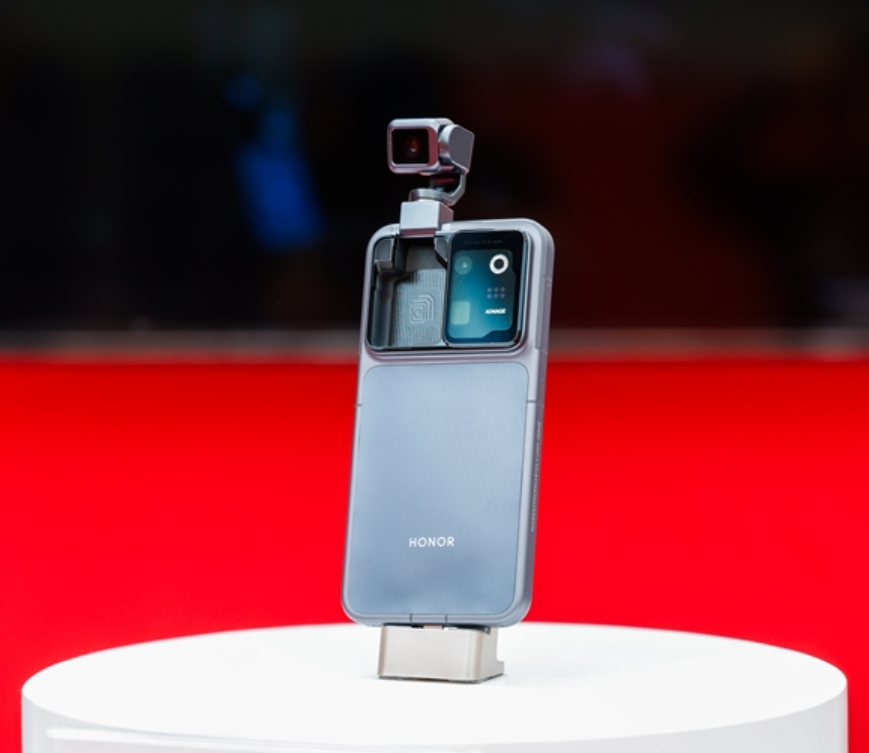
Honor has unveiled what it bills as the world’s first “robot smartphone,” the Honor Robot Phone, during Qualcomm’s Snapdragon Fans anniversary party over the weekend. Qualcomm released high-resolution hands-on images of the device, showing the back design and the phone’s defining feature: a robotic-arm camera gimbal.
A camera that physically moves
The headline element of the Honor Robot Phone is a hidden robotic-arm gimbal system. When not in use, the arm retracts into the body of the phone. With a single tap, it extends outward and allows the camera to physically move, delivering fully automatic framing, subject tracking and advanced stabilization. It is an unusual mechanical approach in a category where camera movement is normally handled entirely in software.
On-device embodied AI
According to Qualcomm, the Honor Robot Phone is powered by a flagship Snapdragon chipset and features on-device embodied AI capabilities alongside what the company describes as powerful AI computing performance. That processing is what enables the handset to stably drive the autonomous robotic camera system and handle motion decision-making locally, without relying on the cloud. The emphasis on running AI workloads directly on the device echoes a broader industry push toward on-device intelligence, similar in spirit to recent AI chip and on-device model efforts in China.
Where it fits in the robotics race
The product blurs the line between consumer electronics and robotics, packaging a motorized manipulator and perception-driven control into a pocket device. It arrives amid a wider wave of Chinese robotics ambition, from plans for a household humanoid robot to rapid progress in dexterous robotic hands. The robotic-arm gimbal is a far simpler mechanism than a humanoid limb, but it applies the same combination of actuation and AI-driven control to a mass-market form factor.
An unusual debut venue
The reveal did not come at a traditional Honor product launch but at Qualcomm’s Snapdragon Fans anniversary party, where Qualcomm itself released the hands-on imagery. The framing positions the device as a showcase for what a flagship Snapdragon chipset can do when paired with embodied AI — AI that perceives and acts in the physical world rather than living purely on screen. By using the camera arm to demonstrate autonomous motion control, the two companies are pitching the phone as evidence that meaningful robotics workloads can now run on a handheld processor.
Availability
The Honor Robot Phone is scheduled for an official launch in the third quarter of this year. Pricing and detailed specifications beyond the Snapdragon platform and the gimbal system were not disclosed at the unveiling, with Qualcomm and Honor instead using the event to showcase the hardware design and the device’s embodied-AI camera capabilities. A commercial release in the coming months would make it one of the first consumer devices to put a motorized, AI-driven manipulator directly into shoppers’ hands.
Reporting based on coverage from TechNode and Qualcomm.