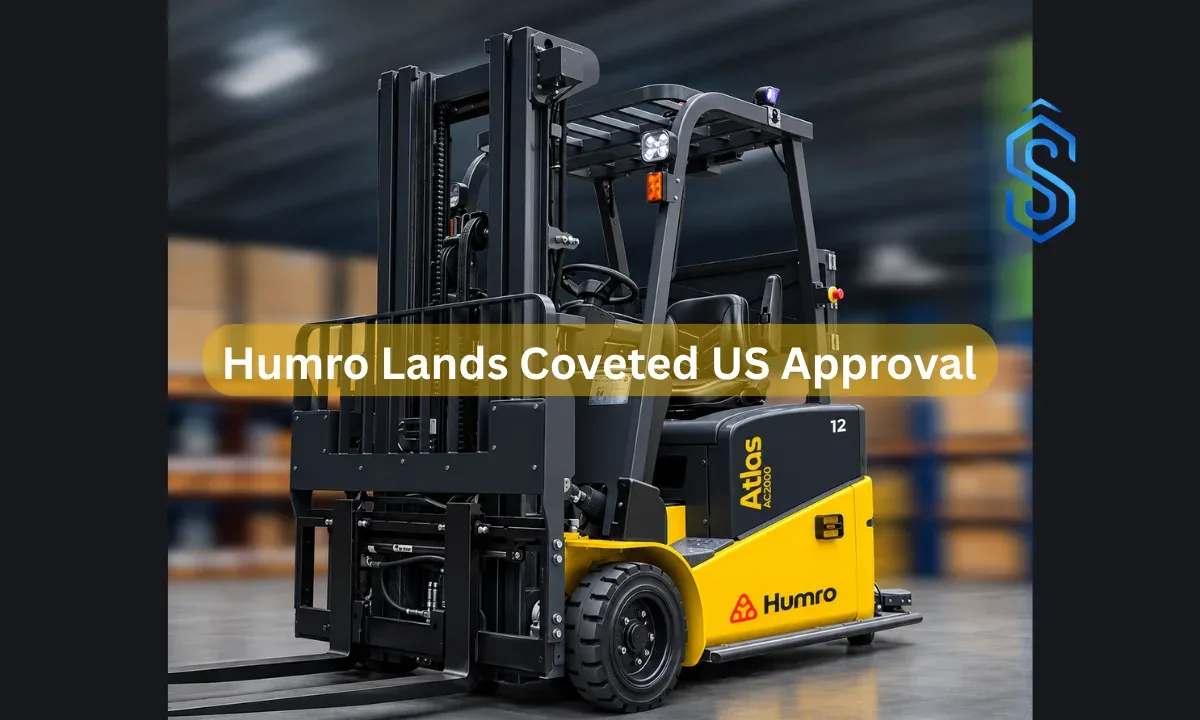
Humro, the robotics arm of India's Affordable Robotic and Automation Limited (ARAPL), has secured Conditional Approval from the US government to sell its autonomous pallet trucks and forklifts in the United States, becoming the only Indian company among the first 13 robotics operators worldwide cleared under a revised national-security review. The approval, dated October 30 and disclosed on November 3, covers Humro's Maia2000 pallet trucks and Atlas AC2000 forklifts, according to Sahyadri Startups.
Humro, based in Pune, says the clearance opens a path into a US autonomous material-handling market it estimates at $150 billion, including potential government procurement work.
Why do robots need government clearance to enter the US at all?
In July 2026, the FCC added foreign-produced advanced robotic devices to its Covered List, a national-security tool previously used mainly against telecom equipment. The move effectively blocked companies outside an approved circle from selling certain autonomous hardware into the US market without a separate review. Firms seeking an exemption must now pass an assessment run by the US Department of War, covering factors like supply chain origin, data handling and manufacturing plans.
Humro's Conditional Approval is not unconditional. The company has committed to a phased plan to manufacture in the US over two years and must still meet Buy American Act and Trade Agreements Act requirements before it can bid on federal contracts. That structure, approval now, onshoring later, appears designed to let foreign robot makers keep selling while gradually shifting production domestically.
What do these robots actually do?
Maia2000 pallet trucks and Atlas AC2000 forklifts are mobile robots built for warehouses and distribution centers, moving pallets and loads between storage racks, docks and staging areas without a human driver. They compete in the same category as autonomous forklifts from US firms like Fox Robotics, now owned by Symbotic, and various Chinese suppliers that have faced tighter scrutiny under the new rules.
Why does this matter beyond one company?
The Covered List policy was framed around concerns that foreign-made robots, particularly from China, could pose data security or supply-chain risks inside US warehouses, ports and factories. Humro's clearance shows the review process is functioning as a filter rather than a blanket ban, letting some non-Chinese foreign manufacturers through while still restricting companies deemed higher risk.
For Humro, the approval is a rare opening for an Indian robotics company into a market increasingly walled off to foreign hardware. ARAPL co-founder Robinson Philipose called it "a significant milestone for Humro and an important validation of our technology," while founder Melind Padole pointed to the company's expanding US and India teams. Whether Humro can convert regulatory access into actual US warehouse contracts will depend on competing against both established domestic players and the 12 other operators that cleared the same bar.