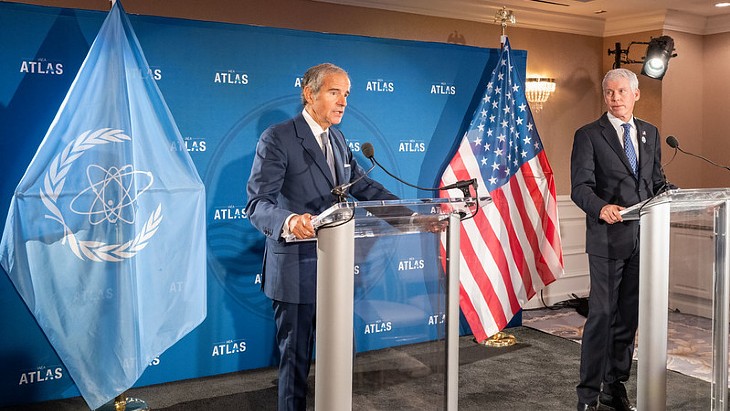
The International Atomic Energy Agency launched its Atomic Technologies Licensed for Applications at Sea (ATLAS) initiative on August 27 in Washington, DC, with 26 countries signing a joint statement of support to advance the deployment of small modular reactors on commercial ships and in floating offshore power plants. It is the first globally coordinated attempt to connect the nuclear and maritime industries, and about 600 delegates from more than 50 countries attended the two-day ministerial event, which was co-hosted by the United States.
Six project groups, technology-neutral
ATLAS will begin implementation through six expert project groups tasked with safety, security, safeguards and regulatory analysis, plus deployment scenarios for both shipborne reactors and floating nuclear power stations. The signatory list stretches from Argentina, Brazil and Canada to Japan, South Korea, Norway, Poland, Romania, Saudi Arabia, Singapore, the UAE, the UK and the US — plus much of Europe, according to the World Nuclear News report from the launch.
Why nuclear at sea, why now
Advances in advanced reactor design, TRISO and molten-salt fuels and maritime engineering mean some nuclear-maritime concepts could be deployment-ready by the 2030s, the IAEA said. Target applications include container ships, bulk carriers, tankers, cruise ships, icebreakers and offshore support vessels, plus floating plants for heat, electricity, desalination and disaster response. "By bringing together the nuclear and maritime sectors, we have the opportunity to shape the future of two crucial industries," said IAEA Director General Rafael Mariano Grossi.

Momentum builds under US administration
US Energy Secretary Chris Wright, who co-hosted the event, said ATLAS aims to "turn the promise of offshore nuclear energy and nuclear-powered shipping into commercial reality" by aligning regulators, developers and shippers. The IAEA push comes weeks after Core Power announced its agreement to develop maritime SMR systems and follows a busy US SMR summer with Holtec's four-unit Oyster Creek plan, the Curio-NuScale-Framatome fuel-cycle MOU, and Antares Nuclear's multi-year TRISO supply lock-in.
What to watch next
The IAEA's technology-neutral framing means Chinese and Russian floating-reactor programmes may still fit under ATLAS, but Western advanced-reactor vendors are best positioned to shape the emerging rulebook. Expect early practical work on port-state safeguards, insurance regimes and IMO-IAEA joint guidance on refuelling protocols. The initiative also raises the strategic value of British and Norwegian nuclear-maritime hubs and could accelerate contract flows for TRISO and molten-salt suppliers.
Reporting based on coverage from the IAEA, World Nuclear News and the US Department of Energy.