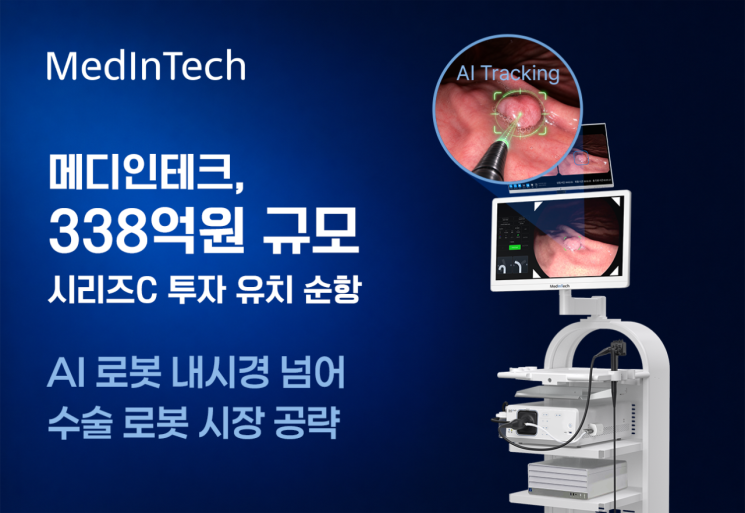
MedInTech, a South Korean medical robotics startup, has raised 33.8 billion won (about $23.6 million) in a Series C round co-led by Atinum Investment and KB Investment, the company said November 17, 2026. Existing backers Smilegate Investment, SL Investment, ICF (NextTrans) and Ushin Venture Investment returned, joined by new investor K2 Investment Partners. The round brings MedInTech's cumulative funding to roughly 62.2 billion won (about $43.5 million) since its founding in 2020. The money will fund R&D staffing, prototype development, regulatory approvals at home and abroad, and a new production line for its robotic endoscope lineup, alongside its first push into surgical robots.
What does MedInTech's robot actually do?
The company's flagship product, INTION S, is a motorized robotic endoscope built around AI-assisted navigation and lesion tracking. Rather than a doctor manually pushing and twisting a flexible scope through the colon by hand, INTION S uses motors to drive and steer the scope while its AI software flags suspicious tissue and keeps the camera oriented on it, cutting down on the physical effort and attention a standard colonoscopy demands from the operator.
In a clinical trial at Seoul National University Hospital involving 178 adults, MedInTech says INTION S performed comparably to conventional endoscopy on standard measures while reducing physician fatigue, a practical bottleneck in high-volume endoscopy units where doctors perform dozens of procedures a day. The device is already in use at National Fire Hospital and Ajou University Hospital domestically, and MedInTech has started selling through distributor DK Healthcare and into Thailand, the Philippines and Mongolia.
Why is robotic endoscopy catching on now?
Endoscopy screening volumes keep climbing as countries push earlier cancer detection, but the procedure is physically repetitive for doctors and prone to missed lesions when fatigue sets in late in a shift. AI lesion-detection software has already shown it can catch polyps human eyes miss; pairing that software with motorized, AI-steered hardware is the next logical step, letting the system handle more of the physical driving while the doctor focuses on interpretation.
MedInTech is also using the robotic control technology it built for endoscopy as the base for a new line of surgical robots, a strategy of expanding from a narrower, already-approved device into a harder, more lucrative robotic surgery market rather than starting a surgical robot program from scratch.
Who's backing MedInTech and what comes next?
The Series C round is still being finalized, with MedInTech telling investors it plans to close additional commitments before year-end, according to Venture Square. The company is also coordinating with a 228 billion won government-backed advanced medical device research initiative, a sign regulators see domestic robotic endoscopy as a priority category. What to watch next: whether INTION S clears additional international regulatory approvals beyond its current Southeast Asian footprint, and how quickly MedInTech's first surgical robot reaches clinical testing.