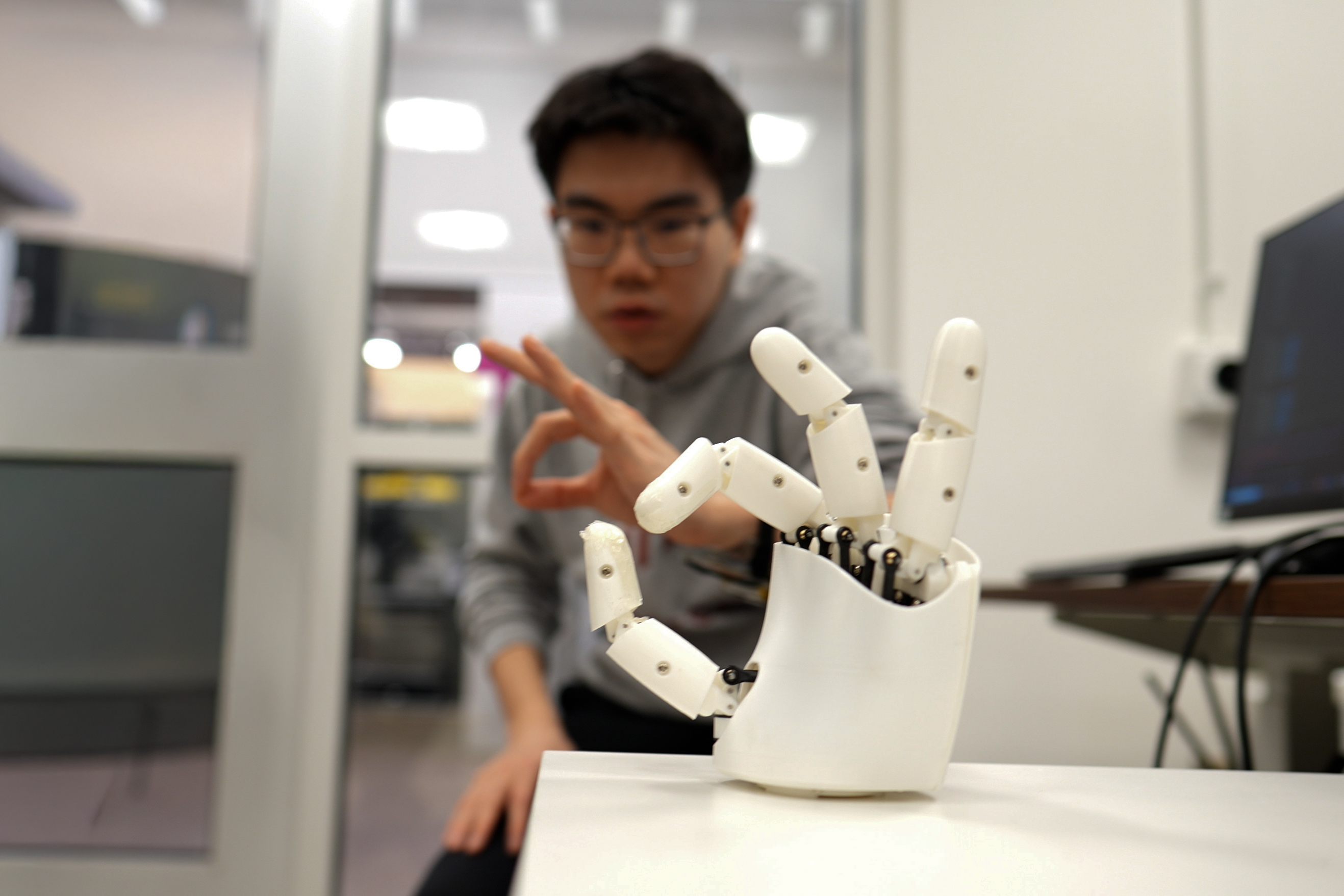
MIT's Ultrasound Wristband Enables Real-Time Control of Robotic Hands
MIT engineers have developed an innovative ultrasound wristband that tracks hand movements in real-time, allowing users to control robotic hands with natural gestures through AI-powered image translation.
Key Takeaways
MIT researchers developed an ultrasound wristband that captures real-time images of wrist muscles, tendons, and ligaments to track hand movements.
An AI algorithm translates the ultrasound images into precise finger and palm positions, enabling natural gesture control of robotic hands.
The system supports complex tasks like playing piano and precise object manipulation, plus natural hand interaction in virtual reality.
It tackles the challenge of replicating human hand coordination, which involves 34 muscles, 27 joints, and over 100 tendons and ligaments.
The device trains on individual users' hand motions, making it adaptable across manufacturing, healthcare, entertainment, and education, and lowering the learning curve for non-expert robot operators.
The Robotics Media Editorial
Researchers at MIT have achieved a significant breakthrough in human-robot interaction with the development of an ultrasound-powered wristband that enables seamless control of robotic hands through natural human movements. This innovative device represents a major leap forward in making robotic control more intuitive and accessible.
Advanced Ultrasound Technology Meets AI
The wristband utilizes sophisticated ultrasound imaging to capture detailed real-time data of the wearer's wrist muscles, tendons, and ligaments during hand movements. This biological data is then processed by an artificial intelligence algorithm that translates the ultrasound images into precise finger and palm positions, creating a direct communication pathway between human intention and robotic action.
Revolutionary Applications in Robotics
The potential applications for this technology extend far beyond simple robotic control. Users can direct robots to perform complex tasks such as playing piano or manipulating objects with remarkable precision. The system also opens new possibilities in virtual reality environments, where users can interact with digital objects using natural hand gestures. This level of control addresses one of robotics' most persistent challenges: replicating the incredible complexity of human hand coordination, which involves 34 muscles, 27 joints, and over 100 tendons and ligaments.
Industry Impact and Future Implications
This breakthrough could revolutionize multiple industries, from manufacturing and healthcare to entertainment and education. The technology's ability to learn individual users' hand motions through training makes it adaptable to various applications and users. For the robotics industry, this represents a significant step toward more natural human-machine interfaces, potentially reducing the learning curve for robotic operation and expanding the accessibility of advanced robotic systems to non-expert users.
The wristband uses ultrasound imaging to capture real-time data of the wearer's wrist muscles, tendons, and ligaments during hand movements. An AI algorithm then translates these images into precise finger and palm positions, creating a direct link between human intention and robotic action.
What can the wristband be used for?
Users can control robotic hands to perform complex tasks such as playing piano or manipulating objects with precision, and interact with digital objects in virtual reality using natural hand gestures. Potential industry applications span manufacturing, healthcare, entertainment, and education.
Why is controlling robotic hands so difficult?
Human hand coordination is extremely complex, involving 34 muscles, 27 joints, and over 100 tendons and ligaments. Replicating this dexterity has been one of robotics' most persistent challenges.
Does the wristband work for different users?
Yes. The system learns individual users' hand motions through training, making it adaptable to various users and applications and more accessible to non-expert operators.