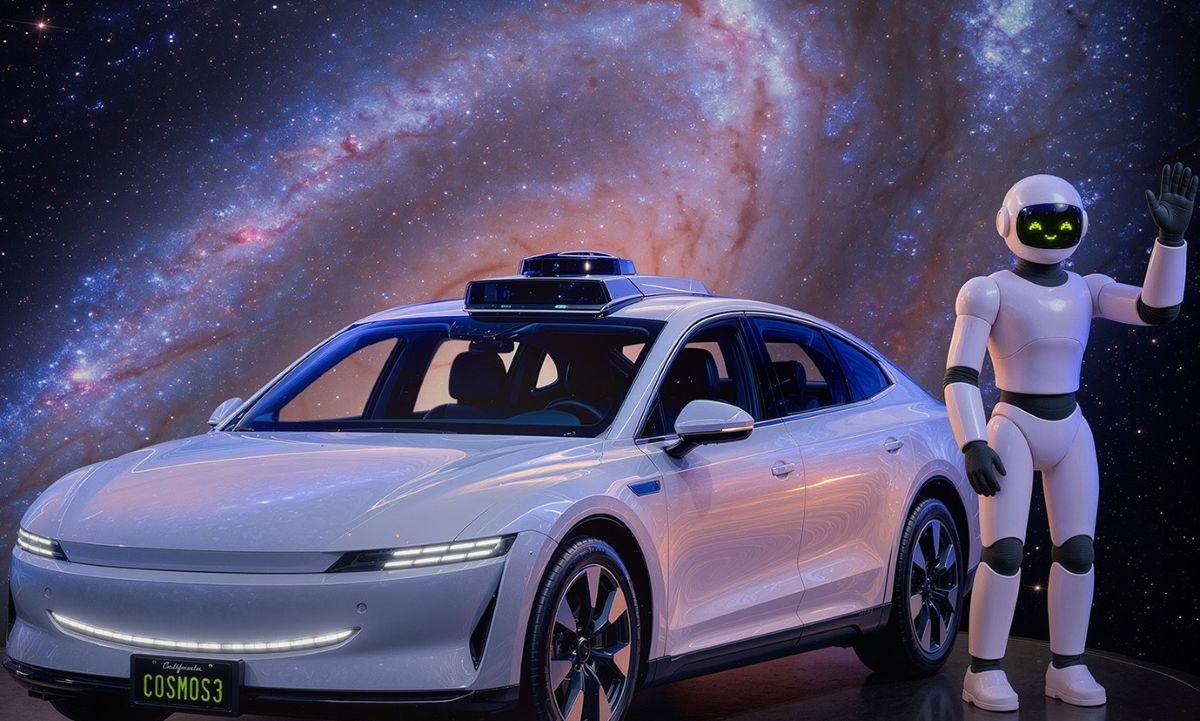
NVIDIA has released Cosmos 3, an open frontier world foundation model built for physical AI, trained on 20 trillion tokens of multimodal data spanning nearly a billion images and 400 million real and synthetic videos. Where large language models learn the world from text, Cosmos 3 learns how objects move, collide, fall and interact over time, giving robots and autonomous vehicles a way to understand the physical world before acting in it.
One Model For Reasoning, World Generation And Action
Earlier Cosmos releases split physical reasoning, world generation and action generation across separate systems. Cosmos 3 unifies them in a single open two-tower mixture-of-transformers model, which NVIDIA says compresses training cycles from months to days. What separates it from a video generator is action data: Cosmos 3 does not just render realistic scenes, it predicts what a robot or vehicle should do next within them.
"The big bang of physical AI is just around the corner thanks to breakthroughs in multimodal reasoning language, vision and world models," NVIDIA founder and CEO Jensen Huang said at the launch.

Solving The Data Problem For Robots And Vehicles
Training a robot or autonomous vehicle on real-world experience is slow, costly and sometimes unsafe. A robot learning to manipulate objects needs millions of interaction examples, and a self-driving car needs exposure to rare hazards such as fog, unexpected road conditions and pedestrian edge cases that cannot be cheaply collected on public roads. World foundation models address this by generating synthetic training data that obeys real physics, letting developers run millions of simulated scenarios in days rather than driving test fleets for years. The approach extends the same simulation-first thinking NVIDIA has pursued with partners in its expanded Cadence robotics partnership.
A Growing Physical AI Ecosystem
The Cosmos platform already has a working ecosystem. Agile Robots, Doosan Robotics, LG Electronics and Samsung are building robotics applications on it, while Li Auto, Waabi and Wayve use NVIDIA's Cosmos models to simulate traffic, weather and pedestrian behavior without physical trials. Alongside the model, NVIDIA launched the Cosmos Coalition, a collaboration including Agile Robots, Black Forest Labs, Runway and Skild AI to advance open world foundation models. The release lands amid a wider push that includes NVIDIA's deepening Hyundai alliance around Atlas robots and its broadened Doosan pact across robotics and AI factories.
The Race For World Models Heats Up
Cosmos 3 enters a fast-forming market for world models. Decart's recently launched Oasis 3 real-time world model targets autonomous driving, while Google DeepMind's Genie 3 excels at generating novel environments from text. Startups led by AI luminaries, including Yann LeCun's AMI Labs and Fei-Fei Li's World Labs, are chasing the same prize. NVIDIA's differentiation, backers argue, is strict physical consistency for industrial use, the trait robotics and autonomous-vehicle developers most need from synthetic data.
Reporting based on coverage from PYMNTS, Axios and NVIDIA.