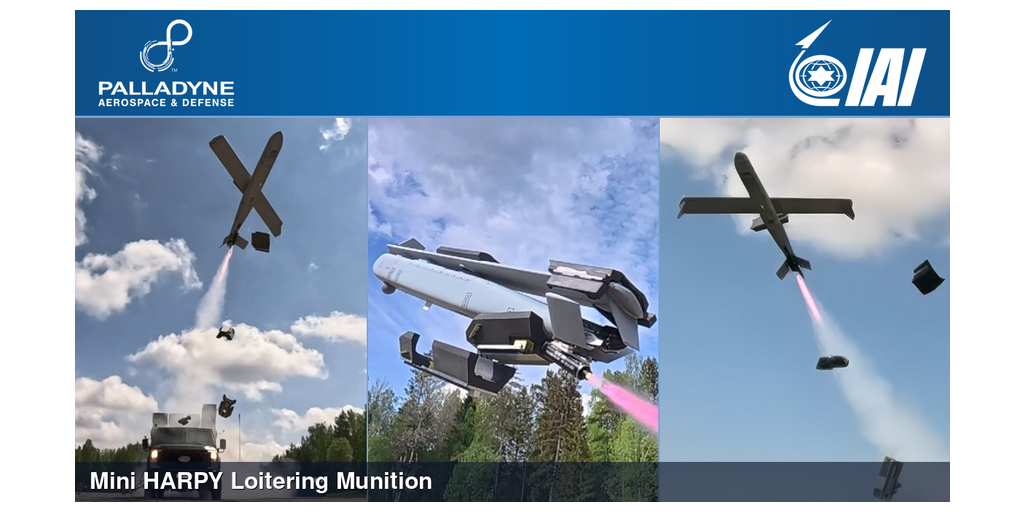
Palladyne AI and Israel Aerospace Industries (IAI) have formed a strategic partnership giving the U.S. defense-tech firm exclusive rights to manufacture, integrate and market IAI's combat-proven HARPY, HAROP and Mini HARPY loitering munitions to the U.S. Department of War.
Exclusive U.S. rights to combat-proven systems
Under the memorandum of understanding, Salt Lake City-based Palladyne AI (NASDAQ: PDYN) secures exclusive U.S. production and marketing rights for the systems, contingent on a definitive agreement and a U.S. assembly line built at Palladyne's expense. IAI will provide engineering support and key subsystems, while Palladyne adapts the munitions to U.S. operational requirements and domestically manufactures components. The deal arrives as the Pentagon ramps investment in loitering munitions for the modern battlefield.
HARPY, HAROP and Mini HARPY
IAI has pioneered the loitering-munition market for more than 40 years. Its HARPY and HAROP systems are optimized to suppress and destroy enemy air defenses, autonomously searching for and striking radar sites, missile launchers and command nodes. The newer Mini HARPY folds both seekers onto one tactical platform, adding an anti-radiation seeker to its electro-optical/infrared sensors so front-line forces can neutralize emitters and counter-UAS arrays.

A vertically integrated defense prime
Palladyne pitches itself as a mid-tier U.S. technology prime, pairing its embodied-AI autonomy stack and SwarmOS drone-swarming software with American manufacturing. "IAI's systems have been validated in real-world combat environments for decades," said CEO Ben Wolff, arguing the partnership can field capability far faster than a clean-sheet program. The move fits a broader wave of defense-autonomy tie-ups and procurement, alongside efforts like Alpine Eagle and Origin Robotics' counter-drone merger, AeroVironment's new combat robots and Anduril's $363M border-tower award.
For IAI, the agreement deepens its U.S. footprint and industrial cooperation; for Palladyne, it is the first major proof of an autonomy-plus-manufacturing model the company says it built in 2025.
Reporting based on coverage from Business Wire, Defense Daily and Aviation Week.