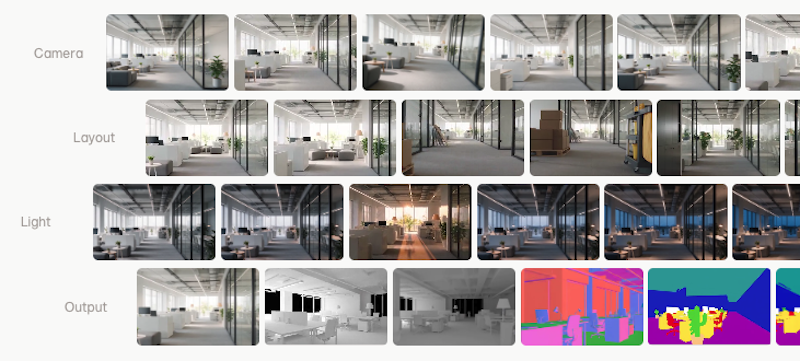
Physicl, a Paris-based startup building synthetic training data for robotics and physical AI, raised a $10 million seed round announced November 15, 2026. Inovia Capital led the round with participation from US Venture Partners, according to Robotics and Automation News.
What problem is Physicl actually solving?
Physical AI models that drive robots and autonomous systems tend to fail on situations their training data never covered well: unusual lighting, unfamiliar object shapes, odd physical arrangements. Collecting enough real-world footage to cover every edge case is slow and expensive. Physicl's platform, called Studio, lets researchers build custom 3D environments and generate targeted synthetic data aimed at the specific gaps a model is struggling with, rather than just adding more generic data.
How big is the dataset researchers get access to?
Studio gives users access to 10,000 ground-truth 3D environments and more than 100,000 digital assets, which the company says can be recombined into billions of distinct scene variations. Founder and CEO Alex de Vigan frames the pitch around diagnosis, not volume: "Models fail on edge cases. When researchers find these weaknesses, they need a way to generate data that specifically addresses them and test whether the model improves."
Who is already using it, and does it work?
Physicl counts Meta, World Labs, Epic Games and SpAItial among its customers. SpAItial, a 3D reconstruction company, says it used Physicl-generated data to cut its reconstruction error by more than 50%. SpAItial CEO Matthias Niessner said the platform "gives any researcher access to virtually any physical training data they can imagine," pointing to synthetic data's growing role as a stand-in for scenarios that are rare, dangerous, or costly to capture on camera in the real world.
Why does this matter for the broader robotics industry?
As humanoid and industrial robot makers race to scale deployments, the bottleneck is increasingly data quality rather than data quantity; a model that's never seen a specific lighting condition or object orientation can fail in deployment even after extensive training. Physicl's seed round adds it to a growing field of synthetic-data infrastructure providers competing to supply that targeted data to robotics labs, rather than building robots themselves.