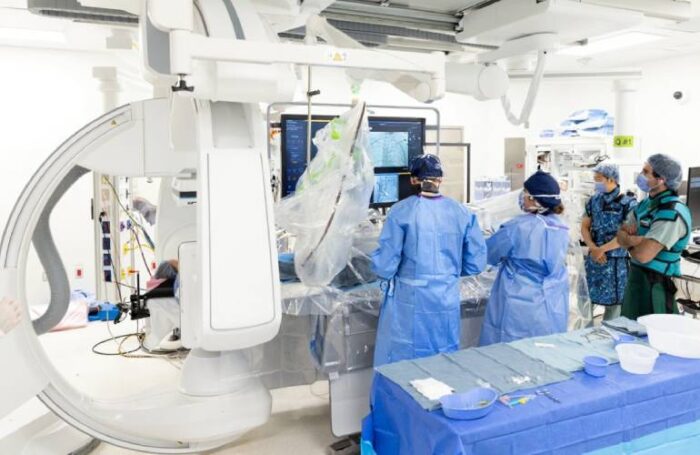
Remedy Robotics has raised $62 million in Series B funding led by DCVC, the company announced on November 16, 2026. The round brings the San Francisco startup's total funding to roughly $97 million since its 2023 Series A, and will fund pivotal clinical trials and FDA approval work for its N1 System, a robot built to perform cardiovascular and neurovascular procedures remotely.
What does the N1 System actually do?
The N1 System threads catheters through a patient's blood vessels to treat strokes, blocked arteries and other vascular emergencies. It pairs computer vision and machine learning with mechanical catheter controls so a physician can plan a procedure, simulate it against a patient's imaging, and then execute it from a console, on-site, from another room, or with increasing autonomy over routine steps.
The pitch is speed and access. Strokes and vascular emergencies are treated best within hours, but many hospitals lack an interventionalist on-site around the clock. Remedy's system lets a specialist operate the robot remotely from wherever they are, without flying a doctor to the patient. The company says it completed the world's first remote neurointerventional procedures in October 2025, and now works with more than 100 hospitals worldwide. Its patent portfolio covers 48 filings spanning the robot's mechanics, imaging registration and autonomous functions.
Where is the $62 million going?
Three places, according to the company: a pivotal clinical trial run with the University of California system, continued work toward FDA clearance for neurovascular intervention, and deployment of prototype N1 Systems across its clinical partner network. A slice also goes toward expanding the AI capabilities behind the system's autonomous functions, the part of the pitch that separates Remedy from a conventional surgical robot.
That roadmap matters because remote and autonomous endovascular care has mostly existed as a research demonstration. Turning a handful of remote procedures into a repeatable, FDA-cleared clinical product requires the kind of trial infrastructure and regulatory documentation this raise is meant to buy.
Who backed the round, and who backed Remedy before?
DCVC led the Series B, joined by UC Investments, Skip Capital, Hostplus, Build Collective (the venture platform founded by former Apple executive Tony Fadell), Blackbird, Divergent Capital and KdT Ventures. Several of those names, including DCVC, Blackbird and Build Collective, also backed Remedy's $35 million Series A in October 2025, giving the company roughly $97 million in disclosed funding across two rounds in just over a year. Remedy was founded in 2020 by CEO Dr. David Bell and CTO Jake Sganga.
How does Remedy compare to other robotic surgery companies?
Remedy sits in a crowded but still immature field of robotic and remote intervention for vascular disease. The Robot Report has pointed to Microbot Medical and Stereotaxis as the closest comparisons, both of which build robotic systems for navigating catheters through blood vessels, though neither has demonstrated fully remote operation at Remedy's scale. Stereotaxis has spent two decades building magnetically guided catheter systems for cardiac procedures, while Microbot's smaller LIBERTY robot targets less invasive endovascular cases. Remedy's bet is that remote operation, not just robotic precision, is the bigger unlock, since it addresses the shortage of interventionalists rather than just the mechanics of the procedure.
What should the industry watch next?
The pivotal trial with the University of California system is the next real checkpoint. Positive results there would move Remedy toward the FDA submission it needs before it can sell the N1 System commercially rather than deploy it as a research prototype inside partner hospitals. Investors are also watching whether Remedy can turn its remote-operation advantage into a staffing solution for rural and under-resourced hospitals, the market it says drove its 100-plus hospital partnership list.