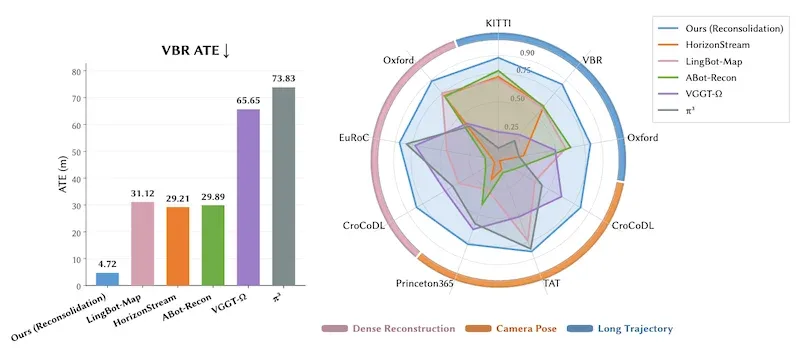
Robbyant, the embodied-AI unit inside Ant Group, open-sourced two robotics models on November 27: LingBot-Map 2.0, a streaming 3D reconstruction system, and LingBot-Navi, a navigation model built on top of it. Together they target one of the most stubborn problems in mobile robotics: keeping a robot's internal map of the world accurate as it moves far from where it started.
On a 5.2-kilometer urban test route, LingBot-Map 2.0 reduced average trajectory error from 31.12 meters in the prior version to 4.72 meters, an improvement of roughly 85%. The model achieves this through what Robbyant calls Geometric Context Reshaping, a correction method applied during inference that is loosely modeled on how human memory reconsolidates information, removing the need for external place-recognition modules or separate pose-graph optimization. It runs at 27.51 frames per second on an Nvidia RTX 5090 and posted 3.92-meter accuracy on the Oxford Spires benchmark and 9.42 meters on KITTI, according to coverage from AiThority.
Why Drift Has Been Robotics' Quiet Bottleneck
Most robots navigate well over short distances, but errors compound as they travel further, a problem known as drift that forces engineers to bolt on supplementary sensors, pre-built maps, or frequent recalibration stops. Robbyant's claimed 85% drift reduction, if it holds outside controlled benchmarks, would let mobile robots operate across larger facilities or outdoor routes without the usual accuracy decay. LingBot-Navi builds directly on that improvement, carrying spatial memory between missions so a robot gets faster and more reliable the more times it covers the same ground, and it can interpret natural-language route instructions rather than requiring pre-programmed waypoints.
There is a catch for companies hoping to build products on it. While LingBot-Navi and the original LingBot-Map 1.0 are released under the permissive Apache 2.0 license, the improved LingBot-Map 2.0 weights are restricted to non-commercial use, meaning a company shipping a commercial robot cannot deploy the upgraded mapping model without a separate licensing agreement with Robbyant.
Where This Sits Against Rivals
Robbyant's release lands in a crowded field of open robotics foundation models from Chinese labs and firms, including recent navigation and manipulation releases from groups like X Square Robot and SenseTime, all racing to set the default toolkit that smaller robot makers build on rather than developing in-house. Ant Group's backing gives Robbyant distribution advantages through its logistics and fintech ecosystem, but the non-commercial restriction on its best-performing model is a deliberate hedge: it lets Robbyant seed adoption broadly while keeping a commercial lever for the component that matters most. Navigation success rates reported on the GOAT-Bench simulation suite, at under 70%, also show there is real room left before these models match human-level wayfinding, suggesting this is an incremental rather than solved milestone in the broader push toward general-purpose robot perception.