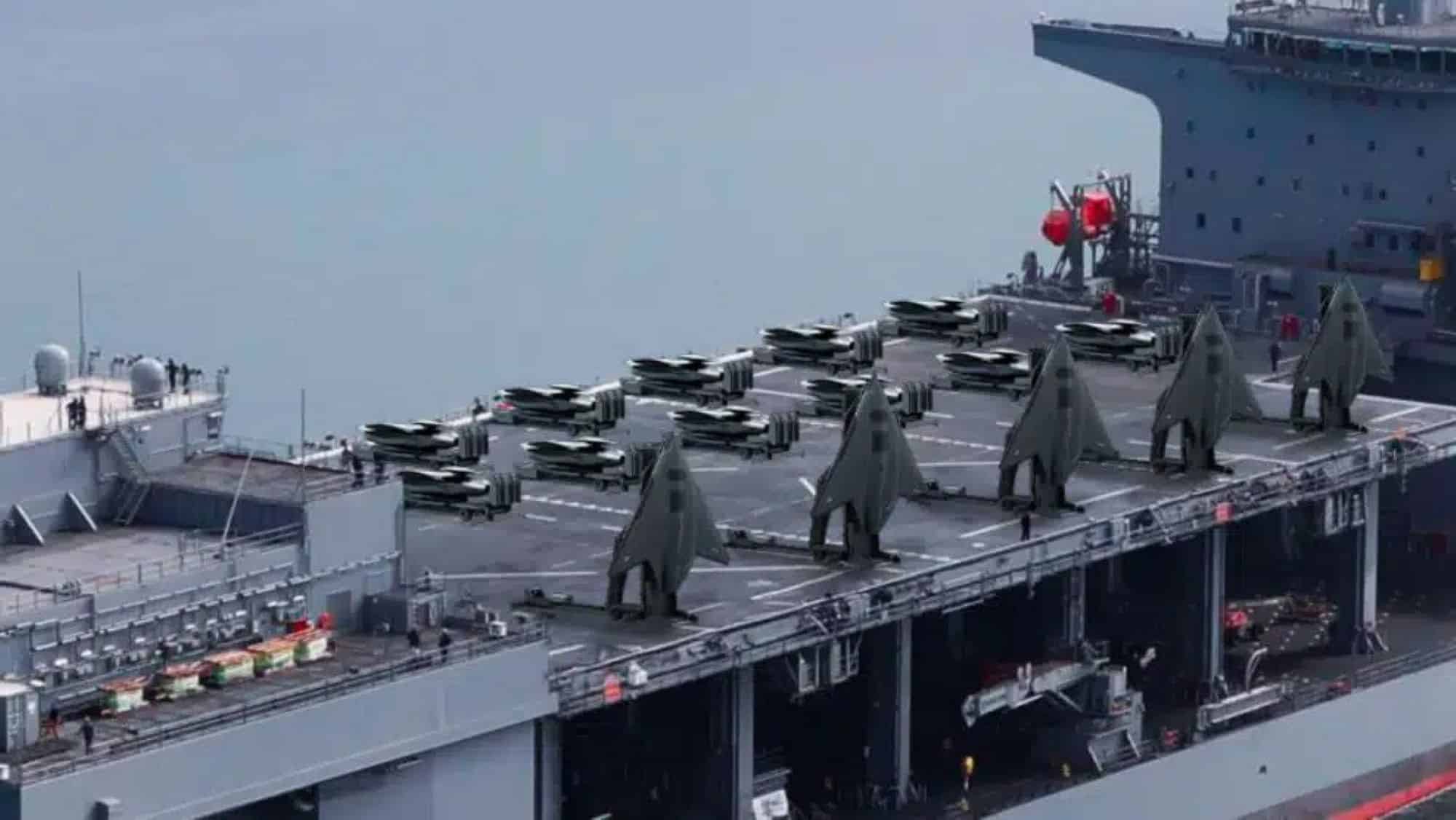
Shield AI's X-BAT Fighter Drone Hits $400 Million in Funding as Navy Adds $150 Million
Shield AI's X-BAT autonomous fighter-style drone has reached $400 million in total investment after a new $150 million Navy contract modification, with flight testing set for later in 2026.
Key Takeaways
Total investment in Shield AI's X-BAT program reached $400 million as of October 8, 2026, combining government contracts and private capital.
A new $150 million Navy contract modification was added on top of an earlier $50 million award and $150 million from Shield AI itself.
X-BAT is a VTOL aircraft powered by a General Electric F110-GE-129 engine with a thrust-vectoring exhaust nozzle, designed to launch and recover without a runway.
The drone runs on Shield AI's Hivemind autonomous flight software and is being built for the Navy's Collaborative Combat Aircraft Increment 2 program.
Around 500 engineers at Shield AI and its suppliers are working on the aircraft, with flight testing planned for later in 2026.
Kaan Tınmaz
Shield AI's X-BAT program has crossed $400 million in total investment as of October 8, 2026, after the U.S. Navy added a $150 million contract modification for the autonomous, carrier-capable drone, according to The Aviationist. The new funds come from the Office of the Under Secretary of War for Acquisition and Sustainment, on top of a $50 million award from the Navy's Portfolio Acquisition Executive Aviation Rapid Capability Cell in August and $150 million in private capital Shield AI committed itself.
X-BAT is a vertical-takeoff-and-landing (VTOL) aircraft designed to operate without a runway, aimed at the Navy's Collaborative Combat Aircraft program's Increment 2 phase.
The funding milestone underscores how fast U.S. military spending on autonomous, AI-piloted aircraft is accelerating. Unlike traditional fighter jets, X-BAT is designed to fly and fight without a human in the cockpit, using Shield AI's Hivemind software stack that the company has also deployed on smaller drones. Runway independence is the aircraft's other selling point: its Launch and Recovery Vehicle for Tethered Flight lets it operate from austere locations or ships without a conventional runway, a capability the Navy has prioritized as it plans for contested environments where airfields could be targeted.
Shield AI has already completed engine light-off and integrated the thrust-vectoring nozzle, and wind tunnel testing has validated the aircraft's weapons bay aerodynamics. Production and flight testing will run out of the company's X-Forge 2 facility in Newton, Kansas, with X-Forge 3 in Des Moines, Washington, set to become the first full production site. With flight testing now approaching, X-BAT is moving from a funding story to a performance one — the next real test will be whether the aircraft can fly, land, and operate autonomously as advertised.
How much funding has Shield AI's X-BAT program received?
The program has reached $400 million in total investment as of October 8, 2026, combining Navy contracts and Shield AI's own private capital.
What is Shield AI's X-BAT drone?
X-BAT is an autonomous, vertical-takeoff-and-landing fighter-style drone being developed for the U.S. Navy's Collaborative Combat Aircraft Increment 2 program.
Does X-BAT need a runway?
No, it uses a Launch and Recovery Vehicle for Tethered Flight that lets it take off and land without a conventional runway.
When will X-BAT fly for the first time?
Flight testing is scheduled for later in 2026, following completed engine light-off and thrust-vectoring nozzle integration.