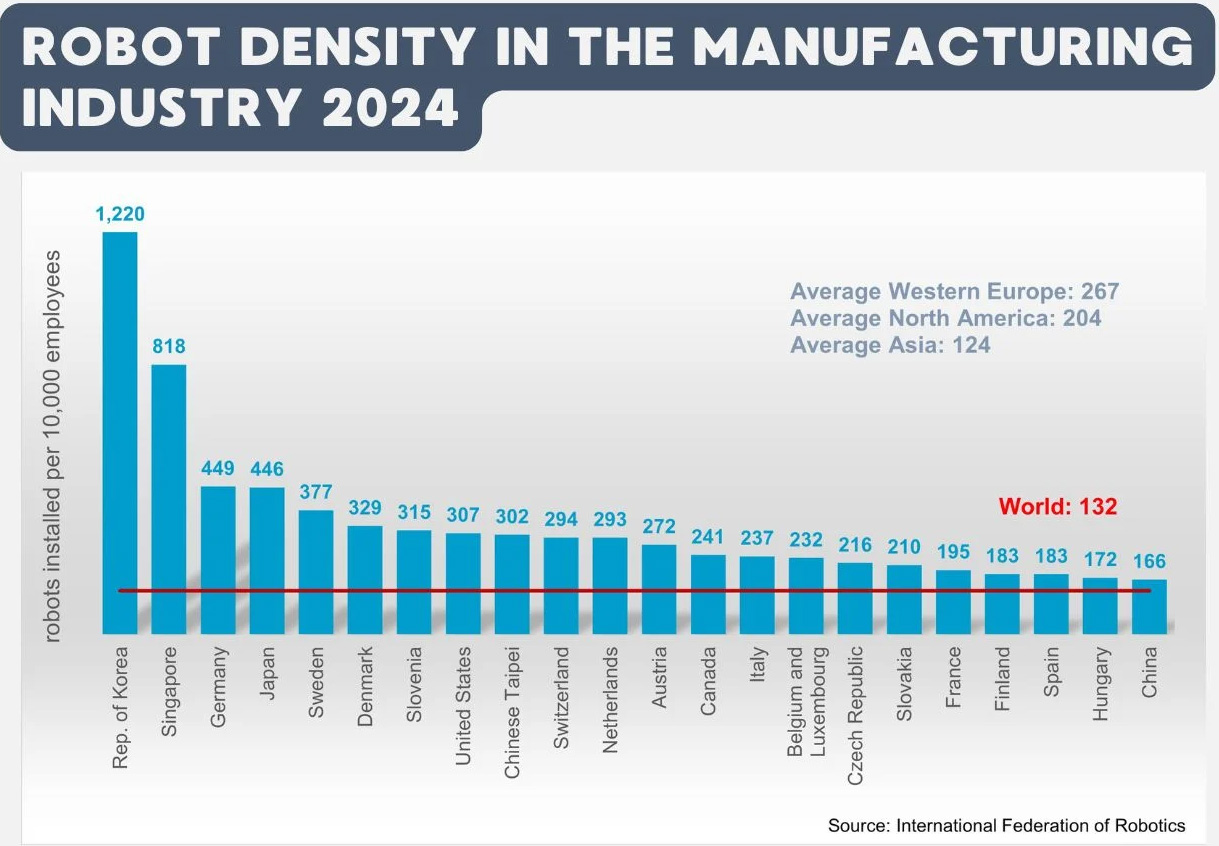
South Korea leads global manufacturing automation with 1,220 robots per 10,000 manufacturing employees, according to 2024 data from the International Federation of Robotics (IFR). This figure is nearly 10 times higher than the world average of 132 robots per 10,000 workers.
Singapore ranks second with 818 robots per 10,000 employees, while Germany leads European nations at 449 robots per 10,000 workers. The data reveals significant regional disparities in automation adoption.
Regional Automation Gaps Widen
Asian countries dominate the top rankings in robot density measurements. Western Europe averages 267 robots per 10,000 manufacturing workers, outpacing North America's 204 robots per 10,000 employees.
The massive gap between leading nations and the global average highlights varying automation strategies worldwide. Countries with higher robot density are positioning themselves for competitive advantages in global manufacturing supply chains.
Manufacturing Transformation Accelerates
The IFR data indicates that robot adoption focuses on augmenting human capabilities and improving workplace safety rather than simple workforce replacement. Nations investing heavily in robotics infrastructure are building long-term manufacturing competitiveness.
Countries lagging in robot density face potential challenges in maintaining relevance within increasingly automated global supply chains. The 2024 figures demonstrate that automation investment directly correlates with manufacturing sector advancement.