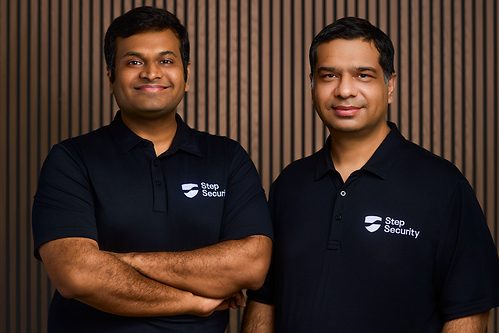
StepSecurity has raised $20 million in Series A funding led by Elephant, the company announced on November 18, 2026. Runtime Ventures, Inner Loop Capital and SaaS Ventures also participated. The round brings StepSecurity's total funding to $23 million, following a $3 million seed round; no valuation was disclosed.
The company, founded by security veterans Varun Sharma and Ashish Kurmi, builds tools that protect software supply chains from the point a developer — human or AI — writes code through the moment it ships into production.
What StepSecurity builds and its traction
StepSecurity's platform covers developer machines, code repositories, package registries and CI/CD pipelines. Its flagship free offering, Harden-Runner, locks down GitHub Actions workflows and is used by more than 20,000 open-source projects. Paid products include Secure Registry, which vets third-party packages before they enter a build, and tooling aimed specifically at AI coding agents, which the company argues introduce new attack surfaces because they can pull in and execute code with less human review than a developer typically applies.
The company says annual recurring revenue grew fivefold in each of the last two years and is on pace for similar growth in 2026. Enterprise customers named in the announcement include Circle, Dexcom, Kong, Mercari, Chainguard, XBOW and Utility Warehouse.
Investors and what the money is for
Elephant led the Series A; StepSecurity says it will use the capital to expand its product and engineering team, grow its security research group, and accelerate go-to-market efforts. As part of the announcement, the company is also launching a free community tier of Secure Registry, a move aimed at widening adoption among smaller development teams before converting them to paid plans — the same strategy that built Harden-Runner's open-source user base.
Where StepSecurity sits in a crowded field
Software supply chain security has drawn heavy investment since high-profile incidents involving compromised packages and CI/CD pipelines in recent years. StepSecurity differentiates itself by targeting the full pipeline — from a developer's laptop through the registry to the CI/CD runner — rather than a single checkpoint, and by extending that coverage to AI coding agents specifically, a category most legacy application security vendors have been slower to address. Its free-tier-to-paid-enterprise model mirrors the open-source-led growth strategies used by other infrastructure security startups that have scaled quickly on usage before monetizing.
What to watch next
StepSecurity has not disclosed a valuation for this round or specific revenue figures beyond growth multiples. With AI coding agents increasingly writing and merging code with minimal human review, the company's ability to prove it can catch malicious or vulnerable agent-generated commits at scale — and convert its large free user base into paying enterprise accounts — will determine whether this Series A is followed by a larger round within the next 12 to 18 months.