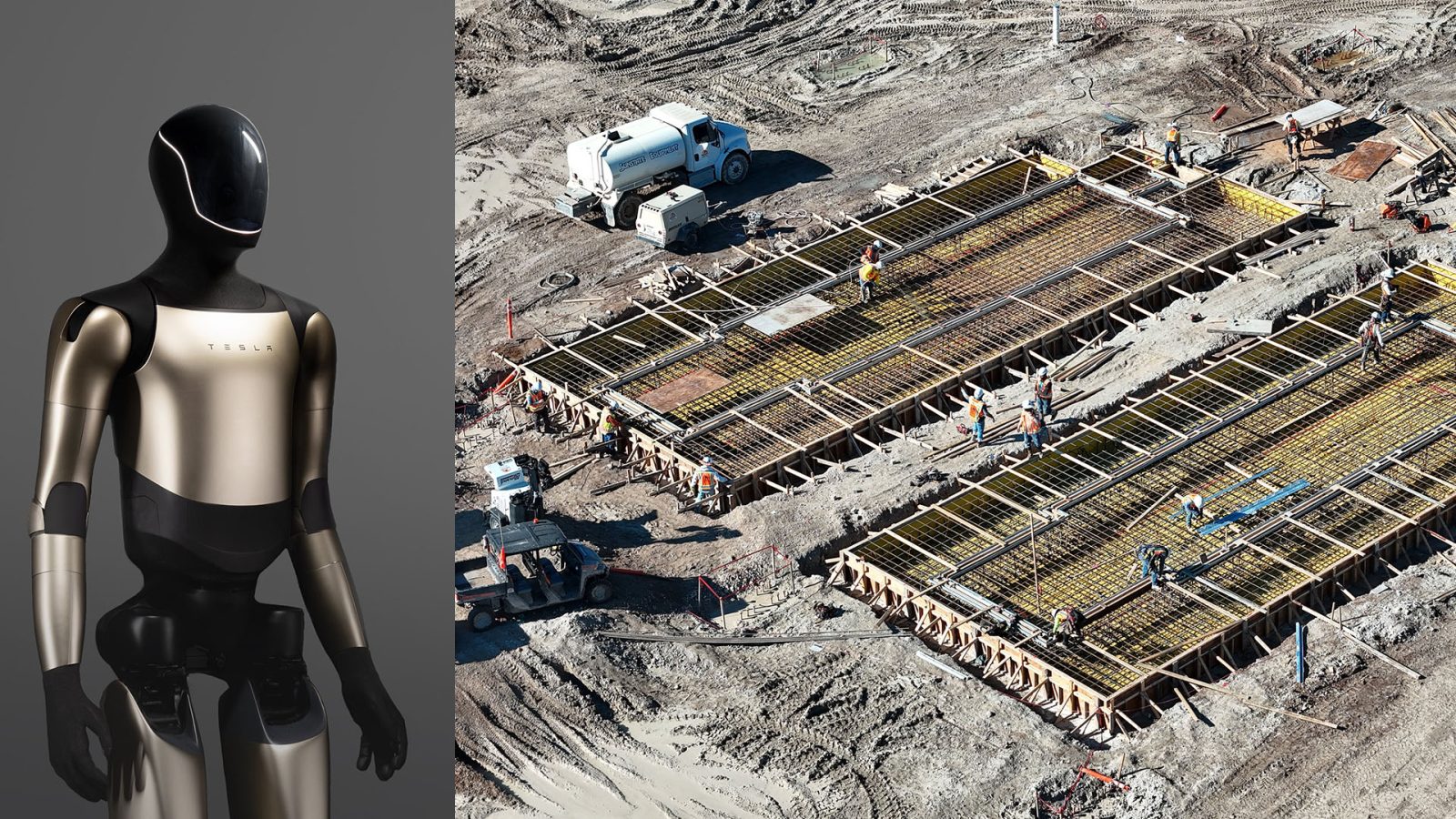
Tesla has begun pouring concrete for its second Optimus production line. Drone footage captured November 25 and reported by Tesla Oracle shows four reinforced foundations rising on the northeast side of Giga Texas in Austin, with rebar cages already set to anchor custom-designed IDRA Giga Press frame mounts before concrete is poured around them.
The presses are the same type IDRA previously built for Cybertruck body castings, shipped from Italy. This time they are being engineered specifically for Optimus humanoid parts, marking Tesla's second dedicated robot assembly site after Fremont, where the company tore down its original Model S and Model X line earlier this year to make room for robot production.
Why a Second Site Matters Now
Elon Musk told investors on Tesla's Q3 2026 earnings call that the Fremont facility already has "the vast majority" of a 1-million-unit-per-year Optimus line installed. Breaking ground on a second site in Texas before Fremont has even finished ramping signals that Tesla expects to need parallel capacity rather than sequential expansion.
That urgency reflects a tighter timeline than Tesla has publicly admitted to in the past. Musk has previously said he expects the hardest problems — AI control, electromechanical design and actuator usage life — to be "solved by the end of next year," meaning Tesla is building factory floor space for a robot whose core engineering is still being finalized. Pouring foundations now, rather than after validation, is a bet that demand and design will converge on schedule.
How This Stacks Up Against Rivals
No other humanoid robot maker has committed to two purpose-built, car-factory-scale production sites simultaneously. Figure AI's BotQ facility in California has reached roughly one robot per hour through a single line. Agility Robotics' RoboFab in Oregon targets 10,000 units annually, an order of magnitude below what Tesla has stated for just one of its two planned Texas and California plants.
The gap is partly explained by differing strategies. Figure and Agility are selling robots into warehouses and auto plants today, with revenue tied to existing deployments. Tesla is pre-building capacity for a product it has not yet finished engineering, leaning on its experience converting car-manufacturing infrastructure — Giga Presses, stamping lines, paint shops — into robot-building tooling.
The risk is capital intensity without matching output. Tesla has already repurposed one car assembly line and is now erecting new foundations for a second, while Optimus has yet to ship at meaningful commercial volume. If reliability and actuator life issues slip past Musk's stated 2027 target, Tesla will be sitting on two factories calibrated for a scale the robot cannot yet support.
For now, the Giga Texas foundations are a tangible marker that Tesla is treating Optimus as a manufacturing problem on the same scale as its vehicle business — building the floor space first and racing the engineering to catch up.