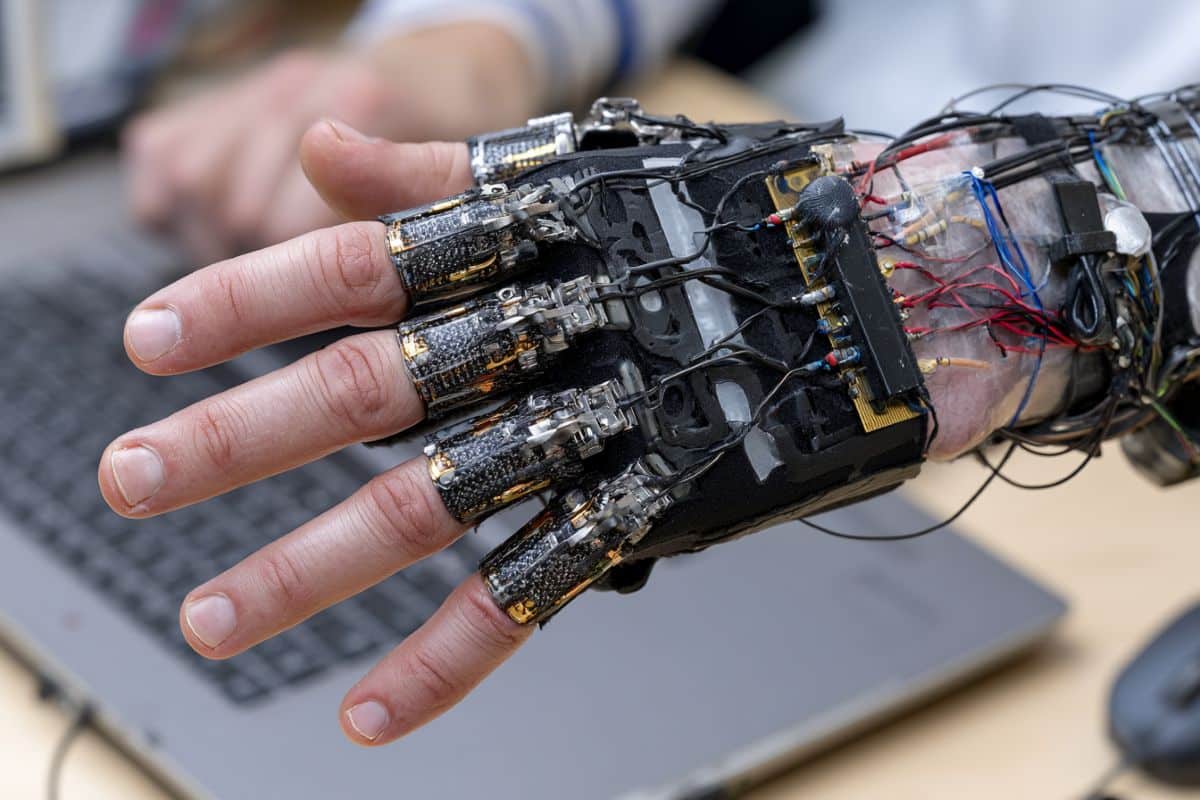
Engineers at the Technical University of Munich (TUM) have built a fabric-and-air-cushion glove that restored intentional grasping to a patient with amyotrophic lateral sclerosis and to six stroke survivors, using machine-learning models that decode faint muscle signals from the forearm with 97% sensitivity. The work was published this month in Nature Machine Intelligence.
13 tubes and a fabric glove
The soft-hand exoskeleton is not the metal-and-motor rig people picture when they hear the word. It is a hand-sewn textile glove studded with air cushions and threaded with 13 tiny tubes that inflate individual chambers to bend the fingers, rotate the wrist and provide an active opposable thumb. Dr. John Nassour of TUM's Chair of Cognitive Systems built the prototype from off-the-shelf fabric with the explicit design goal that "anyone can afford" the device.
The intelligence sits upstream. Surface EMG electrodes on the forearm capture the residual electrical activity of the flexor pollicis longus and neighbouring muscles. A machine-learning grasp predictor, combined with motion data and an error-correction layer, translates those noisy signals into commands to inflate specific air chambers. In tests on healthy controls, the predictor logged 97% sensitivity for intended grasps.

The ALS test that anchored the project
The system was co-developed with an ALS patient who had retained only slight motion in his first thumb joint. Wearing the glove, he picked up a fork for the first time in four years, moved small cubes on the Box-and-Blocks Test and fed himself — outcomes his TUM collaborators described as "co-created" rather than lab-imposed. A short training session using a thumb-controlled video game measurably improved his operational control within five minutes.
In a follow-on trial with six stroke survivors, the researchers reported that patients with the most severe hand impairment benefited most: severely impaired subjects scored 17 points higher on the Action Research Arm Test with the exoskeleton, while moderately impaired patients showed mixed results.
What's next
Professor Gordon Cheng, who directs TUM's Institute for Cognitive Systems, said the team is adapting the glove for stroke survivors, patients with peripheral nerve damage and people living with polyneuropathy. Clinical partner Klinik Passauer Wolf will help extend the concept toward flaccid paralysis in general. The eXprt (Exoskeleton and Wearables Enhanced Prevention and Treatment) initiative is funding the multidisciplinary team through 2029.
The result lands in a fast-moving assistive-robotics segment where medtech investors are hunting for scalable rehab platforms and where health-AI accelerators are actively seeking clinical translation stories. TUM's take — inexpensive fabric plus smart EMG decoding — is a very different bet from stiff exoskeleton frames priced in the six figures.
Reporting based on coverage from TUM, Neuroscience News, Medical Xpress and Nature Machine Intelligence.