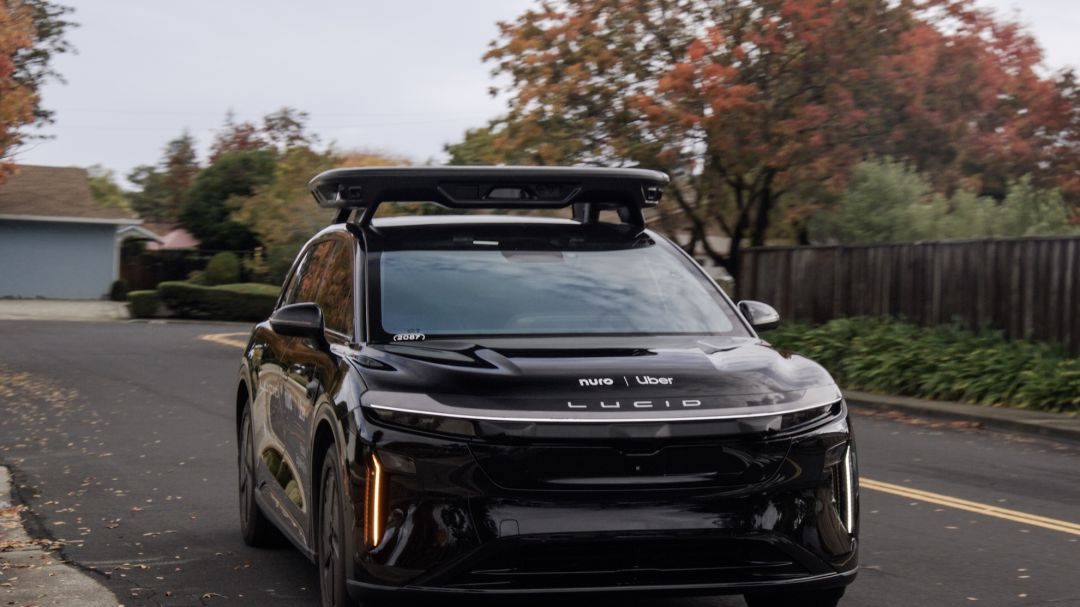
Uber, Nuro and Lucid began testing fully driverless robotaxis on public roads across four South Bay cities on November 24, pulling the human safety operators who had been required in the vehicles for nearly a year. The companies say Uber employees will get driverless rides first, with a commercial launch targeted for the first quarter of 2027.
The vehicle is the Lucid Gravity, an electric SUV unveiled in January 2026 and outfitted with high-resolution cameras, solid-state lidar and radar running Nuro's self-driving software. Nuro operated the Gravity with a human safety driver on Bay Area roads after the California DMV granted it a driverless testing permit in May 2026. The fleet now numbers more than 100 vehicles, with production ramping at Lucid's factory in Casa Grande, Arizona. Nuro runs a separate, still-supervised testing program for the same vehicle in Houston.
Nuro has pursued autonomy licensing since 2022, when it shut down its original delivery-robot consumer business to focus on selling its driving stack to automakers rather than building its own fleet. The Lucid partnership is its first branded robotaxi product, following years of smaller pilots involving food-delivery pods and a standalone robotaxi trial in Phoenix that it later wound down.
A Bigger Bet Than Uber's Usual Playbook
Uber has put real money behind this partnership rather than just an app integration. The company has invested roughly $500 million in Lucid and close to $500 million in Nuro, and it has agreed to buy at least 20,000 Lucid Gravity SUVs over six years. That scale of hardware commitment is unusual for a company that has mostly pursued an asset-light strategy, plugging its app into other companies' autonomous fleets rather than owning any part of the vehicle supply chain. Lucid, majority owned by Saudi Arabia's Public Investment Fund, gets a guaranteed buyer for tens of thousands of vehicles at a moment when its consumer EV sales have lagged forecasts.
The technical approach also sets this partnership apart from rivals. Waymo and Zoox design and integrate their vehicles end to end, building both the sensor suite and the driving software in-house. Tesla retrofits its own production cars with its Full Self-Driving stack. Nuro instead licenses its autonomy software to outside manufacturers, making Lucid the hardware partner rather than the technology owner.
A Crowded Field on a Compressed Timeline
The Bay Area is already the most contested robotaxi market in the country. Waymo runs paid driverless rides across San Francisco and several other California cities. Zoox, Amazon's robotaxi unit, has launched service in Las Vegas, Austin and, most recently, Santa Monica. Tesla's Cybercab has pushed into Texas, where its driverless fleet has topped 1,500 vehicles. Overseas, WeRide and Pony.ai are expanding through partnerships in markets including Kazakhstan.
Uber's strategy has been to aggregate multiple autonomous vehicle partners onto its own app rather than back a single technology stack, letting it capture ride demand no matter which hardware or software ultimately wins out. The Nuro-Lucid launch adds another distinct robotaxi platform to that roster, giving Bay Area riders a wider menu of driverless options once paid service begins.
How quickly that happens depends on regulators as much as engineering. California's DMV has shown it will intervene fast when it judges a driverless system unsafe, having recently pulled Waymo's robotaxis off state freeways over a separate safety order. Uber, Nuro and Lucid now have roughly a quarter to prove their system can operate incident-free with employees in the back seat before the public gets a turn.