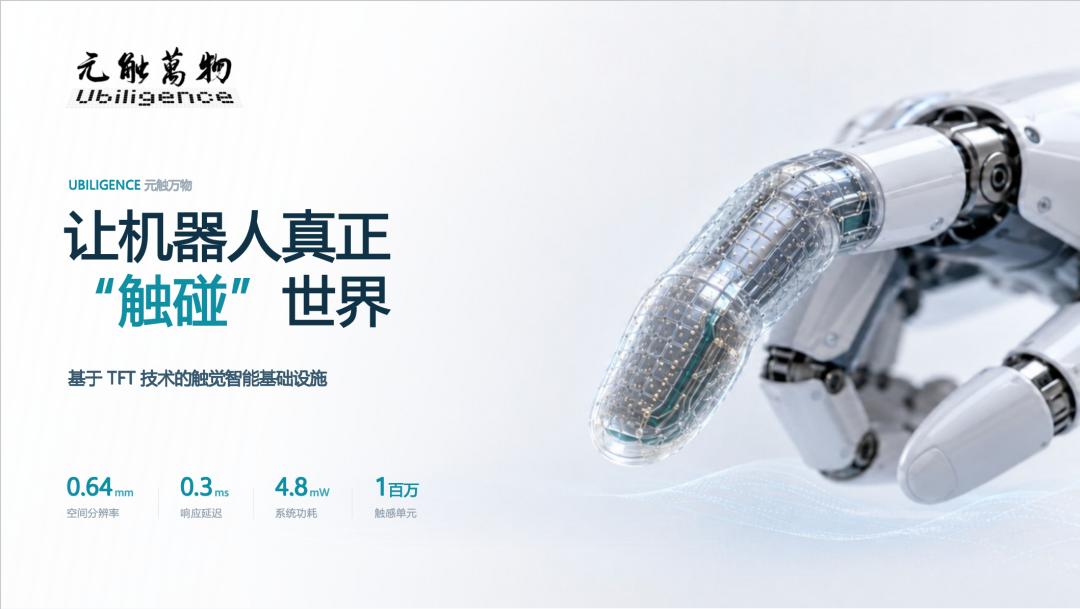
A robotic hand can grip an egg without crushing it only if it knows, in real time, exactly how much force its fingertips are applying — a sensing problem that has lagged behind the mechanical progress of humanoid hands themselves. Beijing-based Ubiligence (元触万物) says it has narrowed that gap with a flexible electronic skin that processes touch data on the sensor itself rather than shipping raw signals to a remote computer. The company disclosed a seed round worth tens of millions of yuan, led by 01 Ventures, in a report republished by NetEase (163.com) on November 23, 2026.
Electronic Skin With Computing Built In
Ubiligence builds what it calls a 'sensing-storage-computing integrated' flexible chip, using thin-film transistor architecture to give its electronic skin onboard data processing rather than relying entirely on a robot's central computer to interpret raw pressure readings. The company says its sensor sheet packs more than 10,000 sensing units at 0.91-millimeter spatial resolution, can detect force changes as small as 1 millinewton, and responds within 0.3 milliseconds — specifications aimed at the precision grasping tasks that dexterous robot hands struggle with today.
The company was founded in May 2026, spinning technology out of a Tsinghua University electronic engineering lab led by associate professor Jiang Chen. Ubiligence recruited Arokia Nathan, a foreign academician of the Chinese Academy of Sciences who also holds fellowships at the UK's Royal Academy of Engineering, the Canadian Academy of Engineering and the US National Academy of Inventors, as chief technical advisor — a credential-heavy hire for a company barely six months old.
Investors in the seed round included 01 Ventures, Infinite Fund (SEE Fund), Xinglian Capital and Dongshan Industrial Investment, alongside two strategic names that double as potential customers: humanoid robot makers Zhipingfang and Songyan Power. Ubiligence says it has already completed prototype validation and shipped sample units to 'leading roboticists,' though it has not named which companies beyond its investor list.
Why Touch Is Becoming a Bottleneck
01 Ventures framed the investment around a shift in the humanoid robot industry: as dexterous hands move from research demos toward volume production, tactile perception is turning from an optional add-on into the component that caps how precisely a robot can manipulate objects. That view echoes recent rounds for other Chinese tactile-sensor suppliers, including ViTai Robotics, which has raised hundreds of millions of yuan to scale sensors beyond its existing work supplying humanoid hand assemblies.
Ubiligence's bet is that integrating computation directly into the skin, rather than treating tactile sensing as a dumb sensor feeding a separate processor, will cut the latency and wiring complexity that has made full-hand tactile coverage expensive to deploy. Whether that architecture holds up outside controlled prototype testing depends on how its components perform once Zhipingfang, Songyan Power or other humanoid makers integrate them into production hands rather than lab samples.
The company has not disclosed the exact amount raised, a valuation, or a timeline for commercial shipment beyond the initial samples already sent to partners. With humanoid hand suppliers from OYMotion to ViTai Robotics racing to lock in design wins with robot makers before standards solidify, Ubiligence's next funding milestone is likely to hinge on how many of those sample shipments convert into production orders.