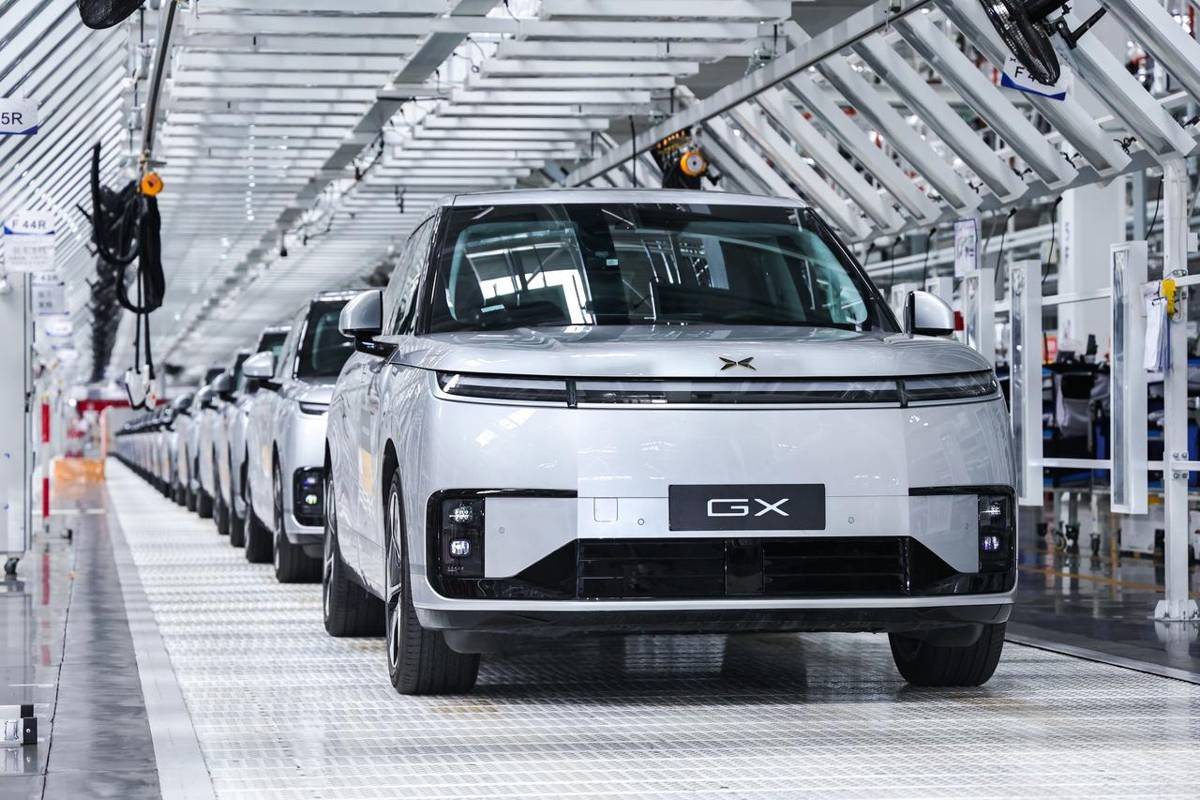
XPENG has rolled out its first mass-produced Robotaxi from its production facility in Guangzhou, China, in what the company describes as the first time a Chinese automaker has mass-produced a Robotaxi developed entirely through full-stack, in-house engineering — from the vehicle platform and AI chips to the autonomous-driving software and final integration.
The launch lands as the autonomous-mobility industry shifts from years of limited pilots toward commercial reality, and it sharpens a global contest that is increasingly about who can industrialize self-driving transport at scale rather than who can stage the most impressive demo.
A production vehicle, not a retrofit
Unlike the bespoke test fleets that often require heavy retrofitting, XPENG's Robotaxi is built on the company's GX platform and engineered from the outset to Level 4 autonomy standards, meaning it is designed to operate without human intervention within defined operating conditions. Building the vehicle through conventional automotive production lines, XPENG argues, can sharply cut costs versus retrofitted prototypes while improving reliability and serviceability — factors that could decide which operators reach a profitable business model. The rollout adds to a wave of commercialization that includes the recent ECARX and May Mobility $750M robotaxi fleet deal.
Four in-house chips, 3,000 TOPS
At the heart of the system are four proprietary Turing AI chips that together deliver an effective 3,000 trillion operations per second (TOPS). XPENG says owning the silicon allows tighter hardware-software integration and lower latency while reducing reliance on external suppliers amid intensifying competition over advanced semiconductors. Computing headroom matters because a modern self-driving stack must simultaneously process visual streams, predict traffic behavior, identify hazards, plan routes and execute decisions in real time.
A LiDAR-free, vision-only bet
Perhaps the most striking design choice is what XPENG leaves out. Where many rivals lean on LiDAR sensors and high-definition maps, XPENG's Robotaxi runs a pure-vision architecture without either, with decisions driven by its VLA 2.0 end-to-end AI model. The company says the approach removes intermediate processing stages found in traditional Vision-Language-Action systems, cutting response latency to under 80 milliseconds while improving adaptability across different urban environments. It is a wager that camera-based perception plus advanced AI can match human-level driving at lower hardware cost — a stance other developers still dispute on safety-redundancy grounds.
Scaling toward commercial service
XPENG plans to begin pilot commercial operations in the second half of 2026, with fully driverless operation targeted for 2027. The timing is notable given recent operational caution elsewhere: in the United States, Waymo halted freeway robotaxi rides in four cities and separately paused service over flooding, underscoring how hard the last mile of deployment remains. Analysts increasingly view industrial scalability and sustainable unit economics — not one-off technical feats — as the defining challenge of the next phase of autonomous mobility.
Reporting based on coverage from XPENG and Highways Today.