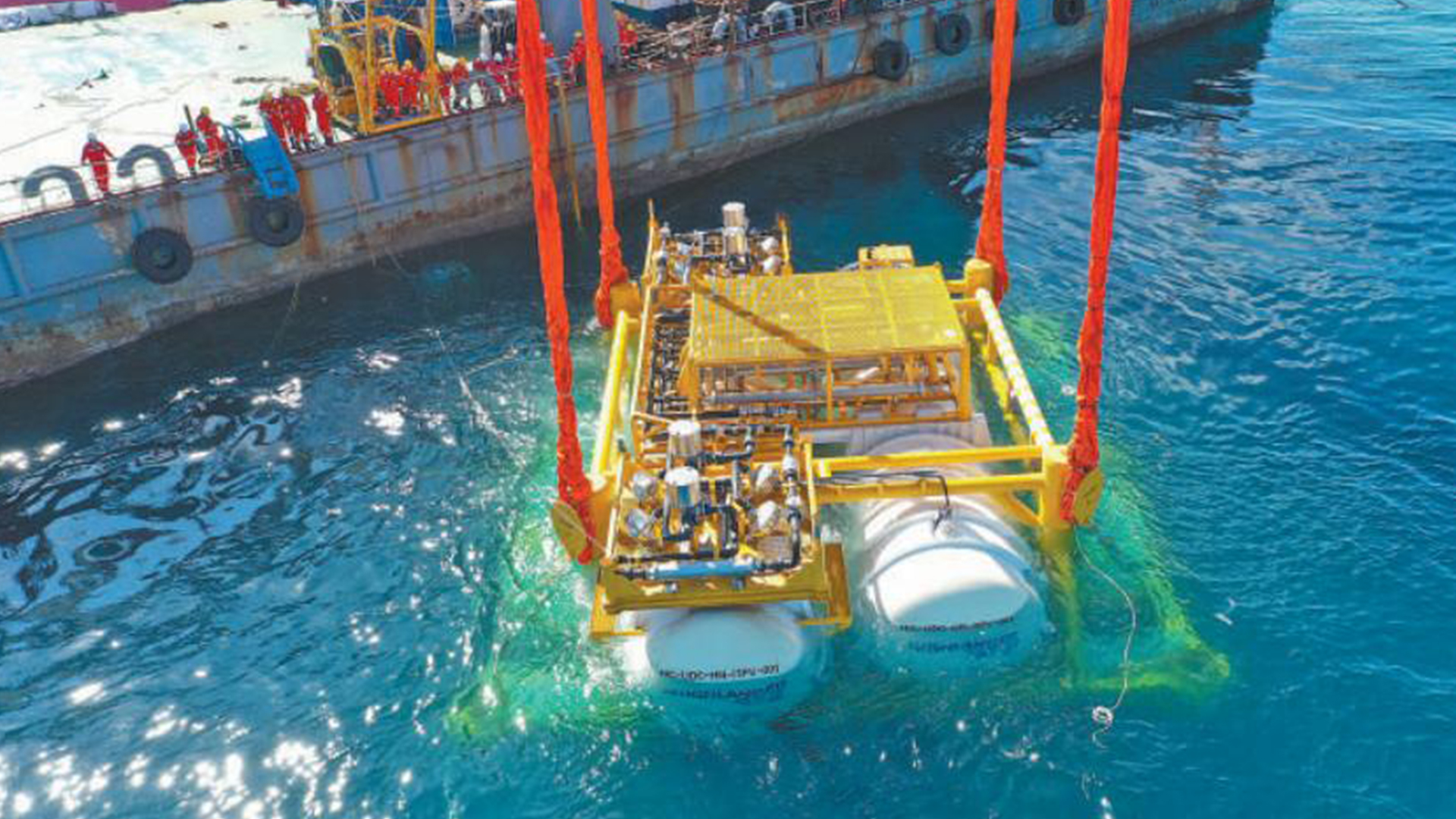
China has switched on what it calls the world's first offshore wind-powered underwater data center, a 24-megawatt facility off the coast of Shanghai's Lingang Special Area that runs artificial intelligence workloads on servers cooled by the surrounding seawater. After initial trials earlier this year, the roughly US$226 million project has now entered full commercial operation.
Computing on the seabed
Pressure-resistant modules housing nearly 2,000 servers sit about 35 meters below the surface, positioned between the first and second phases of Lingang's offshore wind farm. That placement lets the facility draw more than 95% of its electricity directly from over 200 nearby wind turbines. The project was developed in two stages, beginning with a 2.3-megawatt demonstration unit before scaling up to its full 24-megawatt capacity.
GPU clusters from China Telecom and local provider LinkWise have been installed inside the submerged modules to support AI training and inference, big-data annotation, 5G infrastructure and the development of domestic large language models. The build-out reflects the same surge in compute demand driving a global data center construction boom.
Seawater as a free cooling system
Instead of the industrial chillers and HVAC systems that dominate land-based facilities, the Shanghai site uses the ocean as a passive heat sink. Backplane air conditioners pull hot air from the servers and shift refrigerant from liquid to gas; the gas rises to an upper module where seawater carries the heat away, condensing it back to liquid that gravity returns to the server room without additional power.
Chinese media reports put the facility's power usage effectiveness at around 1.15, well below the 1.5 or higher typical of conventional enterprise data centers. Developers say the underwater design cuts electricity consumption by about 22.8%, eliminates freshwater use entirely and reduces land requirements by more than 90% — efficiency claims that matter as AI's appetite for power and cooling keeps climbing alongside the rise of wind and solar in global generation.
Building on past experiments
The Lingang project was launched in June 2025 under a cooperation agreement between the Lingang administrative committee, the Shanghai Lingang Special Area Investment Holding Group and HiCloud Technology, with construction finishing in October 2025. HiCloud also signed operating agreements with partners including Shenergy Group, Shanghai Telecom and CCCC Third Harbor Engineering.
Underwater computing still faces real engineering challenges, from saltwater corrosion and long-term pressure sealing to the difficulty of replacing failed hardware. The Chinese deployment follows Microsoft's earlier Project Natick trials off California in 2015 and Scotland's Orkney Islands in 2018, which were discontinued by 2024 but showed lower hardware failure rates underwater. As operators search for cleaner ways to power AI, ocean-cooled and renewably powered sites are increasingly part of the conversation, much like the hunt for new nuclear power sources for data centers.
Reporting based on coverage from Interesting Engineering, Tom's Hardware, Data Center Dynamics and People's Daily.