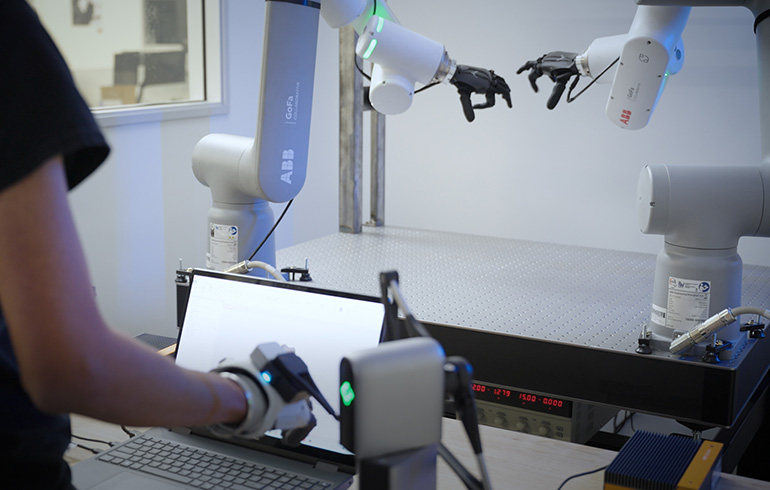
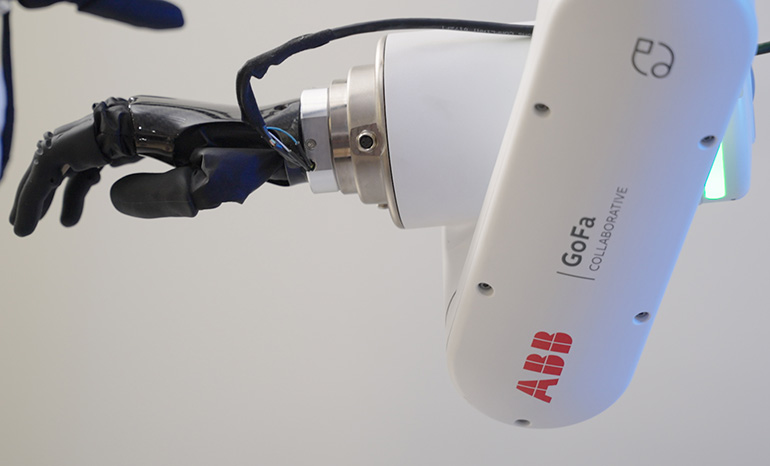
ABB Robotics and San Diego-based bionics company PSYONIC have launched a collaboration that aims to close one of automation's hardest gaps: human-grade dexterity. Announced on June 16, 2026, the partnership pairs ABB's force-limited GoFa collaborative robot with PSYONIC's multi-touch Ability Hand, using real-world data from prosthetic users to teach robots how to grasp delicate, deformable and irregular objects.
From prosthetic limbs to physical AI
PSYONIC originally built the Ability Hand as an FDA-registered, Medicare-covered prosthesis, and it is now worn by hundreds of patients. Its pressure sensors and vibration feedback let users feel contact, grip force and release, while compliant fingers bend rather than break. "A lot of the problems that we solved on the prosthetics side — robustness, consistency, tactile feedback for high-mix, low-volume handling — are the same for industrial users," said founder and CEO Dr. Adeel Akhtar. Over the past year, he noted, demand has flipped from prosthetics toward robotics as physical AI has exploded.
Why touch beats teleoperation
Most robot training today relies on teleoperation gloves, VR rigs or video analysis, which capture position but not force. By placing the same Ability Hand on both people and robots, PSYONIC can record how much pressure a human applies to a coffee mug or a raspberry, then sync that tactile signal with multimodal data such as Meta Ray-Ban camera feeds. The result is richer training data that, PSYONIC says, lets vision-language-action and world models learn with up to 20x less data. The work uses NVIDIA's Isaac Lab and GR00T tooling, echoing the broader physical-AI race seen in deals like Teradyne's production-ready physical AI push.
Targeting three industries first
The partners say improved grasping and digital integration could cut engineering time by up to 30%, citing the International Federation of Robotics. Over the next six to 12 months they are chasing 99%-plus reliability on pick-and-place tasks in automotive and warehousing, plus laboratory automation in life sciences, where handling beakers and test tubes is a large untapped market. Aerospace, packaging and logistics are next. The move underscores how heavily capital and talent are flowing into U.S. robotics, a theme also visible in Standard Bots' 00M raise to scale American-made robots.
ABB Group sold ABB Robotics to SoftBank for .3 billion in October 2025, and the unit is building its "Autonomous Versatile Robotics" strategy around exactly this kind of physical-AI manipulation. Both companies will demonstrate the work at Automate in Chicago next week. PSYONIC is also developing a next-generation hand designed to work across cobots, wheeled and legged robots, and humanoids.
Reporting based on coverage from The Robot Report and ABB Robotics.