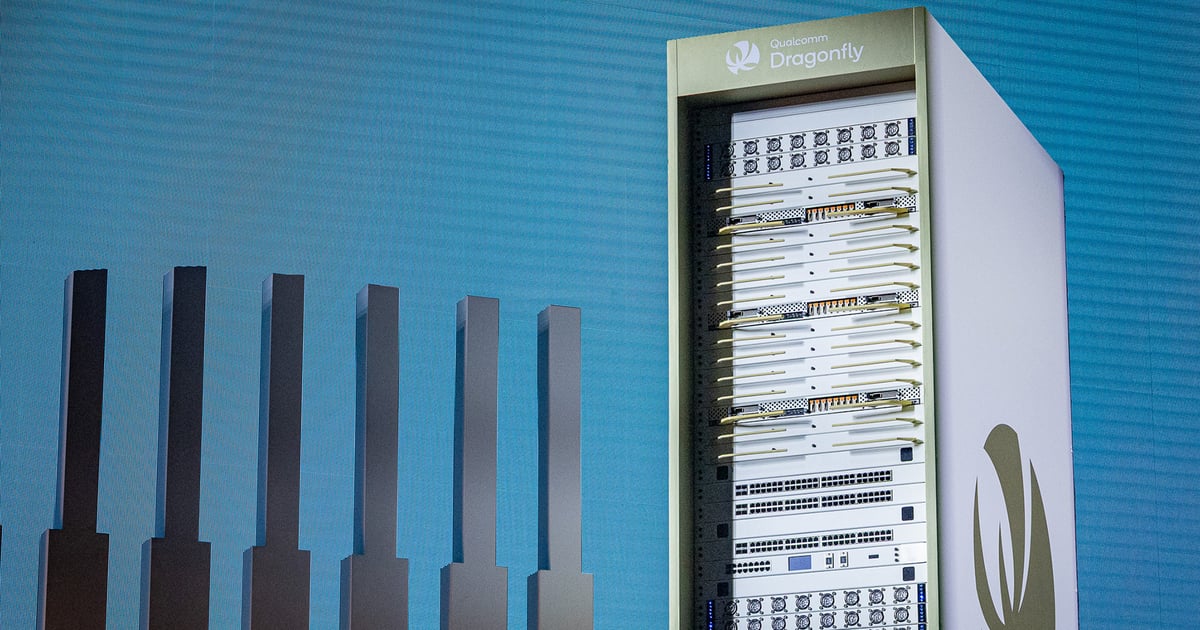
Qualcomm has signed Meta as the first announced customer for its new Dragonfly C1000 data center CPU, a strategic multi-generation supply agreement that marks the chipmaker's most significant move yet beyond smartphones and into the AI data center. The deal was disclosed alongside Qualcomm's June 2026 investor meeting and sends a clear signal that the company intends to compete directly for hyperscale compute budgets.
A custom CPU built for agentic AI
The Dragonfly C1000 is a central processing unit engineered specifically for agentic AI workloads, the increasingly autonomous software agents that plan, call tools and act with limited human oversight. Qualcomm is positioning the chip around performance-per-watt, arguing that data center operators now care as much about power efficiency as raw throughput as electricity becomes the binding constraint on AI expansion. Qualcomm has set a target of roughly $15 billion in data center sales by fiscal 2029, and the Meta agreement is the anchor tenant that makes that ambition credible.
Why Meta matters
Meta will deploy the Dragonfly C1000 when it enters production, with Qualcomm guiding to availability in the second half of 2028 and across future capacity expansions. For Meta, which is spending tens of billions of dollars annually on AI infrastructure, a second credible CPU supplier improves bargaining leverage and reduces single-vendor risk. For Qualcomm, a logo of Meta's scale validates a roadmap that until recently existed mostly as a brand: the company first unveiled the Dragonfly data center line at Computex 2026 before attaching a flagship product and a marquee customer to it.

Stacking the data center playbook
The CPU agreement does not stand alone. Qualcomm recently moved to acquire Modular for $3.9 billion, gaining a software layer the company likens to an open alternative to NVIDIA's CUDA, and it has been in talks around RISC-V assets to broaden its compute portfolio. Together the moves describe a full-stack strategy: silicon, software and now a hyperscale customer. The push lands in a market where custom inference silicon is proliferating fast, from OpenAI and Broadcom's Jalapeño chip to a wave of in-house accelerators at every major cloud.
The competitive stakes
By targeting CPUs rather than GPUs, Qualcomm is attacking a layer of the data center where Arm-based designs have been gaining share against incumbents on efficiency grounds. Success would give the company a durable, high-margin foothold in AI infrastructure to complement its handset business. The risk is execution against a 2028 timeline in a field moving in quarters, but locking in a customer of Meta's size years ahead of production is exactly the kind of commitment Qualcomm needed to be taken seriously in the data center.
Reporting based on coverage from CNBC, Bloomberg, Data Center Knowledge and HPCwire.