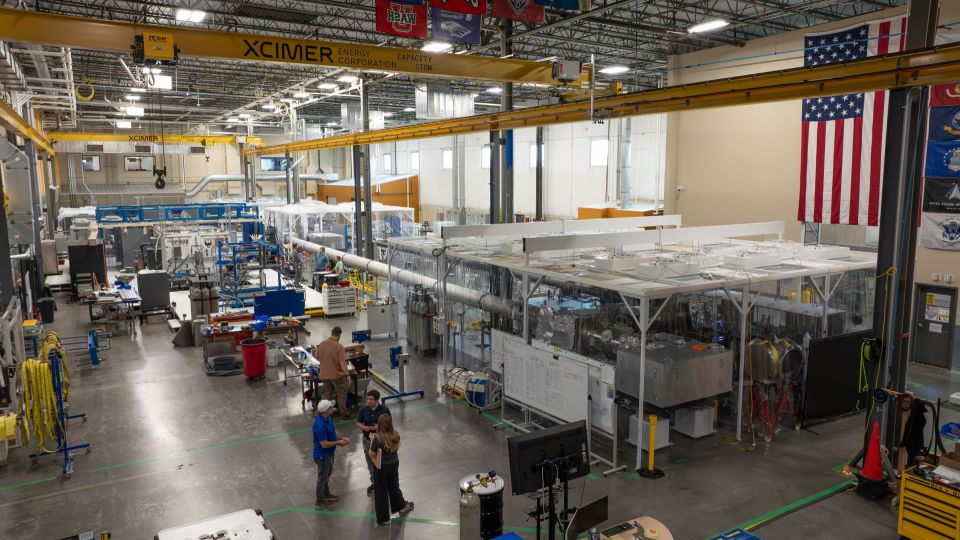
The U.S. Department of Energy has approved Xcimer Energy's preconceptual technical design and technology roadmap for Athena, the Denver-based company's commercial laser inertial confinement fusion (ICF) power plant — a key milestone in the DOE's Milestone-Based Fusion Development Program.
A different bet on laser fusion
Xcimer's architecture is meant to address the cost problem that has dogged inertial confinement fusion since Lawrence Livermore's National Ignition Facility (NIF) hit net energy gain in 2022. Rather than use NIF's 192 solid-state glass laser beamlines, Xcimer is building an electron-beam-pumped krypton-fluoride (KrF) excimer laser with just two beamlines, paired with a stimulated brillouin scattering (SBS) gas optic that compresses microsecond pulses down to the nanosecond range needed for fusion ignition.
'NIF proved laser fusion physics works,' said co-founder and president Alexander Valys. 'Our thesis is that commercial laser fusion becomes possible only if the laser system itself becomes dramatically simpler, cheaper and more manufacturable.' Xcimer is targeting laser costs under $100 per joule and a chamber that needs no first-wall replacement.

From Phoenix to Athena
The company will execute its roadmap on four machines. Phoenix, already operating in Denver, is the largest privately owned laser system in the world and is demonstrating end-to-end excimer amplification with SBS pulse compression at over 1 kJ pulse energies. Anvil, slated for 2028, will combine commercial-scale Argos laser modules to deliver 200 kJ on target. Vulcan, planned for the early 2030s, will combine 40 Argos modules to produce 4 megajoules of laser light to demonstrate wall-plug breakeven — upgradeable to 12 MJ. Athena, the ultimate commercial system, would be a 400 MW fusion power plant running continuously at up to 1 Hz, with a molten-salt liquid wall that absorbs flux, breeds fuel and carries heat.
Where fusion sits in mid-2026
Xcimer's announcement lands in a particularly active week for fusion policy and capital. The DOE released its finalised national fusion strategy on June 9 targeting commercial energy by the mid-2030s. Tennessee became the first U.S. state to put its own fusion regulatory framework into effect on the same day. And in the private market, Helion Energy raised a $465M Series G at a $15.5B valuation to underpin its Microsoft power deal, while General Fusion is preparing six June investor conferences around its Spring Valley SPAC vote. Advanced fission has also captured fresh attention with TerraPower deploying an NVIDIA Omniverse digital twin for its Natrium reactor.
Reporting based on coverage from Nuclear Newswire (ANS) and Xcimer Energy.