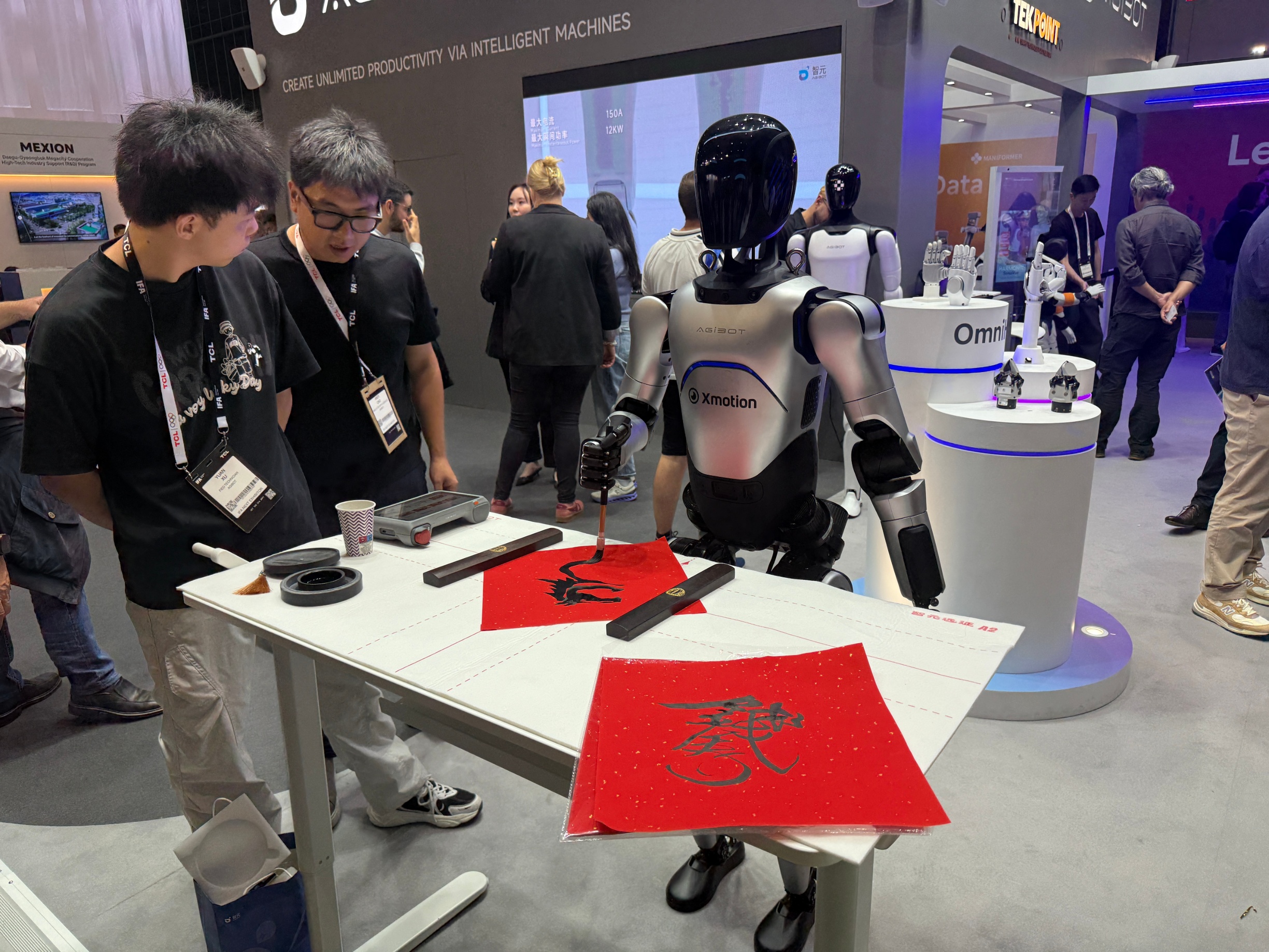
AgiBot brought its A3 humanoid to IFA Berlin 2026 with a demonstration that stopped the show floor: real-time Chinese calligraphy, executed with the kind of force sensitivity that has, until now, belonged to human wrists. The robot stood over a sheet of paper at Stand H25-371 in the IFA Next innovation zone on September 4, laying down brush strokes with modulated pressure, angle and speed — the three simultaneous variables that make Chinese calligraphy one of the most demanding contact-sensing tasks in robotics.
Why Calligraphy Is Hard For A Robot
Every stroke requires the hand to control downward brush force (which sets line width), lateral angle (which shapes ink flow) and movement speed (which controls ink density from start to finish). Standard industrial hands use gearboxes to multiply torque, but the gearbox interposes a mechanical translation between the finger and the motor and blocks the bidirectional force signal that delicate manipulation needs. AgiBot's answer is a fully direct-drive hand — no gearboxes, no tendon transmission — that lets the motor feel the brush drag on the paper.
Inside The OmniHand 3 Ultra-M
The dexterous hand system behind the performance carries 20 active degrees of freedom, weighs about 630 grams and delivers plus or minus 0.2 mm positional repeatability. Visuotactile sensors sit at all five fingertips, converting fingertip skin deformation into contact location and force magnitude in a single data channel. The A3 platform itself is a 173 cm, 55 kg humanoid with a claimed industry-first full-body touch sensing layer, a 360-degree microphone array, and up to 12 kW of instant peak power that enables somersaults. The touch layer extends real-time tactile awareness beyond the hands, which matters both for packed IFA aisles and for the crowded factories the robot is designed to enter.

Market Position And European Debut
AgiBot, founded in Shanghai in February 2023 by two former Huawei engineers, hit 15,000 lifetime robots in June 2026 and, according to Smart Analytics Global, shipped about 8,400 humanoids in the first half of the year — roughly 44 percent of global volume. IFA follows the company's UK Partner Conference in July and its Robot-as-a-Service launch at MWC 2026, which offered A3 units at 899 euros per day across 17 countries. AgiBot will also join the show's first-ever Robots on the Runway catwalk on September 5, alongside Unitree, DEEP Robotics, EngineAI, Dobot and others.
Why Europe Matters More Now
The IFA push follows the US Federal Communications Commission's July 28, 2026 decision to add foreign-made advanced robotic devices — including humanoid robots — to its national security Covered List, effectively closing the US market to new AgiBot models. Europe has issued no equivalent restriction, leaving the adoption decision with individual buyers. AgiBot's A2 Ultra already carries CE-MD and CE-RED certifications for EU safety and radio compliance, but those approvals do not address the sensor-data implications of Chinese laws that require companies to cooperate with state intelligence work — a factor procurement teams are advised to weigh alongside the mechanical achievement on display.
Reporting based on coverage from TechTimes, IFA Berlin and PR Newswire.