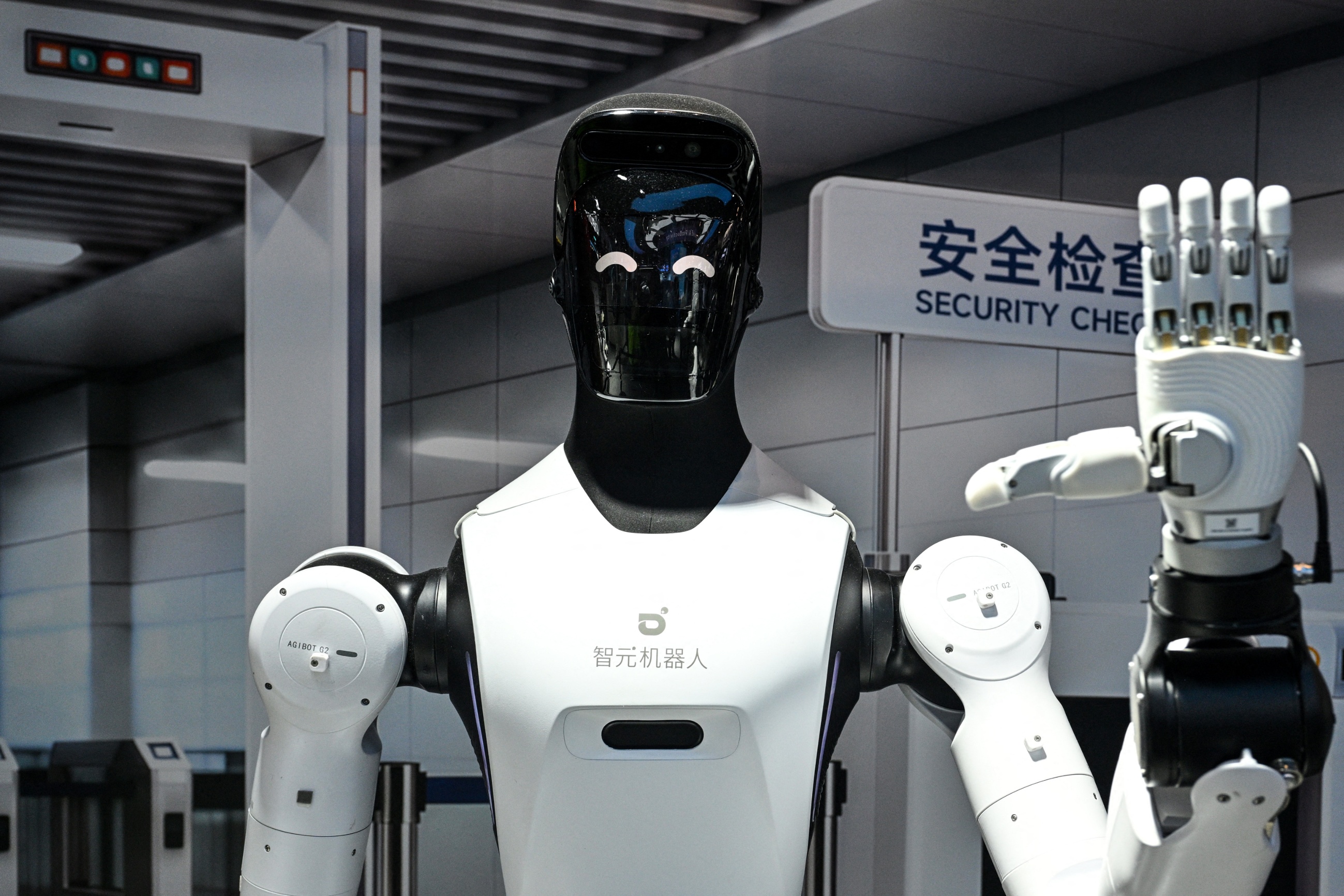
AgiBot walked into the World Artificial Intelligence Conference in Shanghai on July 18, 2026 and made the most ambitious product statement in its short history, unveiling four robots simultaneously and staffing the show floor with more than 30 units. Co-founder and CTO Peng Zhihui used the sidelines of WAIC 2026 to declare that AgiBot intends to export its embodied AI stack to every corner of the world, capitalizing on the company's roughly 39% share of the global humanoid supply market.
A3 Ultra: Endurance Over Spectacle
The Yuanzheng A3 Ultra is a full-size humanoid engineered for sustained deployment rather than trade-show moments. At 174 cm and 60 kg, it carries 51 active degrees of freedom, a 5 kg per-arm payload and up to eight hours of combined operating time with hot-swap batteries and autonomous charging. Compute runs on NVIDIA's Thor SoC inside a proprietary three-layer heterogeneous architecture rated at roughly 700 TOPS, while positioning fuses GPS, RTK and UWB for centimeter-level accuracy indoors and outdoors. Perception combines 3D LiDAR, RGB-D cameras, fisheye lenses and binocular vision so the robot keeps working at the edges of each sensor's range. WAIC organizers designated the A3 Ultra a Gem of the Exhibition, the only embodied AI product among ten items chosen.
X2 Edu And G2 Max: Ecosystem And Factory
The Lingxi X2 Edu is a 130 cm education humanoid with 29 DoF, seven per arm and a 3 kg payload, built around fully modular hardware and open motion-control interfaces so university teams can rip it down to the sensor level and rebuild. The Jingling G2 Max, AgiBot's first heavy-payload force-controlled task robot, uses an omnidirectional wheeled base with battery swap and autonomous charging. It has the deepest deployment record of the four: G2 units run consumer-electronics quality-inspection lines at Longcheer Technology's Nanchang facility, where AgiBot reports a 99.99% task success rate across 64,800 tasks in a six-day public livestream. Longcheer plans to scale to 100 G2 robots at the site by the end of Q3 2026.
OmniHand 3 Ultra-M: Direct Drive As Training Data Advantage
The OmniHand 3 Ultra-M packs 20 active DoF into 630 grams with 0.3 s open/close cycle time, ±0.2 mm positional repeatability and 5 kg gripping capacity. The defining choice is fully direct-drive actuation: no gearboxes, no tendons, no compliance between motors and fingers. That preserves force transparency during contact, which lets the hand capture higher-quality contact-force signatures during teleoperation and demonstration capture. Visuotactile sensors at all five fingertips and a tactile palm array complete a pipeline explicitly engineered to feed AgiBot's GO-2 embodied foundation model better training data than position-controlled competitors can produce.
Why The Launch Matters Beyond The Hardware
The launch consolidates a full-stack pitch that AgiBot has been building all year: an installed base above 15,000 units, a Robots-as-a-Service model priced at €899 per day across 17 countries, and now a product mix that spans commercial service (A3 Ultra), university research (X2 Edu), heavy industrial workflows (G2 Max) and manipulation research (OmniHand). Peng's export statement lands in a context where China's 15th Five-Year Plan designates embodied AI as one of seven strategic future industries — a designation that unlocks the 60 billion RMB National AI Industry Investment Fund and mandates that thousands of subordinate plans align with embodied AI targets.
Buyers should still weigh the gaps that four product launches do not close: independent audits of AgiBot's reliability claims remain absent, U.S. legislation including the American Security Robotics Act is pending, and every AgiBot robot ships subject to Article 7 of China's National Intelligence Law. On the technology axis, the direction is real and the pace is faster than most Western competitors are matching. Whether that translates into orders outside Shanghai is the actual test of Peng's export ambition.
Reporting based on coverage from Tech Times, AgiBot press materials, Pandaily and Global Times.