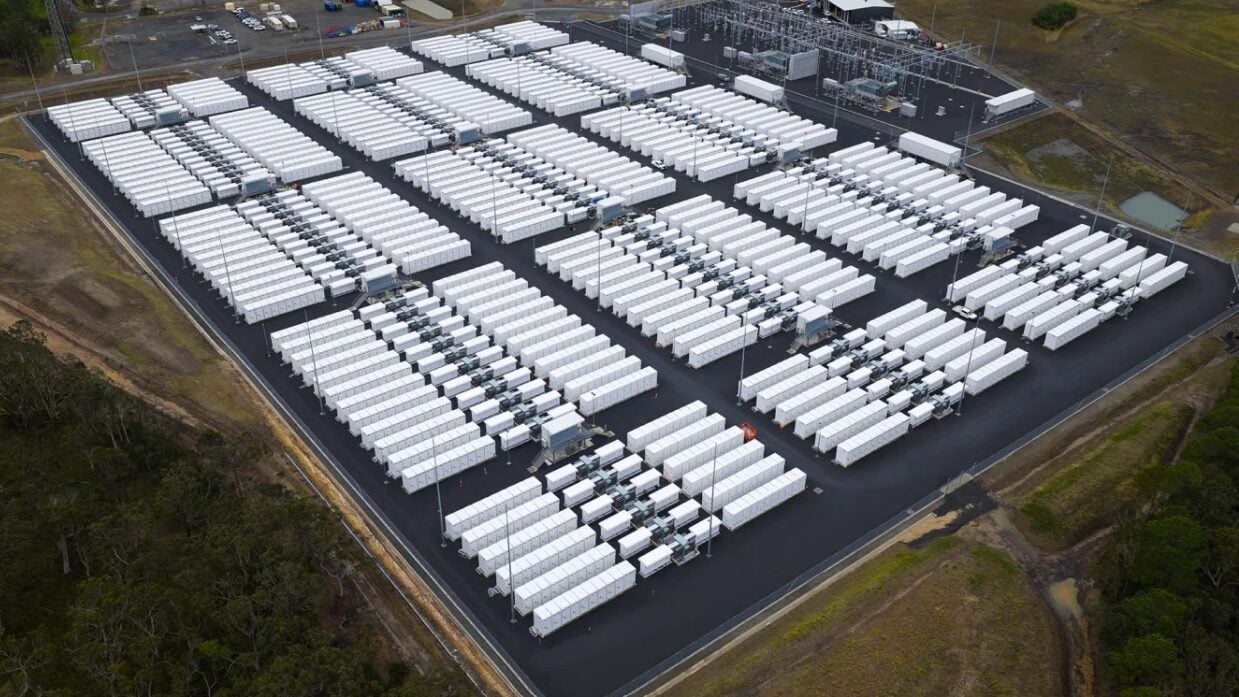
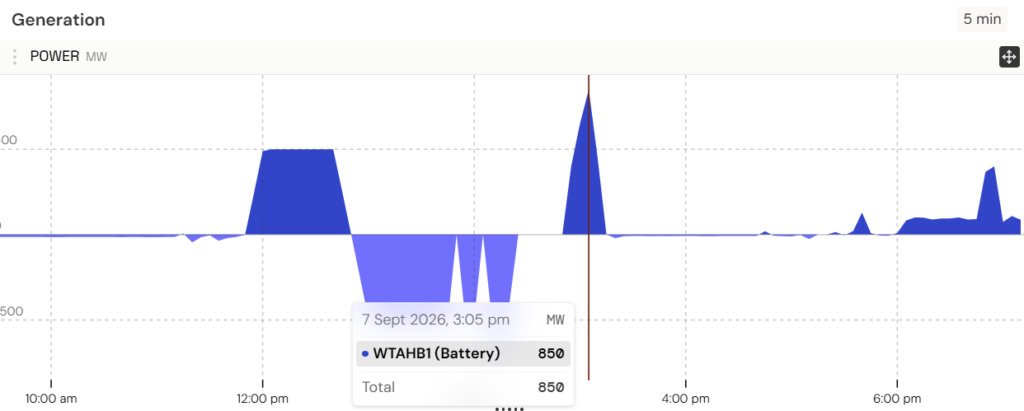
Akaysha Energy’s Waratah Super Battery briefly reached its full rated output of 850MW on 7 September, according to Open Electricity data, before delivering a 701MW discharge two days later that lines up with its full System Integrity Protection Scheme obligation to Transgrid.
Back to full capacity after a year of constraint
The BlackRock-backed 850MW/1,680MWh facility, built at the former Munmorah coal-fired power station near Budgewoi, New South Wales, has been running below rated output since October 2025, when High Voltage Transformer 3 (HVT3) suffered a catastrophic failure that ruptured its tank wall and forced HVT2 offline as a precaution. The facility ran at 350MW for months, returned to 700MW in June after HVT2 recommissioning, and now — with the domestically manufactured HVT3 replacement from Wilson Transformer Company energised — is testing its full 850MW rated capacity ahead of Akaysha’s previously stated end-of-2026 timeline.
SIPS: NSW’s ‘giant shock-absorber’
Under the SIPS contract, Transgrid monitors 36 transmission lines and instructs the battery to inject up to 700MW while paired generators adjust output, allowing the grid serving Sydney, the Hunter and Illawarra to run harder while the Hunter Transmission Project is delivered. The 701MW dispatch on 9 September is the first at that full contracted level.
Supply chain has shifted underneath the project
Original BESS provider Powin Energy filed for Chapter 11 during the outage; US integrator FlexGen took over long-term servicing of Powin’s global fleet — including Waratah — while Hitachi Energy acquired full ownership of Spanish PCS specialist Eks Energy. Waratah’s return to full output lands as Australia’s grid-scale BESS fleet earned AU$28.79M in energy and FCAS revenue in August, with capture rate climbing to 54%.
Reporting based on coverage from Energy-Storage.News and Open Electricity data.