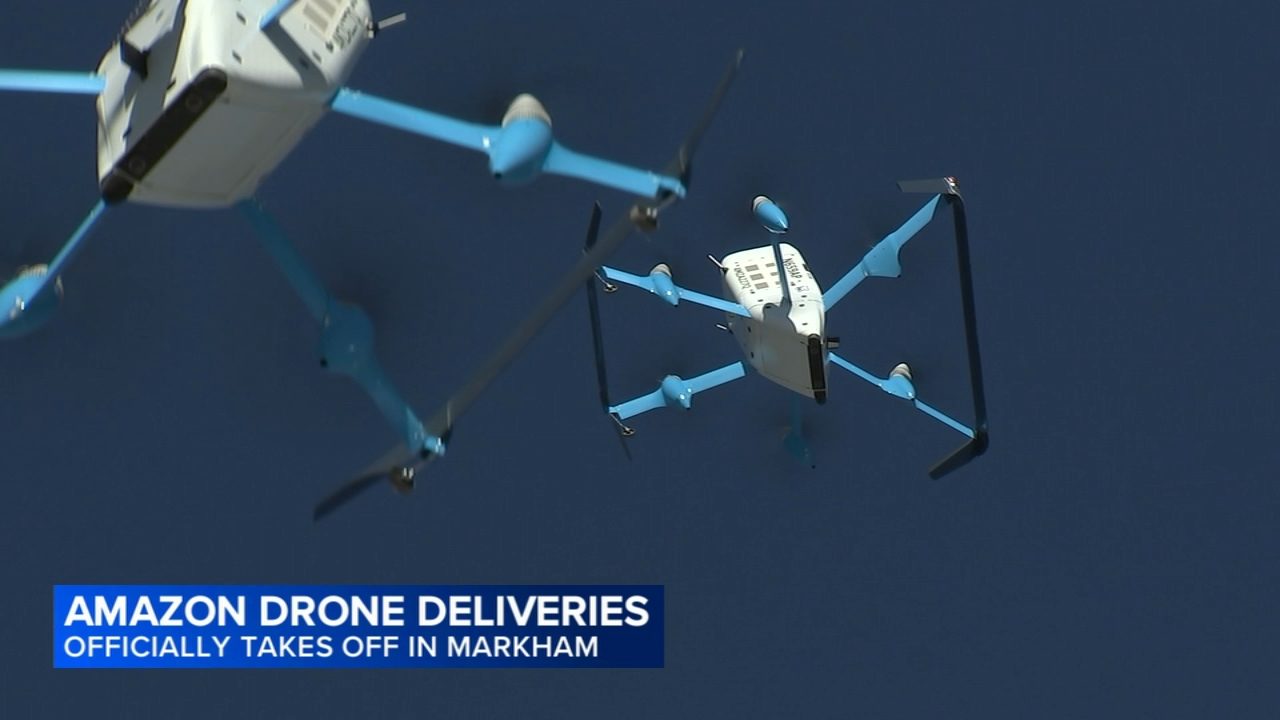
Amazon marked the official opening of its first Prime Air drone delivery center in Illinois on November 10, 2026, with a ribbon-cutting ceremony at its IGQ1 fulfillment center in Markham attended by Mayor Roger Agpawa and city officials. More than 20 drones now operate from the site during daytime hours, according to ABC7 Chicago.
The service covers a roughly 7.5-mile radius from the Markham facility, reaching Tinley Park, Midlothian, Homewood, Flossmoor, Dolton, and Blue Island. Amazon says eligible orders can arrive in as little as 30 minutes, with drones cruising at 200 to 400 feet before descending to 13 feet to drop packages.
How does the Markham service actually work, and what can it deliver?
Drones fly under an FAA Part 135 air carrier certificate and use obstacle-detection technology during descent. Amazon says available items include diapers and baby supplies, over-the-counter medications, pet care products, and other household essentials, mirroring the category mix the company has prioritized at its other drone sites.
Pricing follows Amazon's existing Prime Air model: delivery is free for Prime members on orders of $50 or more, $2.99 for smaller Prime orders, and $4.99 for non-Prime customers. Amazon says the drones create new local roles, including FAA-certified drone operators, maintenance staff, and ground support, without displacing existing delivery drivers who continue handling other package types.
How does this compare to Amazon's other drone markets, and to rivals?
Markham is Amazon's first Prime Air center in Illinois, and the company has said a second center is planned for nearby Matteson. Amazon's broader Prime Air ambitions span nearly 500 U.S. cities long-term, with the company deliberately prioritizing suburban areas over dense urban cores to avoid skyscrapers and airport airspace conflicts.
The move puts Amazon in more direct competition with Walmart's drone delivery network, which already operates at more than 75 stores across five states and has a stated goal of 270 locations by 2027 through its partnership with Wing. Both retailers are racing to normalize drone delivery as a standard fulfillment option rather than a novelty, betting that density of coverage, not any single flashy feature, will determine which network customers actually use.
What should residents and competitors expect next?
Local coverage of the Markham rollout has already flagged friction points familiar from other Prime Air markets: noise complaints, tree cover interfering with descent paths, and difficulty finding clear drop zones near pools or dense landscaping. Amazon will need to manage those operational snags across six suburbs simultaneously while it builds out the Matteson center, the company's next announced step in the Chicago market.