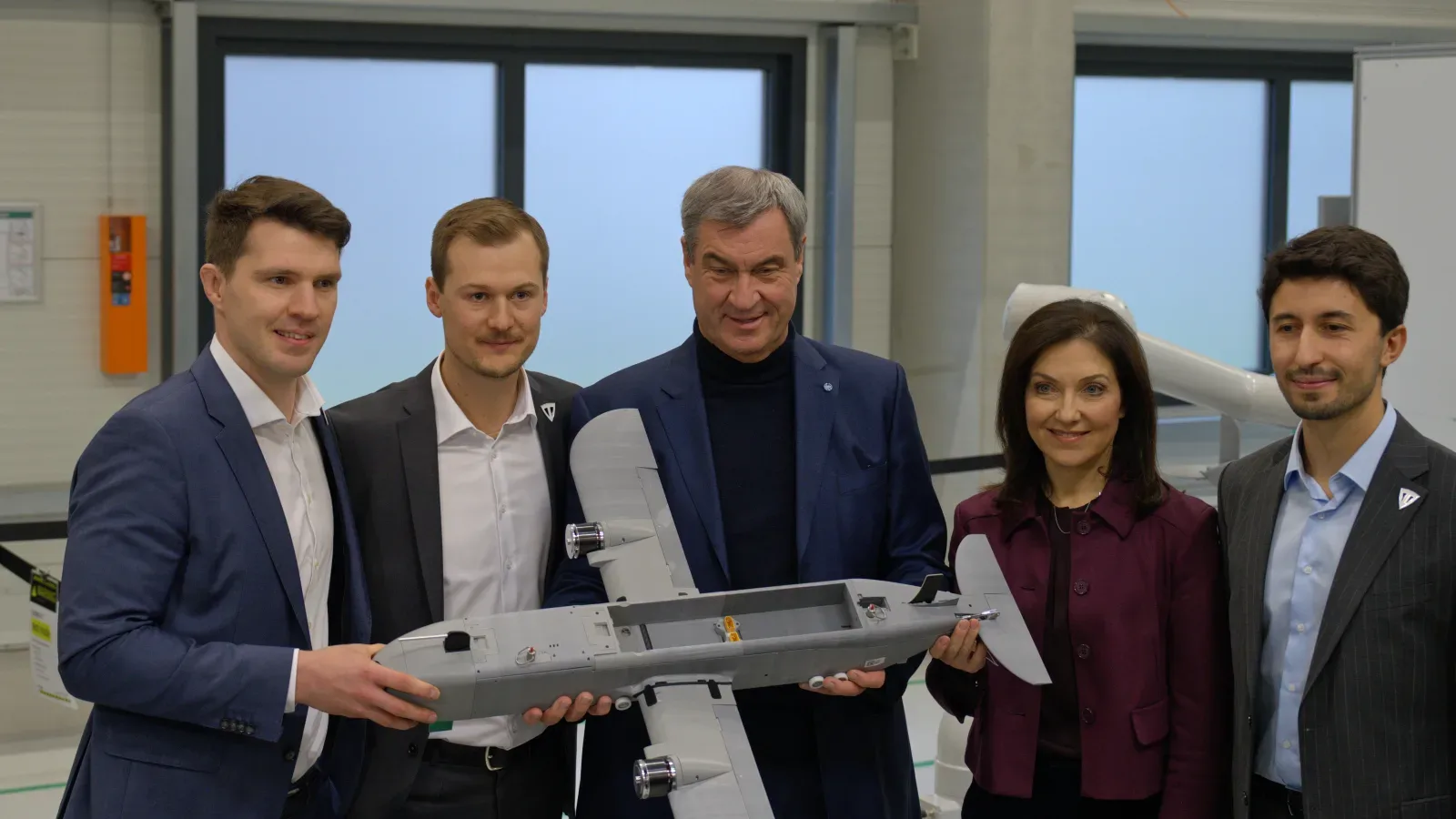
Three government officials, including Bavaria's minister-president, stood inside a converted Munich-Aubing warehouse on November 9 to cut the ribbon on what a German drone startup calls the blueprint for Europe's next wave of defense manufacturing. TYTAN Technologies opened a roughly 3,000-square-meter production facility there with a target of building up to 3,000 autonomous interceptor drones a month, the company said.
The opening, backed by an estimated €10 million investment, marks TYTAN's shift from prototype builder to volume manufacturer less than three years after the company was founded in response to Russia's invasion of Ukraine. 'From prototype to series production in mere months — this is how defense capability develops today,' CEO and co-founder Balázs Nagy said at the event, according to Defence Network. 'The Munich-Aubing production will serve as a blueprint for additional European facilities.'
The facility starts with roughly 60 employees and is designed to scale to about 100 across shifts. German Federal Economics Minister Katherina Reiche and Bavarian Minister-President Markus Söder both attended, with Söder calling the plant proof that 'established corporations and new defense scale-ups complement each other, strengthening Europe's technological sovereignty from Bavaria.'
Two Drones, One Mobile Launcher
TYTAN builds two interceptor models. The EOS is a short-range multicopter weighing roughly 6 kilograms, built to destroy small drones under NATO's Class I threshold — systems below 150 kilograms — by ramming them out of the sky at up to a reported 375 km/h within a 15-to-60-kilometer range. The METIS is a longer-range, fixed-wing interceptor carrying roughly a 1-kilogram warhead, aimed at Class II drones weighing 150 to 600 kilograms, with a range of up to 60 kilometers and a speed above 350 km/h.
Alongside the factory opening, TYTAN and German defense contractor KNDS unveiled a mobile counter-drone vehicle built on KNDS's armored Dingo 2 pickup platform. The vehicle carries up to 12 interceptors loaded in four METIS containers, seats a three-person crew of driver, drone operator and weapon-station operator, and meets STANAG 4569 Level 3 ballistic protection. KNDS and TYTAN plan to begin series production of the vehicle in early 2027. TYTAN has also integrated Hensoldt's Spexer radar, which tracks more than 300 targets across 360 degrees, and signed a letter of intent with Mercedes-Benz to explore vehicle-based interceptor systems using the G-Class and Sprinter.
A Market Shaped by Ukraine's Drone War
TYTAN has raised more than €30 million in a Series A round and already supplies interceptors to Ukrainian forces, where cheap, mass-produced counter-drone systems have become a daily necessity against Russian Shahed-type drones that typically cost $10,000 to $50,000 apiece — a fraction of the several-million-dollar price of a Patriot interceptor. Germany's Bundeswehr has also moved to procure TYTAN's Drone Defender system, though the scale of that order has been reported inconsistently, ranging from an initial prototype contract to a larger framework potentially worth hundreds of millions of euros.
Not every account of TYTAN's technology has been uniformly positive. At least one Ukrainian unit commander has said the company's interceptors lack the speed to reliably catch jet-powered Shahed variants that can exceed 300 km/h, since interceptor doctrine generally calls for a roughly 25% speed advantage over the target. TYTAN has not published independent test results against those faster threats.
Still, the Munich opening puts TYTAN among a small group of German defense startups — formed since 2022 — that have moved from garage prototypes to industrial-scale output, a shift the company says it now intends to replicate at additional sites in Poland and Hungary.