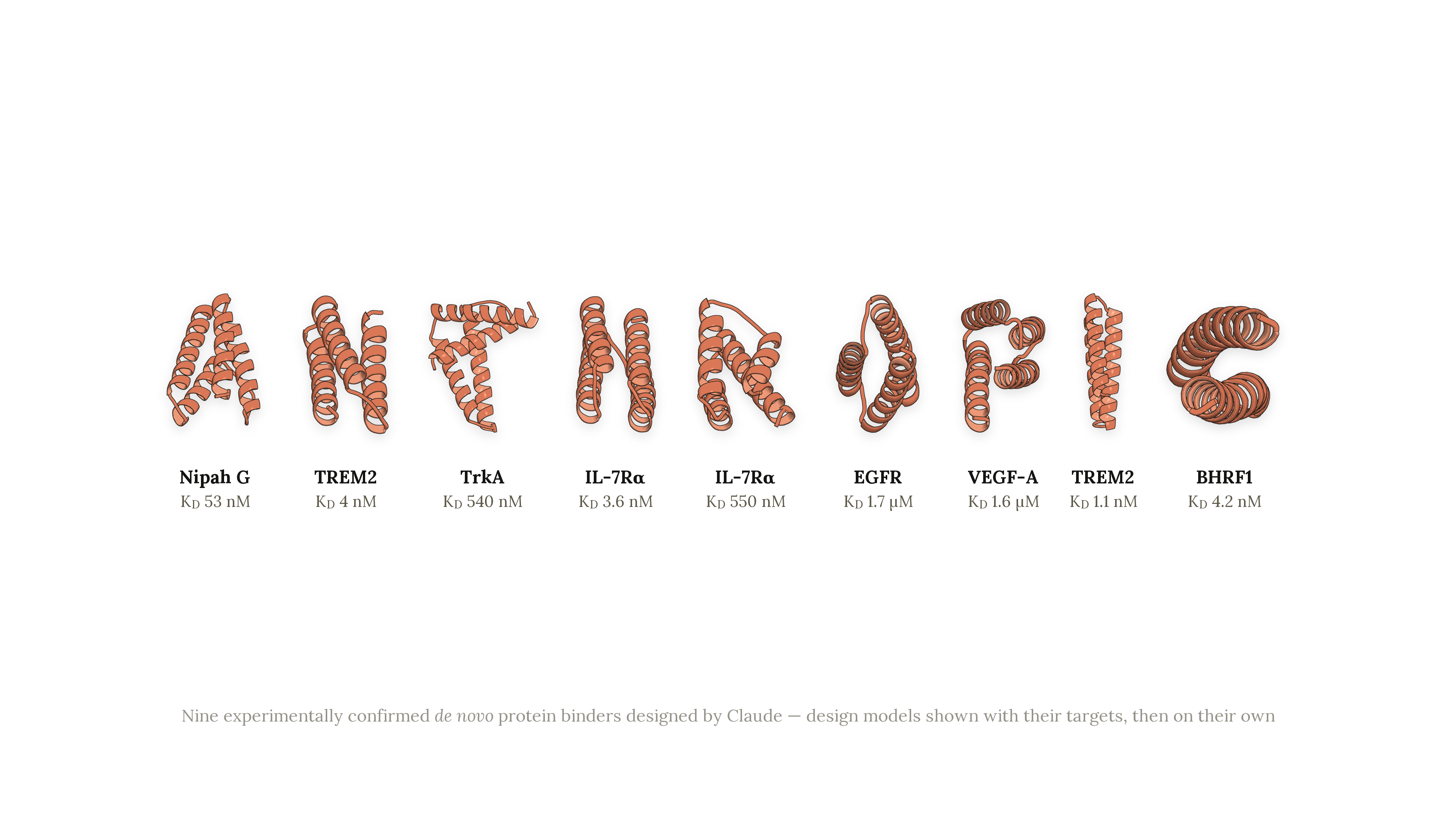
Anthropic on August 18 disclosed the results of an autonomous protein design campaign in which its Claude Mythos Preview and Claude Opus 4.8 models produced confirmed de novo binders for 14 of 15 protein targets, with wet-lab validation performed independently by Adaptyv Bio and Twist Bioscience. The AI-run campaign generated 354 confirmed binders from 1,320 designs across the targets, one of the largest publicly released de novo binder datasets to date.
How Claude Ran The Protein Design Campaign
The experiment used Anthropic's Claude Science workbench and a roughly 30,000-token protein design prompt, plus tool access to specialized structure design, sequence design and co-folding models running on NVIDIA H100 GPUs. In a 48-hour multi-target mode Mythos Preview and Opus 4.8 hit overall success rates of 26.7% and 22.6% respectively; in single-target mode with 24-hour sessions Mythos Preview climbed to 35.1%, well above the 10-15% typical for current protein binder campaigns. Anthropic said the agent chose target epitopes, generated candidate structures and sequences, ran multiple rounds of in silico optimization, and screened for novel, soluble, high-affinity binders with essentially no human scientific guidance beyond the initial prompt.
Adaptyv Bio And Twist Bioscience Confirmed The Hits
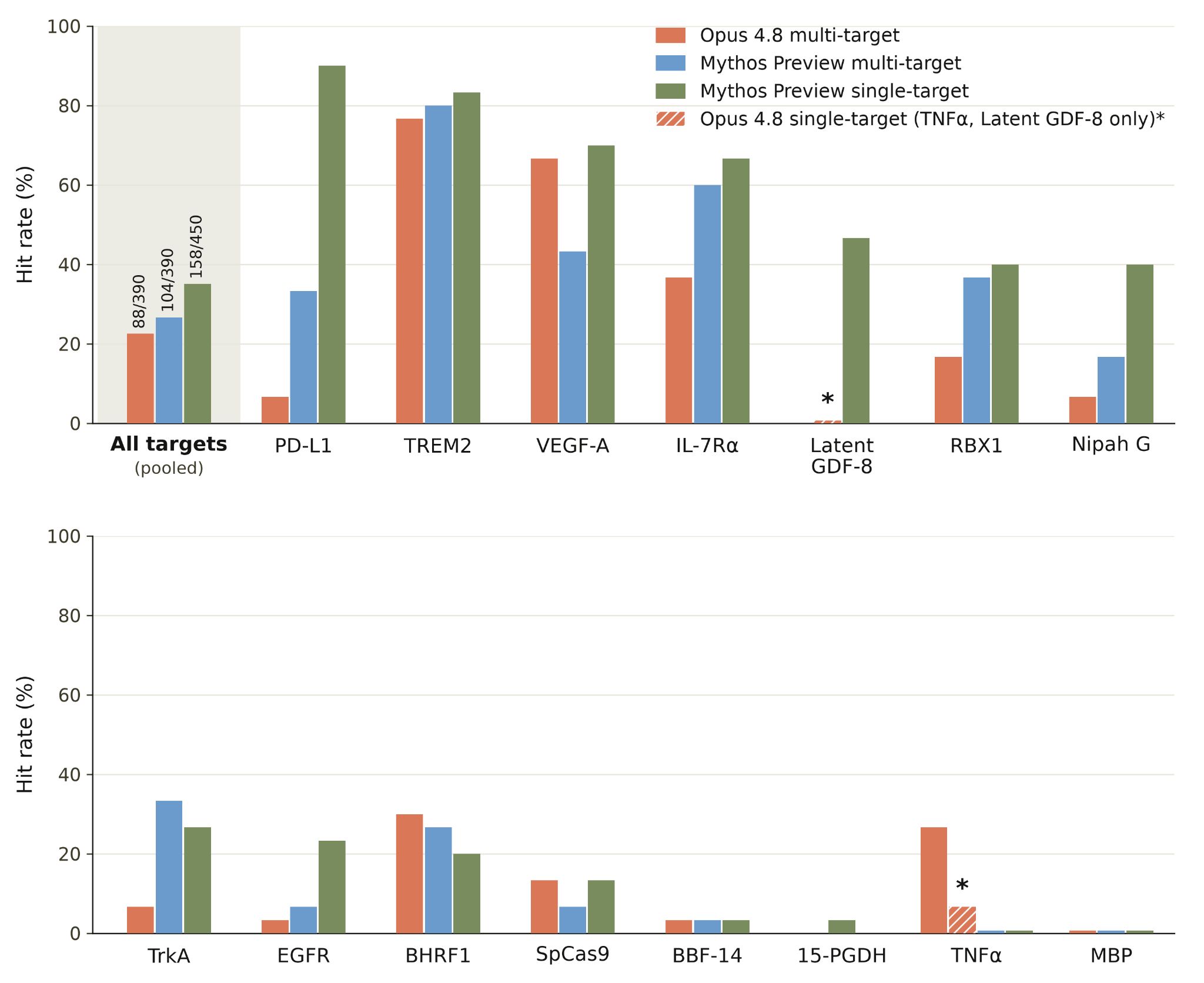
External evaluators Adaptyv Bio and Twist Bioscience produced and tested the AI-generated proteins in the lab. On the RBX1 target — used in Adaptyv Bio's public BenchBB competition — Mythos Preview posted a 40% hit rate versus 3.7% for human competition participants, with its top-ranked design outperforming the winning entry. Opus 4.8 was the only Claude model to succeed against the therapeutically important TNFα multimer, producing species cross-reactive binders that hit human, cynomolgus monkey and mouse TNFα. Claude also produced 15 confirmed binders across six targets that contained at least 20% β-strand, an unusually difficult structural motif for AI protein designers. The models did not crack every target: MBP produced no confirmed binder and BBF-14 yielded only three modest-affinity hits.
What It Means For Drug Discovery
Anthropic was careful to caveat that "protein binders are not drugs" and that a high-affinity binder is only the first step toward a therapeutic candidate. Still, compressing weeks-to-months of specialist work into a 24-to-48-hour autonomous run — while matching or exceeding the best previously published designs on several targets — is a concrete example of AI agents entering biology labs. Anthropic said protein design and other dual-use capabilities remain blocked in the general-access Claude Fable 5, and are gated behind a forthcoming trusted access program for scientists; the company also shared its prompts and all in vitro and in silico data on Hugging Face.
The disclosure lands alongside a wave of AI activity from Anthropic, including its rumored mega IPO, an $6 billion talks to acquire Decart and a growing focus on custom AI silicon.
Reporting based on coverage from Anthropic, Adaptyv Bio, Twist Bioscience, XenoSpectrum and The Next Web.