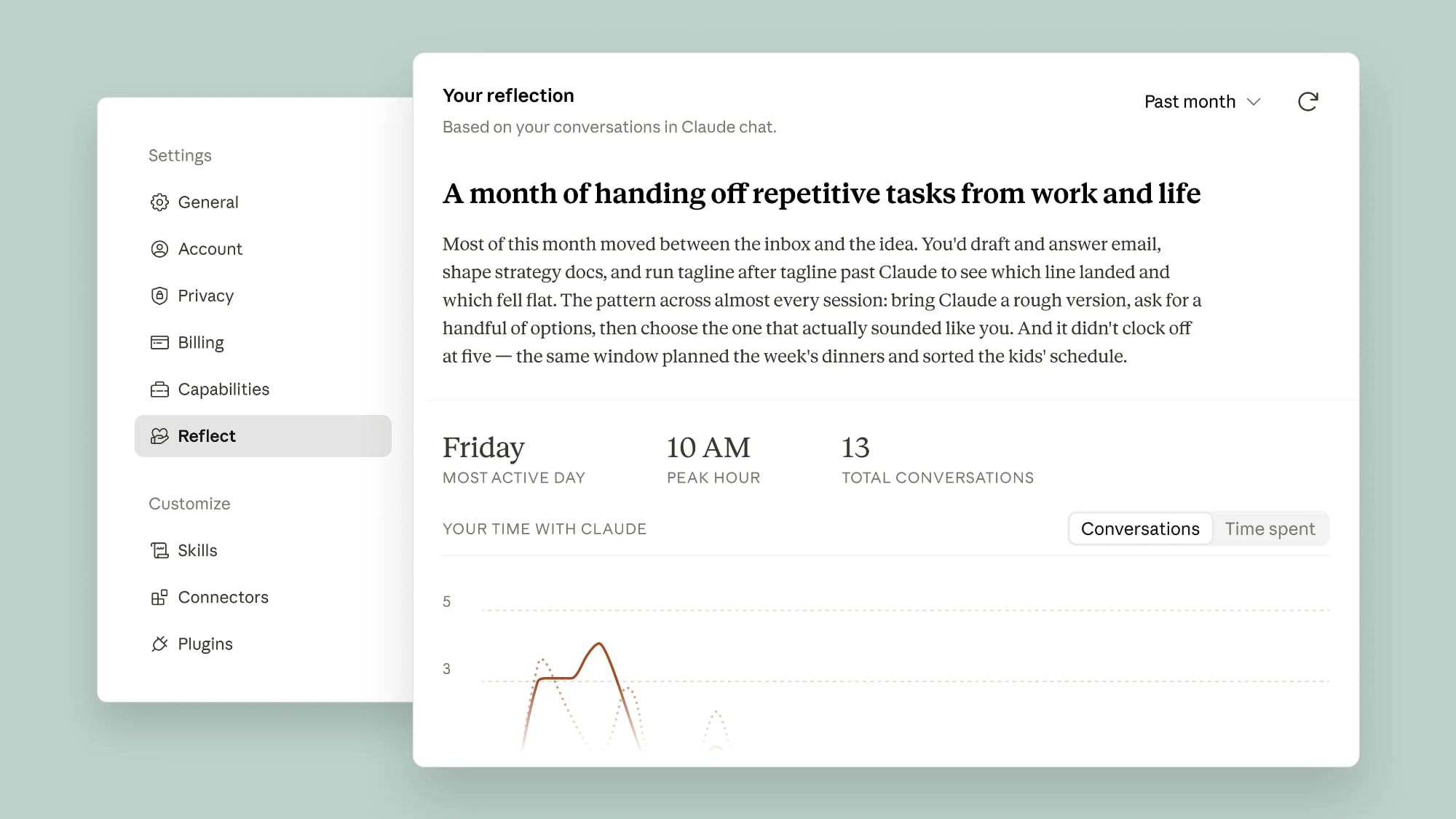
Anthropic Ships 'Reflect' Dashboard To Show Users How They Really Use Claude
Anthropic has launched Reflect, a beta Claude dashboard that summarises how users spend time with the model, scores habits against a 4D AI Fluency Framework and offers break reminders.
Key Takeaways
Anthropic launched Reflect on July 9, 2026, a beta Claude dashboard that recaps topics, most active day, peak hour and work habits over 1, 3, 6 or 12-month timeframes.
Reflect scores usage against Anthropic's 4D AI Fluency Framework — Delegation, Description, Discernment and Diligence — rather than just tracking raw time spent.
Found in Settings > Time and Focus, Reflect offers quiet hours, configurable break reminders and reflective prompts encouraging users to keep some tasks off Claude.
Privacy guardrails exclude incognito chats and health-integration conversations, data is not repurposed, and the tool requires memory turned on.
Reflect is available on web and Claude Desktop for Free, Pro and Max users, arriving amid rival launches like GPT-5.6-powered ChatGPT Work and Anthropic's Fable 5 rollout.
Kaan Tınmaz
San Francisco, July 9, 2026 — Anthropic has launched Reflect, a new Claude dashboard in beta that summarises what users have actually done with the chatbot, encourages more deliberate work habits and prompts users to consider whether they still want to keep certain tasks off Claude. The company is pitching Reflect as an antidote to reflex-use — a nudge to keep humans in the loop as agentic Claude models increasingly execute end-to-end tasks.
Spotify Wrapped, For AI
Reflect shows users a monthly recap of the topics they spent time on, their most active day, peak hour and observations about how they work with Claude. Users can toggle 1, 3, 6 or 12-month timeframes; Anthropic plans to add cumulative time-spent tracking next. Rather than a raw stopwatch, Reflect scores usage against Anthropic's 4D AI Fluency Framework: Delegation, Description, Discernment and Diligence — the four skills Anthropic argues determine effective collaboration with Claude.
Break Reminders And Quiet Hours
The tool sits in Settings > Time and Focus, where users can schedule quiet hours and break reminders after configurable session lengths. Anthropic said Reflect will also surface reflective prompts like "What's one thing you want to keep doing yourself, even if Claude could do it faster?" — a rare product framing that leans into asking users to use less of the product.
Privacy Guardrails
Reflect excludes incognito chats and any conversation connected to a health integration tool from its insights, and the underlying data is not repurposed. It requires memory to be turned on and is available on the web and Claude Desktop for Free, Pro and Max users.
A Model Family Under Pressure
Reflect ships as Anthropic pushes Claude further into work automation. The company launched GPT-5.6-powered ChatGPT Work as a rival earlier this week, and Anthropic itself recently opened Fable 5 (its first Mythos-class model) to all subscribers. Reflect follows the recent June launch of Claude Sonnet 5 and June debut of Fable 5.
Reporting based on Anthropic's product blog and coverage from MacRumors and TestingCatalog.
Reflect is a beta Claude dashboard launched July 9, 2026 that summarises how users spend time with Claude, showing monthly recaps of topics, most active day, peak hour and habit observations, scored against Anthropic's 4D AI Fluency Framework.
What is the 4D AI Fluency Framework?
It is Anthropic's framework of four skills — Delegation, Description, Discernment and Diligence — which the company argues determine effective collaboration with Claude. Reflect scores usage against these dimensions instead of acting as a raw stopwatch.
Who can use Reflect and where is it available?
Reflect is available on the web and Claude Desktop for Free, Pro and Max users. It requires Claude's memory feature to be turned on and lives in Settings > Time and Focus.
How does Reflect handle privacy?
Reflect excludes incognito chats and any conversations connected to a health integration tool from its insights, and the underlying data is not repurposed by Anthropic.