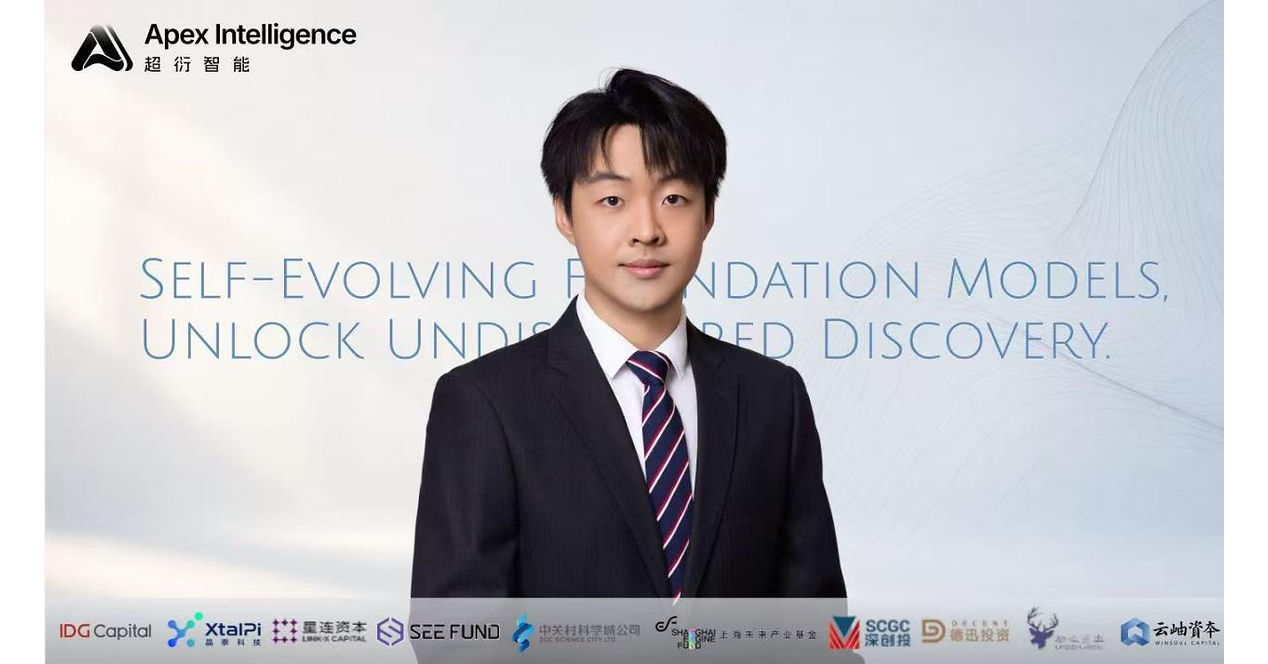
Beijing-based Apex Intelligence has closed nearly $50 million across back-to-back angel and angel+ rounds, giving one of China's most closely watched new foundation-model outfits real capital to chase recursive self-improvement. The company was founded in June 2026 by Yongchao Chen, a 27-year-old Tsinghua University assistant professor who politely turned down Google DeepMind to start it.
Betting on self-evolving models
Apex is aiming at models that generate and consume their own research trajectories — training data, reasoning traces, tool calls — so the systems iterate on themselves rather than waiting for the next human-curated dataset. In Chen's own framing, "models taught by humans are ultimately limited by humans themselves… ASI will replace humanity's most accomplished scientists." Apex plans to evaluate the approach against ASI-oriented benchmarks for autonomous scientific research.

The syndicate
The angel round was led by IDG Capital, LinkX Capital and XtalPi, joined by Decent Capital, SEE Fund, Monad Ventures and Winsoul Capital. The follow-on angel+ was led by state-linked Zhongguancun Science City Fund, SCGC and Shanghai Engine Fund. The syndicate blends China's classic tech-VC bench with the sovereign capital that Beijing has been steering toward domestic AI foundations.
Where the money goes
Proceeds are earmarked for the first Apex foundation model training run, compute procurement and research-trajectory data pipelines, plus early hires. The company will compete with a growing Chinese cohort of open-source model labs, including Shanghai AI Lab, and with international peers like Arcee AI.
Why it matters
Recursive self-improvement is one of the more contested ideas in frontier AI research. Apex's raise puts a well-credentialed team, with meaningful state backing, into that lane at nine-figure scale — and turns Chen from an academic voice into a founder his backers now expect to ship.
Reporting based on coverage from PR Newswire, 36Kr and TechStartups.