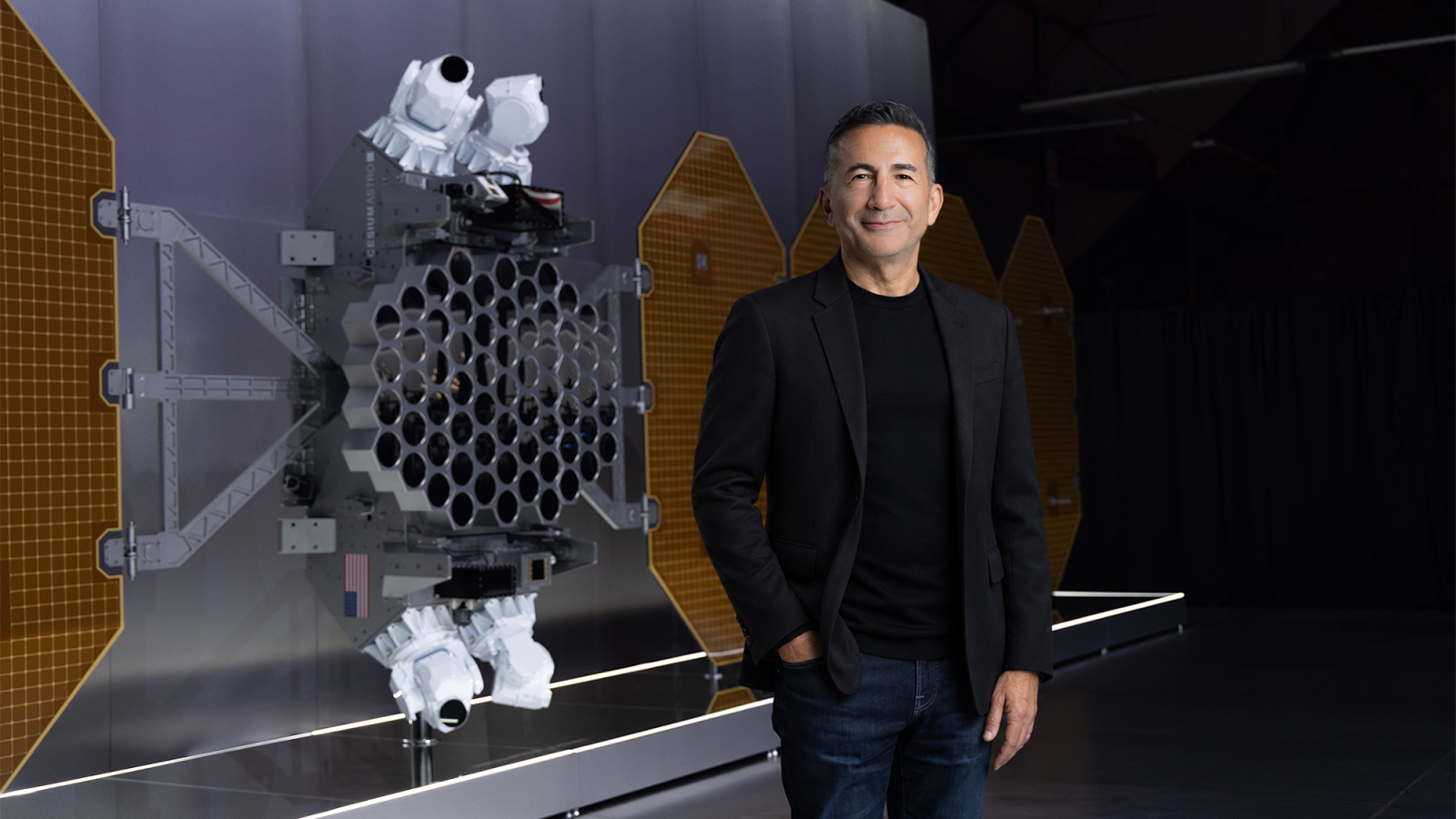
CesiumAstro has raised $730 million in a Series D equity round, alongside a separate $100 million debt facility, in a raise the company announced on November 5, 2026. Janus Henderson led the equity round, with participation from Insight Partners, Sands Capital, Sumitomo Corporation of Americas, Toyota's Woven Capital, Incharge Capital, Magnetar, AV and NewSpace Capital, while EXIM and JPMorgan provided the debt piece. The new capital pushes CesiumAstro's valuation above $4.5 billion and brings its total 2026 fundraising past $1.2 billion, according to the company's press release.
What does CesiumAstro actually build?
Think of a satellite as a flying cell tower. CesiumAstro makes the radios and antennas that go inside it. The company designs custom silicon chips, active phased arrays, and what it calls software-defined payloads — communications hardware that can be reprogrammed in orbit rather than swapped out.
A phased array is an antenna with no moving parts. Instead of physically pointing a dish, it steers its signal electronically, letting one satellite juggle conversations with dozens of ground terminals or aircraft at once. CesiumAstro sells this under two product lines: Element, its own satellites, and Skylark, the ground and airborne terminals that talk to them.
Why pour $830 million into hardware right now?
CesiumAstro launched its first Element-1 satellite in October 2026, giving it on-orbit proof that its phased-array and payload technology works outside the lab. CEO Shey Sabripour framed the raise as the payoff for that validation, saying the company is now proven "on orbit, on the ground and in the air" with more than $1.2 billion raised this year alone.
The money is earmarked for four things: pushing the underlying silicon and antenna technology further, expanding manufacturing inside the United States, building and launching the next generation of Element spacecraft, and rolling out Synchronicity, CesiumAstro's planned satellite constellation for persistent communications coverage. A slice is also set aside for international growth, suggesting the company wants customers beyond U.S. government and defense buyers.
How does this compare to the rest of the satcom market?
CesiumAstro isn't trying to out-build SpaceX's Starlink or Amazon's Kuiper, both of which operate their own mega-constellations serving consumers directly. It's closer to an arms supplier than a retailer: it sells the chips, antennas and terminals that other satellites, aircraft and ground stations use to talk to each other, a role that puts it in competition with phased-array specialists like Mynaric and terminal makers serving the same defense and commercial customers.
That positioning helps explain the investor mix. Toyota's Woven Capital and Sumitomo point to automotive and industrial interest in resilient connectivity, while EXIM Bank financing — a U.S. export-credit agency — signals government-linked business tied to national security priorities. Janus Henderson, an asset manager rather than a defense-focused fund, suggests the company is also pitching itself as a long-term infrastructure bet rather than a pure defense play.
What happens next?
The near-term test is whether CesiumAstro can turn one validated satellite into a working constellation. Synchronicity's deployment timeline wasn't detailed in the announcement, but with U.S. manufacturing capacity now funded, the company's next milestones will likely be additional Element launches and early Synchronicity service announcements. Investors who just wrote checks at a $4.5 billion-plus valuation will be watching for proof that the on-orbit validation translates into recurring contracts, not just technical bragging rights.