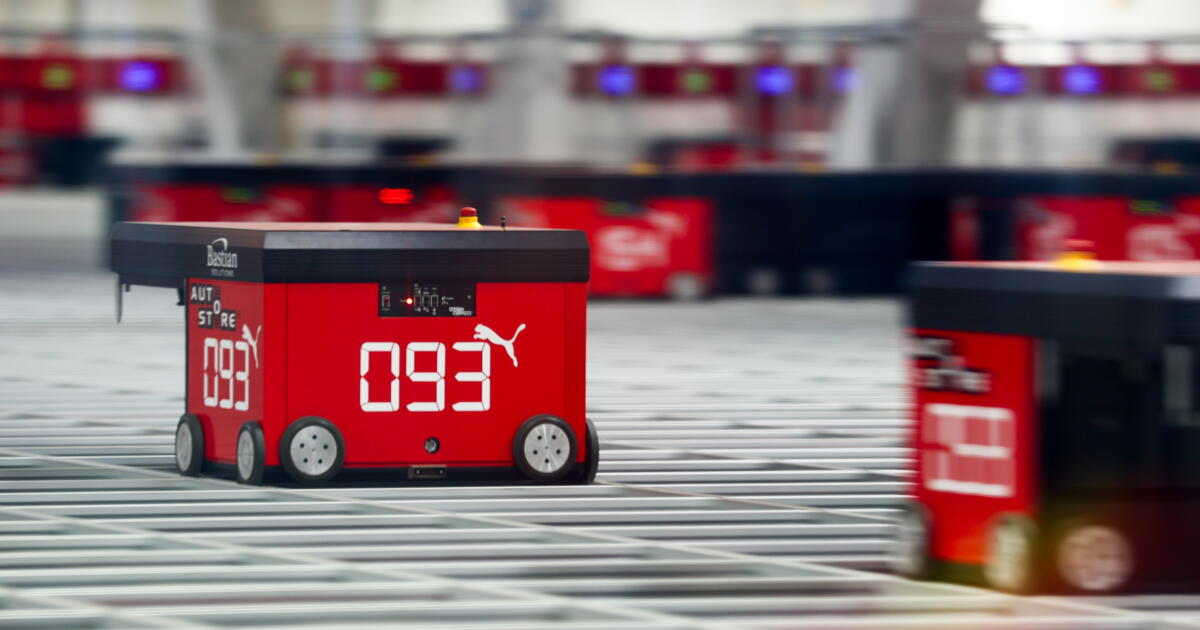
Inside a 672,000-square-foot warehouse off Van Ness Avenue in Torrance, California, 170 red robots are gliding across a grid of stacked plastic bins around the clock this holiday season, pulling sweatshirts, sneakers and backpacks for the sportswear brand Puma. The facility is leased and run by shipping giant Maersk, and together the robots and roughly 100 human workers on site are processing up to 20 million units a year, with the robotic grid holding as many as 175,000 boxes at once, according to the Los Angeles Times.
The robots come from Norwegian automation company AutoStore, and Maersk reports they're holding a 99.7% uptime rate at Torrance while each unit draws less electricity than a household vacuum cleaner. That combination of reliability and low power draw is exactly what retailers need during the crush of Black Friday and holiday-season order volumes, when a single stalled robot in a crowded grid can back up an entire pick line.
How does an AutoStore grid actually move that many boxes?
Picture a giant three-dimensional cube made of stacked bins, with robots riding on rails across the top rather than driving through aisles on the floor. Each AutoStore robot drops down into the grid, grabs the specific bin it needs using a built-in lift mechanism, and hauls it up to a port where a human worker picks out the item an order requires. Because the robots travel on top of the stack instead of between rows, warehouses can pack bins far more densely than in a traditional pallet-rack layout, which is how Torrance fits 175,000 boxes into its footprint.
"They don't take sick leave and they don't take lunch breaks," said Ellen Brune, AutoStore's vice president of product, describing the appeal of a system that runs the same repetitive retrieval task nonstop through overnight shifts and demand spikes alike. The nearly 100 people still working the floor aren't being replaced so much as redirected: they load incoming apparel into the grid and hand-pack finished orders once a robot delivers the right bin, rather than walking the warehouse floor themselves.
Why is Maersk opening this warehouse to other brands next year?
Right now, Torrance runs exclusively for Puma. Starting next year, Maersk plans to open its spare capacity to additional brands, making it the first site in Maersk's North American AutoStore network to serve multiple clients at once rather than being dedicated to a single retailer.
"This does all the repetitive movement, and the associates are doing more decision-making, problem-solving and working with our customers," said David Hune, Maersk's head of contract logistics, explaining the shift in how the company wants its warehouse staff to spend their time once the robots absorb the routine box-fetching.
The multi-client move points to a broader pattern in warehouse automation: once a robotic system proves it can hit near-100% uptime on one account, operators look to spread the fixed cost of that infrastructure, the grid, the robots, the software, across several customers rather than building a separate system for each one. For AutoStore, which competes with rivals like Exotec and Autostore's own installed base running into the thousands of sites worldwide, a flagship account willing to share its grid with competitors' goods is also a useful proof point for other retailers weighing the same trade-off ahead of next year's holiday rush.