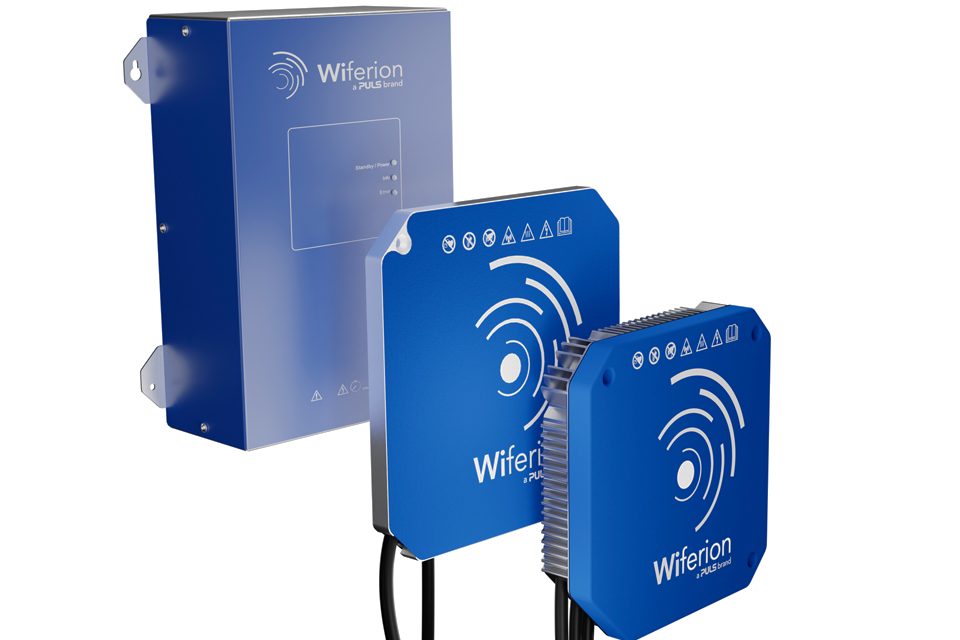
German charging technology company Wiferion, a brand of power electronics firm PULS, announced on November 28 that its CW1000 wireless charging system has received cleanroom certification to ISO 14644-1 Class 2, one of the strictest air-cleanliness standards used in semiconductor and pharmaceutical manufacturing. The certification came from the Fraunhofer Institute for Manufacturing Engineering and Automation IPA, and Wiferion says it's currently the only vendor whose charging system can be used safely inside a cleanroom at all.
It sounds like a narrow, technical milestone, but it addresses a real bottleneck for anyone trying to run autonomous mobile robots, AMRs, or automated guided vehicles, AGVs, inside a wafer fab or a sterile pharmaceutical production line: how do you recharge a robot's battery without introducing the exact particles, dust, metal shavings, friction debris, that a cleanroom exists to keep out?
Why can't robots just plug in like normal?
Conventional charging relies on physical contacts: plugs, pins or sliding contact rails that touch metal to metal. Every one of those contact points can generate microscopic particles through friction and arcing, and in a standard warehouse that's a non-issue. Inside a Class 2 cleanroom, where air cleanliness is measured in particles per cubic meter at sizes smaller than a human hair, that kind of contamination can ruin a batch of silicon wafers or contaminate a pharmaceutical production run worth far more than the robot itself.
Wiferion's answer is to remove physical contact from the equation entirely. The CW1000 charges robots inductively, using electromagnetic fields to transfer up to 1,000 watts of power across a small air gap, the same basic principle behind wireless phone chargers, just scaled up substantially. Because there's no plug, no exposed metal and no mechanical wear, there's nothing generating the kind of particle shedding that contact-based charging can produce over thousands of charge cycles.
How does a charger actually pass a cleanroom test?
Fraunhofer IPA's testing measured how many particles the CW1000 emits during operation and classified the result against the ISO 14644-1 scale, where lower numbers mean stricter cleanliness. Class 2 sits near the top of that scale, suitable for the most sensitive stages of chip fabrication. The system is also fully encapsulated and sealed to IP65 or IP67 on the charging-station side and IP54 on the robot side, ratings that describe resistance to dust and moisture, which helps explain why it's easy to wipe down and unlikely to trap contaminants in seams or joints.
"Our wireless charging solution is fully encapsulated and works without mechanical contacts," said Matthieu Ebert, Wiferion's director of product and technology. "This makes us currently the only provider whose charging systems can be used safely in the cleanroom."
The timing lines up with a broader shift already underway in chip manufacturing, where companies like Samsung and TSMC have publicly committed to scaling up fleets of factory robots over the next several years. Every one of those robots eventually needs to recharge, and if the charging hardware itself can't clear cleanroom standards, operators are stuck either tolerating contamination risk or pulling robots out of the cleanroom entirely to recharge elsewhere, losing time and defeating the point of automation. A certified wireless charger removes that trade-off, which is a small piece of infrastructure doing a fairly large amount of work in keeping automated fabs actually automated.