BAAI Unveils Wujie World Model System, Marching Into Physical AGI
China's Beijing Academy of Artificial Intelligence unveiled its Wujie world model system — Physis-v0.1 and RoboBrain Orca — at the 2026 Zhiyuan Conference, part of an unprecedented June wave of 13 new embodied AI foundation models.
Key Takeaways
BAAI unveiled its Wujie world model system at the 2026 Zhiyuan Conference, comprising two models: Wujie Physis-v0.1 and Wujie RoboBrain Orca.
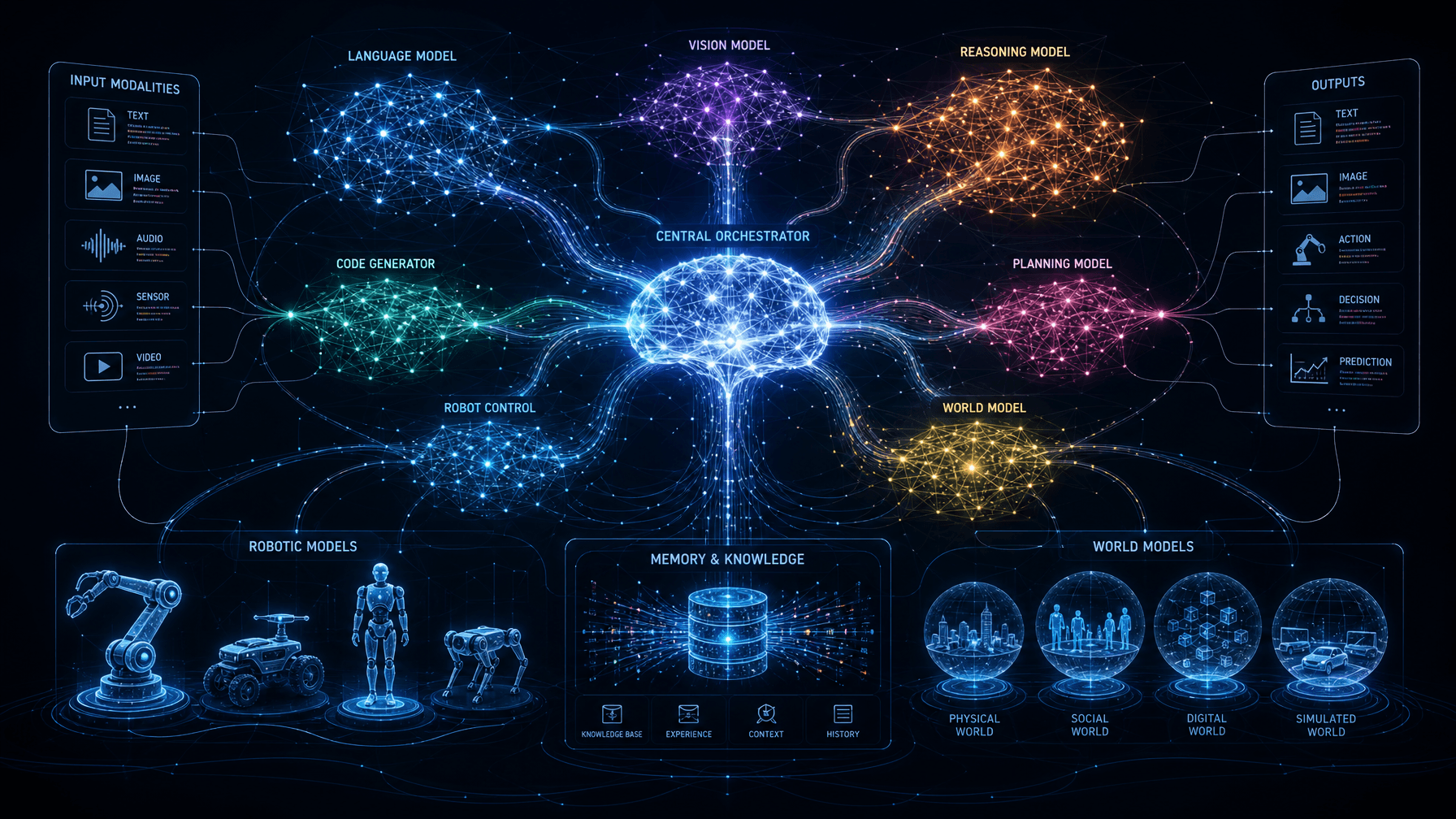
Physis-v0.1 predicts the next physical state of a scene by compressing video, RGB-D imagery, 3D point clouds and force-tactile feedback into a unified latent space, letting robots imagine outcomes before acting.
RoboBrain Orca is a robot brain model fusing language and visual representations, providing unified representation, causal reasoning and multi-modal decoding for downstream policies.
The launch is part of an unprecedented June wave of 13 new embodied AI foundation models in 30 days from Chinese labs, roughly one every 48 hours, including Alibaba's Qwen-Robot suite.
Wujie marks BAAI's pivot from language and multimodal models (WuDao, Emu3, BGE) toward physical AGI, competing with Alibaba, Mistral's Robostral Navigate and NVIDIA GR00T; BAAI was added to the US Entity List in March 2025.
Kaan Tınmaz
The Chinese embodied AI race got another entrant this month as the Beijing Academy of Artificial Intelligence (BAAI) unveiled its Wujie world model system at the 2026 Zhiyuan Conference, part of a June wave that saw 13 new embodied AI foundation models released in 30 days — roughly one every 48 hours.
A two-layer world model
Wujie is split into two headline models. Wujie Physis-v0.1 is a physical world model that predicts the next physical state of a scene by compressing video, RGB-D imagery, 3D point clouds and force-tactile feedback into a unified latent space, letting a robot imagine how its environment will evolve before acting. Wujie RoboBrain Orca is a robot brain model that fuses language and visual representations, providing unified representation, causal reasoning and multi-modal decoding for downstream policies.
From WuDao to Wujie
The launch marks BAAI's decisive turn from language and multimodal models — including the WuDao family, Emu3 and BAAI General Embedding (BGE) — toward physical AGI, the same target now being chased by Alibaba's Qwen-Robot suite, Mistral's Robostral Navigate and NVIDIA's GR00T foundation models. BAAI itself, added to the US Entity List in March 2025, is one of China's most-watched AI labs.
Every 48 hours, a new embodied AI model
The Wujie release sits at the center of an extraordinary June: alongside BAAI, Alibaba's Tongyi Lab shipped Qwen-RobotNav, Qwen-RobotWorld and Qwen-RobotManip, and Tsinghua-backed startups pushed out a wave of humanoid controllers. The pattern signals that Chinese labs believe the bottleneck in embodied AI is no longer hardware or teleoperation data but the world-modeling and reasoning layers Wujie is aimed at.
Reporting based on coverage from Pandaily, CGTN, Houdao AI and SCMP.
Wujie is a two-layer embodied AI system unveiled by the Beijing Academy of Artificial Intelligence at the 2026 Zhiyuan Conference. It consists of Wujie Physis-v0.1, a physical world model that predicts how a scene will evolve, and Wujie RoboBrain Orca, a robot brain model for reasoning and decision-making.
How does Wujie Physis-v0.1 work?
Physis-v0.1 compresses video, RGB-D imagery, 3D point clouds and force-tactile feedback into a unified latent space, allowing a robot to predict the next physical state of its environment and imagine how it will evolve before acting.
Why is the June 2026 embodied AI wave significant?
Chinese labs released 13 new embodied AI foundation models in 30 days — roughly one every 48 hours — including BAAI's Wujie and Alibaba's Qwen-RobotNav, Qwen-RobotWorld and Qwen-RobotManip. This signals a belief that the bottleneck in embodied AI is now world-modeling and reasoning layers, not hardware or teleoperation data.
How does Wujie compare to other embodied AI efforts?
Wujie targets physical AGI, the same goal pursued by Alibaba's Qwen-Robot suite, Mistral's Robostral Navigate and NVIDIA's GR00T foundation models. It represents BAAI's shift away from earlier language and multimodal work like WuDao, Emu3 and BGE.