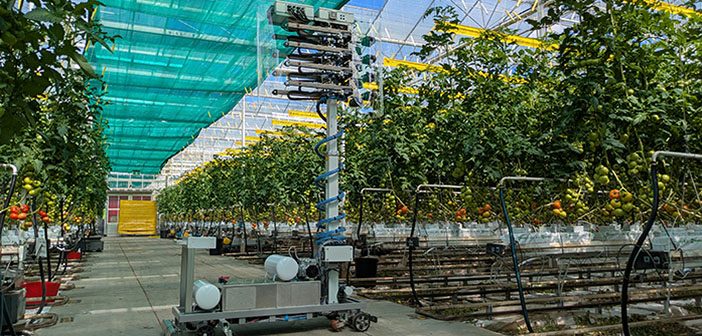
Biobest, part of Belgium's BioFirst Group, launched Polly on November 18, 2026 — a fully autonomous pollination robot for commercial tomato greenhouses, built with Israeli agtech company Arugga AI Farming after a five-year development partnership. One robot now covers roughly a hectare without continuous human supervision.
How does a robot actually pollinate a tomato flower?
Polly uses cameras and image recognition to scan individual flowers and identify which ones are ready for pollination. When it finds one, it fires a controlled burst of air at the flower to release pollen, mimicking the vibration bumblebees create when they land and buzz.
The robot is designed to work alongside bumblebee colonies rather than replace them. It fills in when bees go quiet — during short winter days under supplementary LED lighting, when energy-saving thermal screens cut light further, or in summer heat above 35°C when bee activity drops off.
What results have growers actually seen, and why does that matter?
Biobest and Arugga's trials across European and North American commercial greenhouses showed yield improvements of 2% to 6%. That range matters commercially because, per Hort News, an increase of just 1.5% is typically enough for a grower to recoup the cost of the technology. A 2-6% gain puts Polly well past breakeven in the trials reported so far.
"They provide an additional layer of pollination security, helping maintain consistent pollination even when environmental conditions limit bumblebee activity," said Jorden van de Walle, Biobest's product manager for pollination.
Why is robotic pollination becoming a bigger deal in greenhouse agriculture?
Commercial greenhouse tomato growers have relied on bumblebee colonies for decades because bees are cheaper and more reliable than manual pollination with vibrating wands. But bee activity is weather- and light-dependent, and growers running energy-efficient greenhouses with thermal screens and LED supplementation are inadvertently creating conditions where bees slow down just when crops need consistent pollination.
That gap is why a venture-backed agtech company spent five years refining a robot narrow enough to solve one problem well, rather than building a general-purpose field robot. It also reflects a broader pattern in protected agriculture: robots are increasingly deployed as a supplement to biological systems, not a replacement, because full automation of a living ecosystem's job is still harder and more expensive than topping it up at the margins.
How can growers get access to Polly, and what's next?
Biobest is offering Polly through 12-month leasing agreements as well as outright purchase, both including maintenance and warranty support, letting growers test the economics before committing capital. Given Biobest's existing distribution network for biological pest control and pollination products in greenhouse regions worldwide, the company is positioned to scale Polly deployments quickly wherever its bumblebee hives already ship.
The next test will be whether the 2-6% yield range holds up across a wider set of climates and tomato varieties as more growers adopt the robot outside the original trial sites.