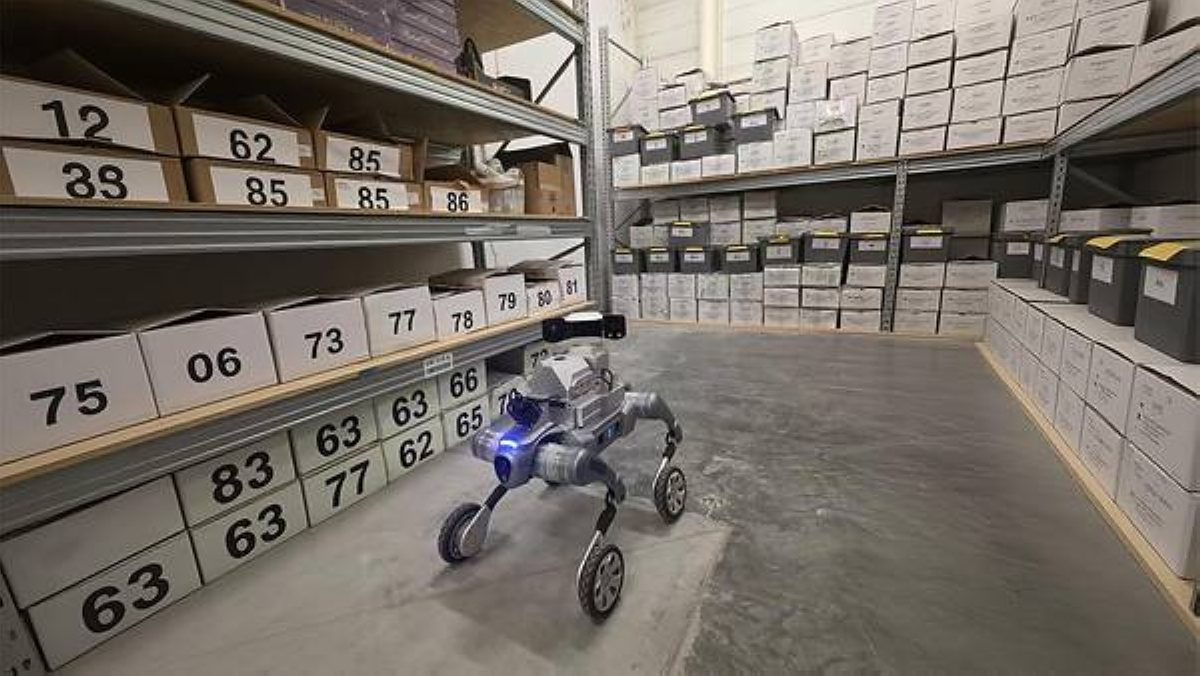
A small, waterproof quadruped is now walking the aisles of a logistics park in Poznan, Poland, scanning shelves that used to get checked just twice a day. Galileo Robotics confirmed on November 16, 2026, that its C1-W robot dog has been deployed at the Polish site to handle warehouse inspection and security patrols, marking what the company calls a benchmark deployment for its embodied AI technology outside China.
The logistics park, run in partnership with a local Polish enterprise, covers more than 2,000 square meters of storage area and roughly 2,250 meters of shelving. Since deployment, the C1-W has pushed inspection frequency from two manual shifts a day to automated patrols every three hours, according to Galileo, cutting the time needed to spot and respond to anomalies from hours down to minutes.
Built for the Industrial Grind, Not the Demo Stage
The C1-W is rated IP65 for dust and water resistance and is designed to operate across a temperature range of -20°C to 55°C, specs aimed squarely at the unheated, unglamorous conditions of a working warehouse rather than a trade-show floor. It can climb slopes up to 30 degrees and navigate autonomously across uneven floors and loading platforms.
Its sensing stack combines optical, thermal and acoustic inputs, which Galileo says lets the robot flag risks such as blocked fire exits, temperature anomalies in high shelf aisles, or unusual noises from equipment, then log the data for a facility's safety team. The company reports the unit has run stably for more than 400 hours since going live at the Poznan site.
Quadrupeds Are Becoming the Preferred Shape for Infrastructure Patrol
Galileo's deployment adds to a wave of quadruped robots finding steady work in roles that are repetitive, physically awkward for humans, or simply too frequent to staff around the clock. Robot dogs from competitors have recently been tested on tasks ranging from lighthouse inspection to port construction documentation, reflecting an industry consensus that four legs handle stairs, ramps and cluttered floors better than wheels, without the cost and complexity of a full humanoid.
For Galileo, the Poznan deployment is as much a market statement as an operational one. Placing a Chinese-developed quadruped into a European logistics park signals an effort to prove the robot's embodied AI brain, built in-house by the company, can hold up under European safety and reliability expectations rather than remaining a domestic showcase.
The economics behind the pitch are straightforward: a warehouse operator trading two manual walkthroughs a day for patrols every three hours gets roughly eight automated checks in the same period, all without adding headcount. If the anomaly-response gains Galileo reports hold up at other sites, the C1-W's next test will be whether it can scale beyond a single Polish facility into the wider European logistics market, according to Manila Times / PR Newswire.