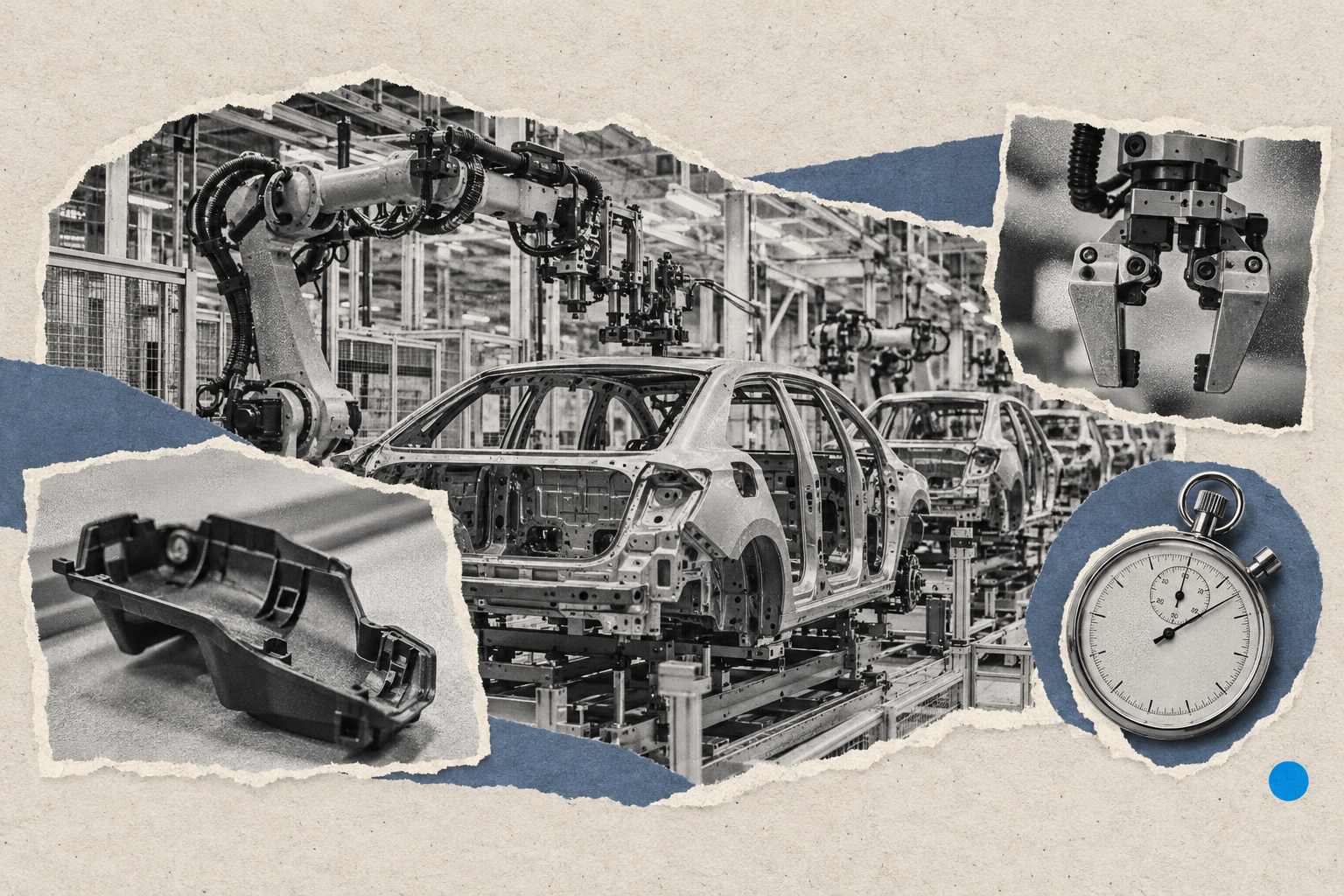
Paris-based Bleu Robotics, working with systems integrator innov8 Robotics, put a Unitree G1-D humanoid robot on a plastic parts line at automotive supplier Novares' plant in Spain and taught it to pick, pack and handle boxes from just 12 human demonstrations in 11 minutes. Novares reported a 100% part-detection rate, a 99.5% pick-and-place success rate over 200 cycles, and a 95% box-handling rate, according to Rocking Robots. The trial followed a four-month test phase at Novares' R&D center in Lens, France, before moving to the live plastics facility in early November.
Bleu Robotics, an Inria spin-out founded in 2025, raised a €5 million pre-seed round led by Contrarian Ventures and OVNI Capital to build what it calls a hardware-agnostic software layer for humanoids. Its model, Bleu_0.1, uses few-shot imitation learning to teach new tasks from a handful of demonstrations rather than hours of programming or large demonstration datasets, and runs on robots that support the Robot Operating System, including industrial arms and humanoid platforms such as Unitree's G1.
The Pitch: Software, Not Hardware
Bleu Robotics isn't building a robot — it's betting that the hardware race among humanoid makers like Figure, Agility and Unitree will commoditize the body, leaving the real value in the software that teaches any given body a new task quickly. That's a capital-light position relative to companies spending hundreds of millions on actuators and manufacturing lines, and it lets Bleu attach itself to whichever humanoid platform wins the deployment race.
The 11-minute training window is the headline number, and it compares favorably against reinforcement-learning or large-dataset imitation approaches that can take days of data collection per task. But speed of learning isn't the same as reliability at scale. Novares itself frames the Novares trial as a proof of concept, not a production deployment, and the companies have not released data on full-shift performance, downtime, failure recovery, or how the robot handles the inevitable edge cases a real production line throws at it over weeks rather than 200 cycles.
Why a 200-Cycle Demo Still Matters
Automotive suppliers like Novares are a logical proving ground because parts-picking and packaging are exactly the repetitive, variable-position tasks humanoids are pitched as solving, more plausibly than tasks requiring fine manipulation or long-horizon reasoning. If Bleu's few-shot approach holds up outside a controlled trial, it would undercut a common argument for humanoid skepticism: that each new task requires expensive, slow retraining.
The company joins a crowded field of groups chasing fast task-transfer for robots, including Physical Intelligence and Skild AI in the US, both targeting the same gap between flashy demos and dependable shift-long performance. Bleu's edge, for now, is a live automotive customer and a concrete number — 11 minutes — that rivals will have to match or beat.